What should you check?
Choose a taste and storage route first, then check the exact pack against the journey to school and the pupil’s needs.
Fuller-taste claim
Consider when: A pupil finds ordinary skimmed milk too light in taste; Arla describes B.O.B as tasting like semi-skimmed milk.
Bear in mind: This is Arla’s taste claim, not an independent comparison, and the filtered fresh milk requires refrigeration.
Filtered fresh
Consider when: The household uses chilled milk regularly and the bottle’s date and opening instructions suit its routine.
Bear in mind: Filtering does not remove the need to keep fresh milk chilled, including before it is drunk at school.
Long-life UHT
Consider when: An unopened carton would be useful as a cupboard backup at home.
Bear in mind: Opening changes its storage requirements; follow the carton’s refrigeration and use-by instructions.
| Priority | What to check | Your needs |
|---|
| Taste |
Look for a claim on the exact product rather than assuming all skimmed milk tastes alike. Try a manageable quantity before making it a regular purchase. |
I would rather try a milk described as having a fuller taste than assume a standard skimmed milk will appeal to the pupil. |
| Nutrition label |
Compare fat, protein and calcium on the selected pack using the same per-100 ml or per-100 g basis. Check the serving size as well. |
Lower fat matters to us, but I want to read the actual milk label rather than judge the whole lunch by one drink. |
| Storage |
Read the required temperature and instructions after opening. For fresh milk, establish how it will remain chilled between home and lunchtime. |
If the milk goes in a school bag, I need a storage arrangement that follows its label until it is drunk. |
| Dairy and school rules |
Check the milk allergen declaration and the pupil’s individual requirements. Ask the school about its packed-lunch and refrigeration arrangements. |
Before packing dairy milk, I need to know it is suitable for the pupil and permitted under the school’s policy. |
Relevant milk brands and ranges
These examples illustrate different product claims and storage instructions; a brand name alone does not establish the taste or requirements of every variant.
Arla B.O.B
A skimmed milk option for shoppers interested in a semi-skimmed-style taste claim.
- Arla describes B.O.B as skimmed milk that tastes like semi-skimmed milk.
- The taste description is a manufacturer claim, not an independent sensory comparison. Follow the filtered fresh product’s refrigeration instructions.
Waitrose
Its listed filtered fresh and Essential UHT skimmed milks provide two different home-storage routes.
- Waitrose filtered skimmed milk says to refrigerate below 5°C and consume within seven days of opening.
- Essential long-life skimmed milk also needs refrigeration below 5°C after opening and says to consume within five days.
M&S
A listed fresh skimmed milk option for households planning to use a chilled bottle.
- M&S lists a 568 ml skimmed milk bottle.
- Its instructions specify refrigeration at 0°C to +5°C and consumption within three days of opening.
Tesco
Its milk range lists both fresh British skimmed milk and British long-life UHT skimmed milk.
- The Tesco range lists fresh skimmed milk in 568 ml, 1.136 L and 2.272 L sizes, plus a 1 L long-life UHT option.
- Check the chosen variant’s pack for its taste description, nutrition values and storage instructions.
Joybuy UHT skimmed milk options
These Morrisons UHT skimmed milk listings suit the unopened-cupboard-backup route. For a school lunch, check the carton’s size, opening instructions and how any milk taken from an opened carton will stay chilled.
 No image available
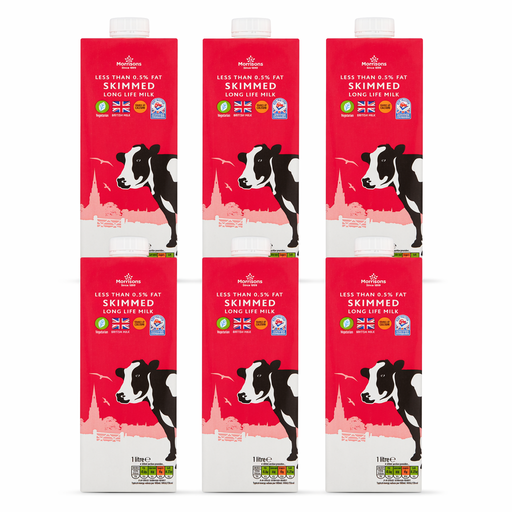
Morrisons British UHT Skimmed Milk, 1 litre, six-pack
The six-pack listing offers 1-litre UHT skimmed milk for keeping unopened as a household backup. Refrigerate after opening and follow the pack instructions; a 1-litre carton is not established as an individual lunch portion. If taste is the deciding factor, try the milk rather than assuming it has a semi-skimmed-style taste.
View on Joybuy
 No image available
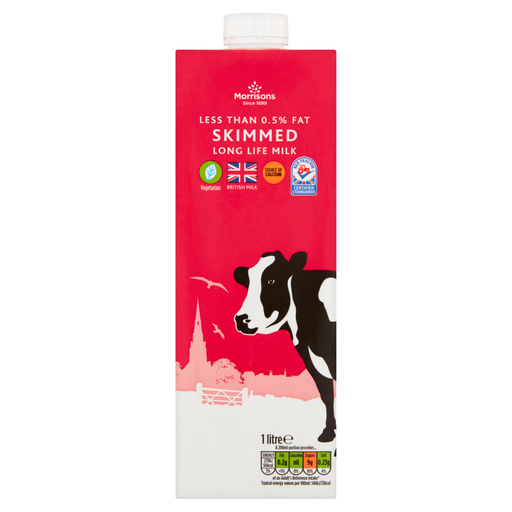
Morrisons British UHT Skimmed Milk, 1 litre
This 1-litre UHT skimmed milk is an option for an unopened cupboard backup. Refrigerate it after opening and follow the pack instructions; check how milk taken to school will remain chilled. Its name does not establish a mild or semi-skimmed-style taste.
View on Joybuy
Common questions
Is skimmed milk an option for a secondary-school pupil?
It can be: NHS guidance discusses skimmed milk as a lower-fat milk choice, and Norfolk and Norwich University Hospitals NHS Foundation Trust guidance says teenagers can be offered semi-skimmed or skimmed milk. Check the pupil’s individual dairy suitability and consider the drink as one part of the lunch.
What if a pupil finds skimmed milk too watery?
Look for a taste claim on the exact product rather than assuming all skimmed milks taste alike. Arla describes B.O.B as tasting like semi-skimmed milk, but that is its own claim; trying a bottle is a practical way to judge personal preference.
Can fresh skimmed milk go in a packed lunch?
Only with a storage arrangement that follows the chosen bottle’s instructions until it is drunk. Waitrose filtered skimmed milk specifies refrigeration below 5°C, and M&S fresh skimmed milk specifies 0°C to +5°C; check whether the school can accommodate the required chilling.
Does UHT skimmed milk need refrigeration?
An unopened long-life carton can serve as a cupboard backup, but follow its instructions once opened. Waitrose Essential long-life skimmed milk, for example, says to refrigerate below 5°C and consume within five days of opening.
What should I check before sending dairy milk to school?
Check the current milk-allergen label, the pupil’s individual requirements and the school’s packed-lunch policy. The Food Standards Agency identifies milk as an allergen; the Department for Education’s school-food guidance addresses food and drink provided in state-funded schools in England, rather than deciding every school’s policy for home-packed lunches.


