Households choosing skimmed milk for tea
If a lower-fat dairy milk is the aim, both organic and standard skimmed milk merit consideration. NHS guidance says skimmed milk retains important nutritional benefits while containing less fat.


Choose organic skimmed milk for afternoon tea if certified organic production matters to the household; standard skimmed milk is an option if it does not. The Department for Environment, Food & Rural Affairs says UK organic labelling requires compliance with organic production rules and supplier certification, while the NHS says skimmed milk retains important nutritional benefits with less fat. Whichever you choose, check the exact bottle for milk allergens, storage instructions and a pack size you can use.
For afternoon tea, the useful distinction is between a preference for organic production and the needs of the person drinking the milk.
If a lower-fat dairy milk is the aim, both organic and standard skimmed milk merit consideration. NHS guidance says skimmed milk retains important nutritional benefits while containing less fat.
An organic label addresses how the milk was produced, not how much fat it contains. For a bottle that meets both preferences, check that it is labelled organic and skimmed.
Organic cows’ milk is still dairy milk. Check the pack before serving it to someone who avoids milk because of an allergy or lactose intolerance; the organic label does not answer either question.
Decide whether organic certification matters, then compare the exact bottles against the needs of the tea drinkers and the amount likely to be used.
Choose it when: The household wants both skimmed milk and a certified organic-production claim. The Department for Environment, Food & Rural Affairs says UK organic labelling requires compliance with organic production rules and supplier certification.
Keep in mind: Organic certification does not make cows’ milk lactose-free or remove its milk allergen.
Choose it when: Skimmed dairy milk meets the tea drinker’s needs and organic production is not a requirement. The NHS says skimmed milk retains important nutritional benefits while containing less fat.
Keep in mind: Check the individual bottle’s nutrition panel and storage instructions rather than assuming they match an organic alternative.
| Priority | What to check | Your needs |
|---|---|---|
| Organic and skimmed labels | Check for both terms on the exact pack if both matter. The Department for Environment, Food & Rural Affairs says UK organic labelling depends on organic-production rules and supplier certification. | I want to know whether the milk meets an organic-production preference as well as being skimmed. |
| Nutrition information | Compare protein and calcium on the same per-100ml or per-serving basis where declared. Sainsbury’s lists 3.6g protein and 130mg calcium per 100ml for its SO Organic skimmed milk. | For tea served to an older guest, I would like to understand what the particular milk contributes, rather than judging it by the word “organic”. |
| Milk suitability | Read the allergen declaration and check whether the drinker needs to avoid lactose or cows’ milk. Organic skimmed cows’ milk remains dairy milk containing lactose. | Someone at the table may need a different drink, so I should check their requirements before serving the same milk to everyone. |
| Pack size and storage | Compare the volume with expected use. Follow the pack’s refrigeration, use-by and after-opening instructions; the Sainsbury’s, Waitrose and M&S organic skimmed milk listings each specify use within three days of opening. | If only a splash goes into each cup, I would rather choose a pack size that fits how often we make tea. |
The labels describe different things: organic refers to production requirements, while skimmed describes the type of milk. One word does not establish the other.
Check the exact bottle for both descriptions if both are important for afternoon tea.
A large bottle may be difficult to finish when milk is used only in tea. The Sainsbury’s, Waitrose and M&S organic skimmed milk listings each instruct shoppers to use the milk within three days of opening.
Match the volume to the number of cups you expect to make, then follow that bottle’s storage and after-opening instructions.
Milk left after the labelled opened-life period may go unused.
Ordinary organic skimmed cows’ milk still contains lactose. It is also not a substitute for checking a milk allergy.
Check what the guest can have and read the allergen label; if a different milk is needed, check that product’s ingredients too.
These retailer and brand listings illustrate distinct skimmed-milk options; check the particular pack before choosing one for your tea table.
Tesco lists a 1.136L Organic Free Range Skimmed Milk.
Sainsbury’s lists a 1.136L SO Organic British skimmed milk.
Waitrose lists Duchy Organic Skimmed Milk in a 2.272L pack.
M&S lists a 1.136L Organic Fresh Skimmed Milk.
Cravendale is a filtered skimmed-milk option for shoppers whose choice does not depend on an organic label.
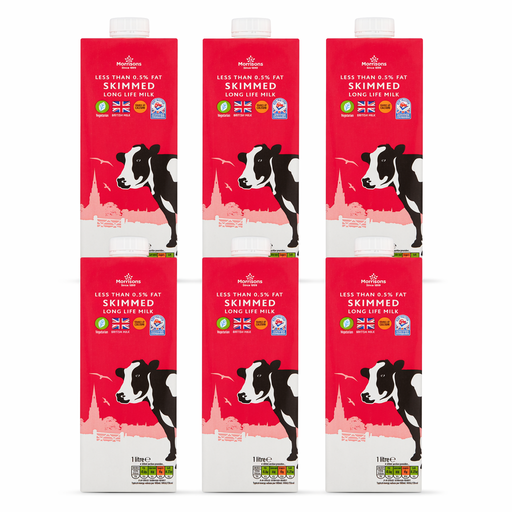
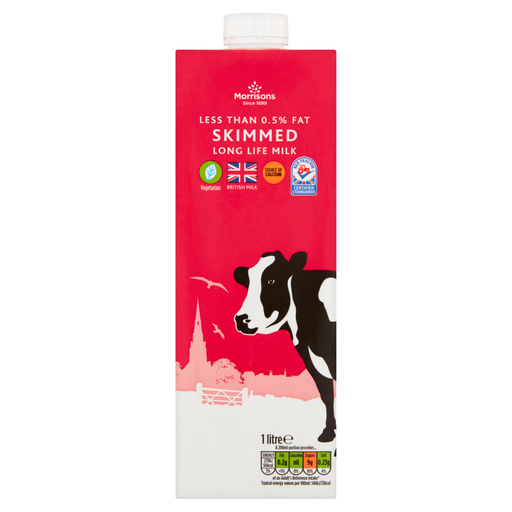
These Morrisons UHT skimmed milk cartons offer single-carton and six-pack formats for afternoon tea. If you specifically want organic milk, check the exact pack for an organic label before choosing either option.
 No image available
The six-carton format is worth considering if several people take milk in their tea or the cartons will be used on separate occasions. Check the pack for organic labelling if required, and follow its storage and after-opening instructions.
 No image available
The single carton avoids committing to a six-pack when milk is used less often in tea. If certified organic milk is the priority, check this exact carton’s label; also check its allergen and after-opening instructions before serving.
An organic label alone does not establish a nutritional advantage for an older person. The Department for Environment, Food & Rural Affairs describes UK organic labelling in terms of production rules and supplier certification; compare the actual bottles’ nutrition panels for the nutrients you want to check.
Yes: Sainsbury’s lists 130mg calcium and 3.6g protein per 100ml for its SO Organic skimmed milk, while Tesco lists 3.5g protein per 100ml for its Organic Free Range skimmed milk. Check the particular bottle and keep the stated measurement basis in mind when comparing labels.
No. Ordinary organic skimmed cows’ milk still contains lactose, so check for a specifically labelled lactose-free product if that is what the tea drinker needs. A milk allergy is a separate consideration: check ingredients and allergens before serving.
Follow the instructions on the exact bottle and its use-by date. The Sainsbury’s, Waitrose and M&S organic skimmed milk listings each specify use within three days of opening; do not assume another pack has the same instruction.