Households serving cereal and coffee
If milk is used at several breakfasts, compare a larger bottle with how quickly your household will finish it after opening. Tesco’s 4-pint skimmed milk says it is best within five days of opening.


Check the milk type before choosing a bottle by size: Tesco and Sainsbury’s list 4-pint skimmed milk, while Sainsbury’s listed 6-pint bottle is semi-skimmed. A 4-pint skimmed bottle suits a household likely to finish it within its label guidance; a 2L filtered skimmed bottle may suit slower use if its stated storage and opened-life instructions fit your routine. Check the date and label on the bottle you buy.
If milk is used at several breakfasts, compare a larger bottle with how quickly your household will finish it after opening. Tesco’s 4-pint skimmed milk says it is best within five days of opening.
If an opened family bottle is often left unfinished, a smaller filtered skimmed bottle is worth considering. Arla states an opened life of up to seven days for its 2L Cravendale skimmed milk when stored at 0–5°C; follow the label on the bottle you buy.
Check both volume and milk type. The Sainsbury’s 6-pint bottle considered here is semi-skimmed, whereas the Tesco and Sainsbury’s standard skimmed bottles considered here are four pints.
Decide whether skimmed milk is essential, then match the pack and its storage instructions to the amount your household uses at breakfast.
Consider when: You want a larger fresh skimmed bottle and expect to finish it within its opened-life guidance.
Trade-off: The Tesco and Sainsbury’s bottles considered here hold four pints, not six.
Consider when: Milk is used more slowly and the particular bottle’s stated shelf life fits your routine.
Trade-off: A 2L bottle holds less than a 4-pint bottle; follow its own date and storage instructions.
Consider when: Six pints matters more to your household than choosing skimmed milk.
Trade-off: Sainsbury’s 6-pint example is semi-skimmed, so it does not meet a specifically skimmed-milk requirement.
| Priority | What to check | Your needs |
|---|---|---|
| Milk type and size | Read both the milk type and pack volume. Tesco lists 0.1g fat per 100ml for its 4-pint skimmed milk; Sainsbury’s lists 1.8g per 100ml for its 6-pint semi-skimmed milk. | I want skimmed milk, so a six-pint bottle labelled semi-skimmed would not meet that preference. |
| Use after opening | Compare the bottle’s date and opened-life instructions with expected use. Tesco says its 4-pint skimmed milk is best within five days of opening; Arla states up to seven days for its 2L Cravendale skimmed milk at 0–5°C. | Will we get through this much milk with cereal and drinks before the bottle’s stated opened-life ends? |
| Storage and format | Check whether the product is fresh, filtered or UHT, and follow that specific pack’s refrigeration instructions. Check the pack date rather than applying one product’s guidance to another. | Separate cartons might fit my breakfast routine better than one large opened bottle. |
| Ingredients | Read the exact pack’s ingredient and allergen information. Skimmed cow’s milk is not automatically lactose-free or free from milk allergens. | If someone in my household must avoid lactose or milk, I need to check the particular product rather than rely on its fat category. |
Bottle size does not identify fat category. Sainsbury’s 6-pint example is semi-skimmed, while Tesco’s 4-pint example is skimmed.
Check the milk type on the exact bottle before choosing it for its volume.
Tesco’s 4-pint skimmed bottle says it is best within five days of opening. A bottle that remains unfinished may not suit a household using only small amounts at breakfast.
Think through likely cereal and drink use, then compare it with the bottle’s date and opened-life guidance.
An unfinished bottle can mean discarded milk.
Skimming does not make cow’s milk lactose-free or remove milk as an allergen. The NHS notes that lactose is found in animal milk, including cow’s milk.
If lactose or milk must be avoided, check the exact ingredients and allergen declaration rather than substituting ordinary skimmed milk on the basis of its fat content.
The delivered pack is the one you will store and serve, so its date, milk type and instructions matter.
Check its label, particularly when pack size or dietary requirements affect your choice.
Tesco lists a British skimmed milk bottle of 2.272L, or four pints, as well as a separate 2L filtered skimmed option.
Sainsbury’s lists a 2.27L, 4-pint British skimmed milk and a separate 3.408L, 6-pint British semi-skimmed milk.
Arla Cravendale offers filtered fresh skimmed milk in a 2L bottle.
M&S presents skimmed, semi-skimmed and whole fresh milk in its range information.
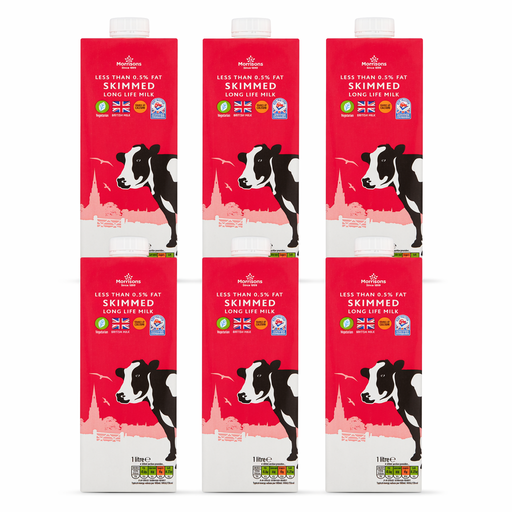
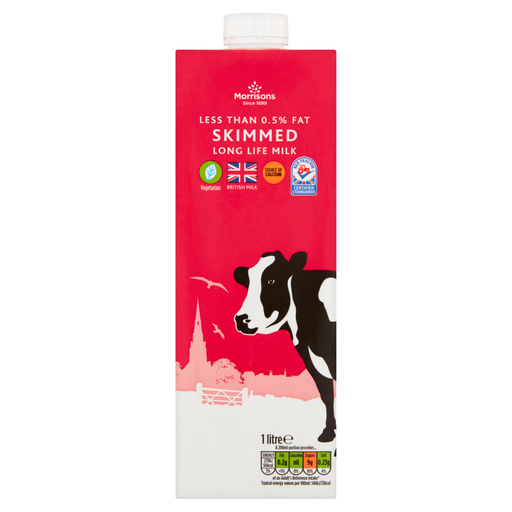
These are UHT skimmed milk options for breakfast: separate 1-litre cartons in a multipack or a single 1-litre carton, rather than one 6-pint fresh bottle.
 No image available
For breakfasts using milk from separate cartons, this is a six-pack of 1-litre UHT skimmed milk, not a single 6-pint bottle or a fresh or filtered milk option. Check each carton’s date, storage instructions and ingredient label before use.
 No image available
For breakfast use when a smaller pack fits your routine, this is a single 1-litre carton of UHT skimmed milk, not a 6-pint fresh bottle. Check the carton’s date, storage instructions and ingredient label before use.
Check the exact product rather than assuming a six-pint bottle is skimmed. Tesco and Sainsbury’s list 4-pint skimmed bottles, while the Sainsbury’s 6-pint bottle considered here is semi-skimmed. Check the assortment at your chosen retailer if six pints and skimmed milk are both important.
A 4-pint standard bottle suits a household expecting to finish it within that bottle’s opened-life guidance. A 2L filtered bottle may suit slower use: Arla states up to seven days after opening for its Cravendale skimmed milk at 0–5°C. Check the instructions and date on whichever bottle you choose.
Follow the particular bottle’s instructions. Tesco says its 4-pint skimmed milk is best within five days of opening, while Arla states up to seven days for its 2L filtered Cravendale skimmed milk stored at 0–5°C. Neither instruction applies automatically to other products.
No: choosing skimmed milk does not itself remove lactose or milk allergens. The NHS states that lactose is found in animal milk, including cow’s milk. Check the exact product label if either ingredient affects your choice.
Check the delivered pack’s milk type, volume, date, ingredients and storage instructions before using it. Those details determine whether it meets your requirements, particularly if you ordered skimmed milk or need to check for an allergen.