Breastfeeding parents choosing milk for themselves
The NHS includes skimmed milk among lower-fat dairy options during breastfeeding. This is a choice for the parent’s meals and drinks, not a substitute for the baby’s milk.


Skimmed milk can be an option for a breastfeeding parent or another adult who prefers lower-fat dairy, but it is not a baby’s main milk or the main drink for a child under five, according to NHS guidance. For the adult’s milk, choose a chilled bottle if you use it regularly, consider a filtered bottle if its stated storage life suits your routine, or keep unopened UHT cartons as a cupboard backup; follow the instructions on the particular pack after opening.
The NHS includes skimmed milk among lower-fat dairy options during breastfeeding. This is a choice for the parent’s meals and drinks, not a substitute for the baby’s milk.
If a chilled bottle often lasts longer than expected, compare its size and use-by date with a filtered bottle’s instructions or unopened UHT cartons. Opened milk still needs the storage specified on its pack.
The NHS advises breast milk or first infant formula until at least age one. It also says skimmed milk should not be the main drink for children under five, although it can be used in cooking for children over 12 months.
Decide who will drink the milk first. Then choose a pack size and storage format that fit how the household uses it.
| Priority | What to check | Your needs |
|---|---|---|
| Child’s age | Check who the milk is for. NHS guidance says babies should continue breast milk or first infant formula until at least one year; skimmed milk is not a main drink for children under five. | I’m buying skimmed milk for an adult and need to keep the child’s main milk choice separate. |
| Adult milk choice | Compare the nutrition panel for the exact product if fat, protein or calcium matters to you. The NHS lists skimmed milk as a lower-fat option during breastfeeding. | For my own drinks or cereal, I prefer lower-fat dairy without assuming every skimmed product has the same nutrition values. |
| Storage format | Check the unopened date, refrigeration instructions and period allowed after opening. Waitrose’s filtered skimmed product states up to one month unopened and seven days opened; Sainsbury’s UHT multipack says to refrigerate after opening and use within three days. | A cupboard backup would help when shopping is unpredictable, or I may prefer a chilled bottle if we use milk steadily. |
| Pack size | Compare the quantity with what you expect to use before the pack’s stated deadline. Tesco lists chilled skimmed milk in 1.136-litre and 2.272-litre sizes, as well as a 1-litre long-life option. | I’d rather choose a pack we can finish than buy a larger bottle solely because it is available. |
| Cow’s-milk protein | Read the ingredients and allergen information if a child must avoid cow’s milk. Milton Keynes University Hospital NHS Foundation Trust notes that lactose-free dairy can still contain cow’s-milk protein. | If my child has been advised to avoid cow’s milk, I need to follow their clinical advice rather than substitute skimmed or lactose-free cow’s milk. |
Lower-fat milk for a parent does not meet the NHS guidance for a baby’s main milk. The NHS also advises against skimmed milk as a main drink for children under five.
Keep the purchases distinct: continue breast milk or first infant formula until at least age one, and choose the child’s main drink according to age-specific guidance.
Chilled milk has a use-by date, while filtered and UHT products have their own instructions after opening. A larger pack can leave milk unused if household demand changes.
Compare pack size with your usual use, then follow the refrigeration and opened-life directions on the bottle or carton.
Lactose-free dairy may still contain cow’s-milk protein, according to Milton Keynes University Hospital NHS Foundation Trust.
If a child has a suspected or diagnosed cow’s-milk protein allergy, follow their healthcare professional’s advice and check the full ingredients and allergen declaration.
These ranges illustrate different pack and storage choices; check the particular product label when deciding what fits your household.
Arla Foods UK lists a 2-litre Cravendale filtered skimmed milk in its range.
Tesco lists own-label chilled skimmed milk in 1.136-litre and 2.272-litre sizes and a 1-litre long-life option.
Sainsbury’s lists an own-label UHT skimmed milk multipack of six 1-litre cartons.
Asda lists a 4-pint British skimmed milk bottle, equivalent to 2.272 litres.
M&S lists British skimmed milk and says it sources its milk from M&S Select Farms.
Waitrose lists both filtered chilled skimmed milk and Essential long-life skimmed milk.
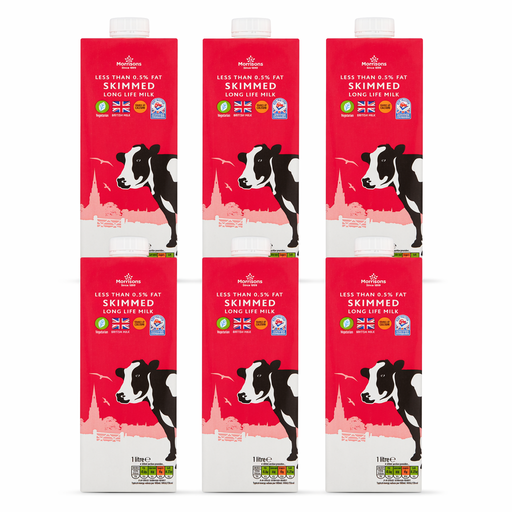
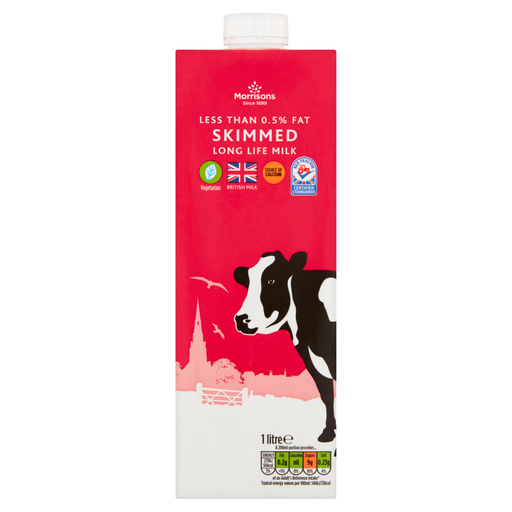
These Morrisons UHT skimmed milk options are for an adult household cupboard reserve: one is a six-carton pack and the other is a single carton. Neither is a baby’s main milk.
 No image available
The six 1-litre UHT cartons suit an adult household that wants separate cartons for cupboard backup. Check each carton’s date and its storage instructions before use; NHS guidance says skimmed milk should not be a child’s main drink under five.
 No image available
The single 1-litre UHT carton suits an adult household wanting a smaller cupboard reserve. Check its date and storage instructions, particularly once opened; it is not a substitute for a baby’s milk.
Yes, as milk for yourself. The NHS includes skimmed milk among lower-fat dairy choices during breastfeeding and advises eating a varied diet; it is not a replacement for your baby’s milk.
No. The NHS says to continue breastfeeding or give first infant formula until your baby is at least one year old.
The NHS says skimmed milk can be used in cooking for children over 12 months, but should not be their main drink while they are under five.
Consider filtered chilled milk if its stated refrigerated life fits your use, or UHT cartons if you want an unopened cupboard reserve. Waitrose states up to one month unopened and seven days opened for its filtered skimmed milk; Sainsbury’s says its UHT skimmed milk must be refrigerated after opening and used within three days. Check the instructions on the product you choose.
No, not necessarily. Milton Keynes University Hospital NHS Foundation Trust says lactose-free dairy can still contain cow’s-milk protein. If your child has been advised to avoid cow’s milk, check ingredients and follow their healthcare professional’s dietary advice.