Nursery staff buying drinks for under-5s
Choose the lunch drink by age, not simply by fat content. The NHS does not recommend skimmed or 1% milk as a main drink for children under 5.


Do not choose skimmed or 1% milk as the main drink for children under 5: the NHS says it does not contain enough fat for that use. Skimmed milk can be used in cooking from age 1, but a nursery must check the intended use against each child’s dietary or allergy plan. For a child with a milk allergy, another type of cow’s milk is not a substitute to choose by assumption.
Choose the lunch drink by age, not simply by fat content. The NHS does not recommend skimmed or 1% milk as a main drink for children under 5.
Check the child’s age and the nursery’s food and allergy arrangements before sending cow’s milk into a shared eating space.
The NHS says skimmed milk can be used in cooking from age 1. Check individual dietary plans, control milk as an allergen and follow the pack’s storage instructions.
Decide whether the milk is a drink or a recipe ingredient before comparing packs; then check the children’s dietary requirements and how the opened milk will be stored.
| Priority | What to check | Your needs |
|---|---|---|
| Age and use | Is this the child’s main drink or an ingredient? The NHS does not recommend skimmed or 1% milk as a main drink under age 5, but permits it in cooking from age 1. Match the drink to the child’s age and nursery policy. | I’m choosing a lunch drink for under-5s, so skimmed milk is not my default choice. If it is for a recipe, I need to check who will eat it. |
| Milk allergen | Read the current pack label and each child’s individual plan. The Food Standards Agency says allergenic ingredients should be controlled and other foods protected from cross-contamination. | I need to know whether any child must avoid milk before serving a drink or a dish made with it. |
| Storage and pack size | Check the pack’s unopened and after-opening instructions, available fridge space and likely use. For example, Sainsbury’s specifies 3 days after opening for its fresh skimmed milk; Waitrose specifies 7 days for its filtered skimmed milk and 5 days for its UHT skimmed milk. | Our kitchen needs to be able to refrigerate an opened pack and use it within that pack’s stated period. |
The NHS says skimmed and 1% milk do not contain enough fat to be recommended as a main drink for children under 5.
Confirm the age group and choose a main drink consistent with the nursery’s policy. Consider skimmed milk for cooking from age 1 only when the recipe and individual dietary plans allow it.
Milk is an allergen. In a shared nursery kitchen, ingredients containing it need to be controlled to protect food prepared for children who must avoid it, as the Food Standards Agency advises.
Check each child’s documented plan and the current product label when a product or recipe changes. Follow the setting’s allergen-control procedures.
Instructions differ by product: Sainsbury’s fresh skimmed milk specifies 3 days after opening, while Waitrose specifies 7 days for its filtered skimmed milk and 5 days for its UHT skimmed milk.
Compare the current label with the fridge space available and the amount the nursery expects to use after opening.
These ranges show formats and milk types worth checking; a brand or format does not override the age and allergy decision.
Arla Foods UK lists whole, semi-skimmed and skimmed 2L milk in its Cravendale range.
Tesco Groceries lists skimmed, semi-skimmed and whole long-life UHT milk.
Sainsbury’s lists British skimmed and semi-skimmed milk. Its skimmed milk is labelled 0.3% fat; its semi-skimmed milk lists 1.8g fat per 100ml.
Waitrose lists filtered fresh and long-life UHT skimmed milk.
Marks & Spencer lists British skimmed milk in a 2.272L pack.
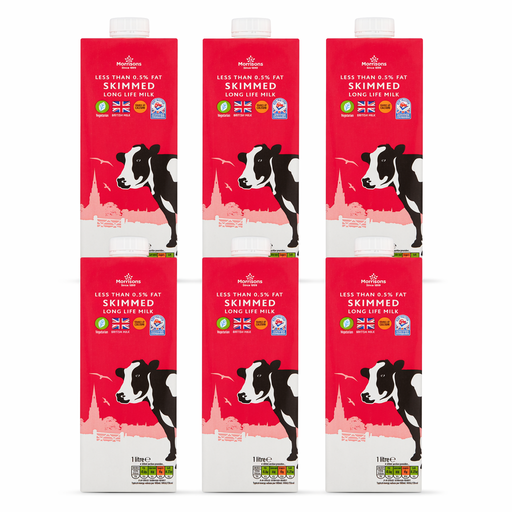
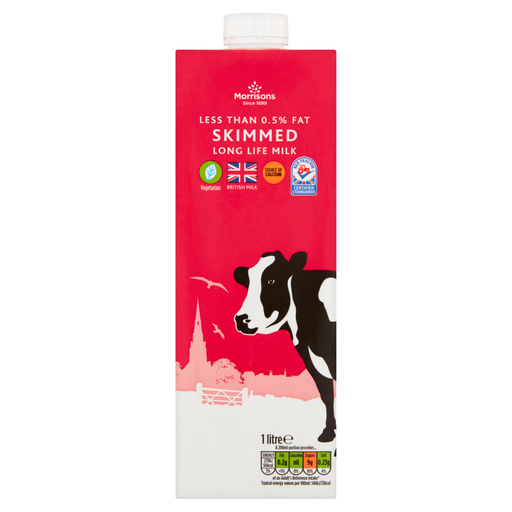
These Morrisons UHT skimmed-milk cartons can be assessed as recipe ingredients, not as main drinks for under-5s. Both listings warn against use for children under 5, so clarify whether the intended nursery recipe use is suitable before ordering, despite the NHS’s general guidance permitting skimmed milk in cooking from age 1.
 No image available
The six-carton format is a consideration for kitchens planning multiple recipes. This is skimmed milk, not an under-5 main drink; the listing also warns against use for under-5s, so clarify the intended recipe use before serving it. Check the current milk-allergen label, each child’s plan and the cartons’ after-opening storage instructions.
 No image available
The single carton lets a kitchen assess a smaller quantity for recipes. It is not an under-5 main drink, and the listing warns against use for under-5s; clarify the intended recipe use before serving it. Check the current milk-allergen label, each child’s plan and the carton’s after-opening storage instructions.
Not for children under 5. The NHS says skimmed or 1% milk does not contain enough fat to be recommended as their main drink, although skimmed milk can be used in cooking from age 1.
Yes, for early-years providers in England caring for children aged 0–5. The Department for Education says that, from September 2025, providers must take its Early Years Foundation Stage nutrition guidance into account and follow it unless there is good reason not to. That requirement should not be treated as a rule for every UK nation.
Check the child’s individual dietary or allergy plan before serving milk or food made with it; do not assume another cow’s milk product is suitable. The Food Standards Agency identifies milk as an allergen and advises controlling allergenic ingredients and protecting other foods from cross-contamination. Check the current label and follow the nursery’s allergen procedures.