Vegan shoppers replacing dairy milk
If you use milk on cereal, in hot drinks or for cooking, check for an explicit vegan suitability statement before comparing plant drinks. Skimmed cow's milk is still dairy milk.


Dairy skimmed milk is not suitable for vegan shopping: Arla lists milk as the ingredient and allergen in its Cravendale skimmed milk. For cereal, drinks or cooking, start with a plant drink labelled suitable for vegans, then compare its ingredients, fortification, allergen information and intended use. An unsweetened everyday drink and a coffee-focused barista drink answer different needs; neither label tells you everything about the other features.
If you use milk on cereal, in hot drinks or for cooking, check for an explicit vegan suitability statement before comparing plant drinks. Skimmed cow's milk is still dairy milk.
If a plant drink will be a regular purchase, compare sweetened and unsweetened options and read each product's nutrient declaration. The UK Government's 2025 summary notes that micronutrient fortification varies between plant drinks.
Vegan suitability and allergy suitability are separate checks. Read the ingredients, declared allergens and precautionary statements on the individual product, particularly when buying for someone else.
Start by ruling out dairy skimmed milk, then compare plant drinks by what you will use them for and what their individual labels declare.
| Priority | What to check | Your needs |
|---|---|---|
| Vegan suitability | Look for a vegan suitability statement and read the ingredients. Arla lists milk as the ingredient and allergen in its Cravendale skimmed milk. | I need a drink that fits vegan shopping; a skimmed or vegetarian description does not make dairy milk vegan. |
| Fortification | Compare the declared calcium, iodine, vitamin B12 and vitamin D additions product by product. The UK Government's 2025 summary says plant drinks vary in micronutrient fortification. | For a drink I buy regularly, I want to know which nutrients are actually listed, rather than assuming all soya or oat drinks have the same recipe. |
| Allergen information | Read the declared allergens and any precautionary statements as well as the vegan label. Vegan suitability alone does not rule out cross-contamination. | When I'm shopping for an allergy, I need to check the individual pack. In a Food Standards Agency and Ipsos UK online survey in England, Wales and Northern Ireland in December 2023, 53% of respondents with a food hypersensitivity to animal-origin allergens, and 50% of those shopping for someone with one, were aware before the survey that vegan products might still pose a cross-contamination risk. |
| Everyday or coffee use | Check whether the product is intended for everyday uses or sold as a barista option. Read its ingredients and nutrient declaration separately; a barista label does not establish its fortification. | I might want one drink for cereal and cooking, or a separate option for making coffee. The format matters more once I know the product meets my vegan and ingredient requirements. |
Skimmed describes the milk's fat level, not whether it comes from an animal. Arla's Cravendale skimmed product lists milk as both its ingredient and allergen.
For vegan shopping, check the ingredients and a vegan suitability statement before comparing other features.
Sweetening and nutrient additions are different product details. The UK Government's 2025 summary says micronutrient fortification varies among plant drinks.
If fortification matters for your regular purchase, compare the nutrients declared on each product rather than relying on its plant base or unsweetened label.
Cross-contamination can matter even when a product is vegan. The Food Standards Agency and Ipsos UK reported that awareness of this risk was not universal among the food-hypersensitivity groups they surveyed.
Check declared allergens and precautionary statements on the pack you are buying, including when a familiar product's packaging changes.
These examples help distinguish dairy skimmed milk from plant-drink ranges; a retailer's inclusion here does not describe every product it sells.
A dairy skimmed-milk reference, rather than a vegan plant-drink option.
An example of an own-label vegan-labelled soya drink.
An own-label oat-drink example for shoppers comparing unsweetened options.
A retailer listing several types of plant-based drink.
A retailer with separate dairy-milk and plant-drink ranges.
A retailer example showing why the wording on a skimmed-milk listing matters.
These Alpro long-life oat, soya and coconut drinks offer everyday and barista-labelled formats to compare when replacing dairy skimmed milk. Check the current pack for vegan suitability, ingredients, fortification and allergens before choosing.
 No image available
An oat option to consider for everyday uses. The name identifies a No Sugars long-life drink in an 8 x 1L pack; check the pack's vegan statement, nutrient declaration and oat-allergen information for your needs.
 No image available
A soya option for comparing everyday plant drinks. The name identifies a No Sugars long-life drink in an 8 x 1L pack; check its current vegan statement, fortification and soya-allergen declaration.
 No image available
A coffee-focused oat format to compare with everyday drinks. It is labelled Barista and comes as an 8 x 1L long-life pack; check its vegan statement, nutrients and oat-allergen information rather than treating the barista name as a nutrition guide.
 No image available
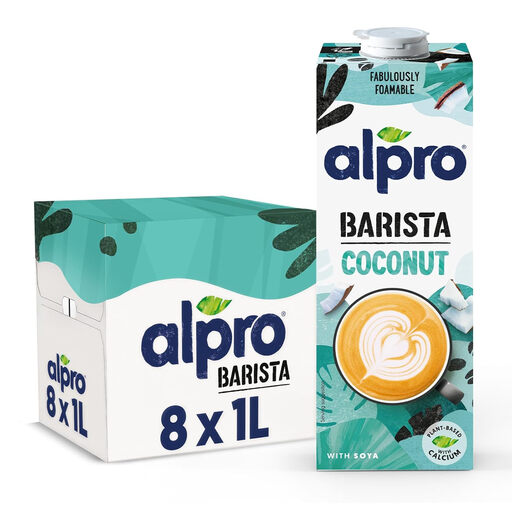
A coconut-labelled barista option for coffee use, supplied as an 8 x 1L long-life pack. If you want an unsweetened drink or need to avoid soya, check the current ingredients and allergen declaration before choosing it.
Not if it is dairy skimmed milk. Arla lists milk as the ingredient and allergen in Cravendale Filtered Skimmed Milk 2L; choose a plant drink explicitly labelled suitable for vegans instead.
Check vegan suitability and ingredients first, then compare the declared nutrient additions and allergens. The UK Government's 2025 summary says plant drinks vary in micronutrient fortification, so the plant base alone does not tell you whether calcium, iodine, vitamin B12 or vitamin D have been added.
No. The Food Standards Agency's research notes that vegan products might still pose a cross-contamination risk for people with food hypersensitivities. Check the chosen pack's allergen declaration and precautionary statements as well as its vegan label.