People changing their everyday milk
If you use milk in drinks, cereal or cooking and want a lower-fat option, skimmed milk fits that use. The NHS identifies skimmed milk as a lower-fat choice that retains important nutritional benefits of milk.


Choose skimmed milk when you need milk for drinks, cereal or cooking; choose grated cheese when the dish needs a cheese topping. They are different products, not interchangeable versions of lower-fat dairy. If you choose grated cheese for weight-management meals, compare the stated serving size, saturated fat and salt as well as any reduced-fat claim.
If you use milk in drinks, cereal or cooking and want a lower-fat option, skimmed milk fits that use. The NHS identifies skimmed milk as a lower-fat choice that retains important nutritional benefits of milk.
If an opened bottle often goes unfinished, pack size and the instructions after opening may matter more than the unopened storage life. Fresh, filtered fresh and UHT products have different stated instructions.
If the meal calls for grated cheese rather than liquid milk, compare cheese products by their stated serving sizes and labels. A reduced-fat description alone does not tell you the serving’s calories, saturated fat or salt.
Start with the ingredient your meal needs: liquid milk or grated cheese. Then compare labels and storage instructions for products in that category.
| Priority | What to check | Your needs |
|---|---|---|
| Everyday milk | Check fat and energy per 100 ml on the exact milk. Tesco Groceries lists 0.1 g fat and 35 kcal per 100 ml for Tesco British Skimmed Milk 1.136 L; other formulations need their own label check. | I need milk for tea, cereal or a recipe, rather than something to sprinkle over a meal. The NHS identifies skimmed milk as a lower-fat milk option. |
| Taste and formulation | Compare fat, energy and protein on the same per-100 ml basis. Tesco Groceries lists Arla B.O.B at 41 kcal, 0.4 g fat and 4.5 g protein per 100 ml, against 35 kcal, 0.1 g fat and 3.6 g protein for the cited Tesco skimmed milk. | If the taste of plain skimmed milk puts me off using it, I can consider another formulation. Arla’s semi-skimmed-style taste description is its own product claim, not a guarantee of my preference. |
| Milk storage | Check pack size, unopened storage and the instructions after opening. The cited Cravendale filtered milk states up to three weeks unopened and seven days once opened; Tesco Groceries says to refrigerate the cited Dairy Pride UHT milk after opening and use it within three days. | Milk lasts longer in my household when the pack size and opening instructions match how quickly we use it. |
| Grated topping | Check the cheese’s stated serving size, calories, saturates and salt. Sainsbury’s lists 84 kcal, 3.0 g saturates and 0.59 g salt per 30 g serving of its Be Good To Yourself Mature Grated White Cheese. | For pasta or a baked potato, I want a cheese topping and can decide how much to add. A reduced-fat claim does not replace checking the portion. |
Liquid milk works in drinks and recipes; grated cheese supplies a topping. Choosing one by the other’s name can leave you with the wrong ingredient.
Decide what the dish needs before comparing labels. Search for skimmed milk if you need liquid milk, or compare grated cheeses if you need a topping.
Sainsbury’s lists 3.0 g saturates and 0.59 g salt in a 30 g serving of its Be Good To Yourself Mature Grated White Cheese. Its reduced-fat comparison is with Sainsbury’s standard mature Cheddar, not with milk.
Check the serving amount you plan to use alongside the nutrition information for that serving.
Instructions after opening vary. The cited Cravendale filtered milk states seven days once opened, while the cited Dairy Pride UHT milk says to refrigerate it and use it within three days of opening.
Choose a pack size and format that fit your usual rate of use; check the instructions on the pack you buy.
An unfinished opened pack may mean discarding milk.
The current pack gives you the details needed for the product you are about to use, including ingredients and storage instructions.
Check its nutrition information, allergens, storage directions and date marking before use.
These examples illustrate particular milk and grated-cheese products; their specifications should not be assumed to apply to every product from the same brand.
Tesco British Skimmed Milk 1.136 L is an example of standard fresh skimmed milk.
The cited filtered skimmed milk offers a different stated storage pattern from standard fresh milk.
A protein-enriched skimmed milk for shoppers considering a different formulation from plain skimmed milk.
The cited 1 L UHT skimmed milk is a cupboard-storage option before opening.
The cited Mature Grated White Cheese addresses the separate need for a grated topping, not liquid milk.
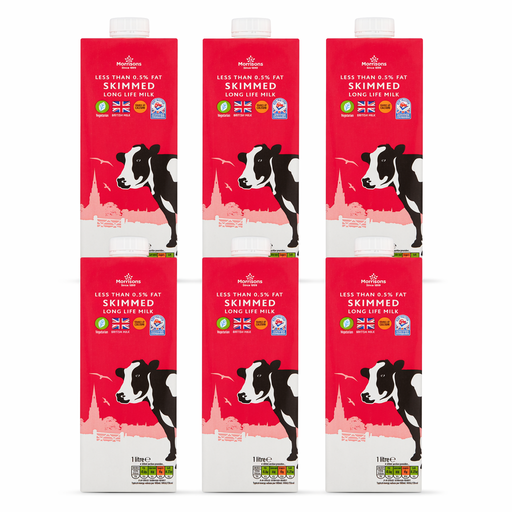
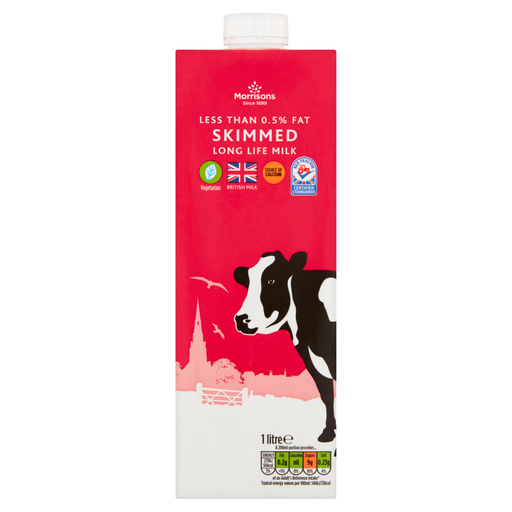
These Morrisons UHT skimmed milk options fit the liquid-milk use case for drinks, cereal and cooking. The choice here is between a single 1-litre carton and six 1-litre packs; neither is a grated-cheese product.
 No image available
A six-pack of UHT skimmed milk for households that expect to use several cartons. Check whether the total quantity fits your use; the listing says to refrigerate each carton after opening and use it within three days. The listing also states that this product is not suitable for children under 5.
 No image available
A single UHT skimmed milk carton if one litre better matches your expected use. The listing says it needs no refrigeration until opened, then should be refrigerated and used within three days. It also states that this product is not suitable for children under 5.
Choose skimmed milk when you need liquid milk and want a lower-fat dairy option. The NHS identifies it as lower in fat than higher-fat milk while retaining important nutritional benefits of milk; that does not make it a weight-loss product on its own.
No. Skimmed milk is liquid milk; pre-grated products are cheese. Buy milk for drinks, cereal or liquid-milk recipes, and compare grated cheeses when the dish needs a topping.
Check the instructions for the exact pack, particularly after opening. The cited Cravendale filtered milk states up to three weeks unopened and seven days once opened; Tesco Groceries says to refrigerate the cited Dairy Pride UHT milk after opening and use it within three days.
No such conclusion follows from a reduced-fat description. Sainsbury’s lists 3.0 g saturates and 0.59 g salt per 30 g serving of its Be Good To Yourself Mature Grated White Cheese, so check the stated portion and both figures.
Yes: “skimmed” describes the milk’s fat content, not the absence of milk constituents. The Food Standards Agency identifies milk as a possible risk for people with a milk allergy or intolerance. Check the current product label for individual dietary decisions.