Who a slimline dishwasher may suit
A slimline machine can make sense for daily dishwasher-safe lunchboxes and dishes, provided there is room for the appliance and its open door.
One-person household with a narrow kitchen gap
You want an under-counter machine for lunchboxes and everyday dishes, but kitchen width is limited. Slimline models are generally around 45 cm wide; Fitting guidance also calls for checks on depth and space for pipework.
Person washing small daily loads
Your usual load is a few dishwasher-safe containers, lids, mugs, cutlery and dishes rather than a machine filled to its stated place-setting capacity. Beko and Hotpoint list half-load functions on particular slimline models, so it is worth checking that feature on the exact machine you choose.
Meal-prepper who needs containers again soon
You may want a short cycle when lunchboxes are needed again quickly. Beko and Hotpoint describe their cited 30-minute programmes for lightly soiled dishes, making the programme’s soil-level guidance as important as its duration.
What matters when choosing
Decide whether your kitchen calls for a freestanding machine or an integrated installation before comparing programmes and basket features.
Freestanding slimline
Choose when: You have a suitable gap and connections and want an appliance that remains visible rather than sitting behind a furniture door.
Allow for: The full appliance depth, rear pipework and space to open the door; nominal width alone does not establish fit.
Integrated slimline
Choose when: Your kitchen is designed for a dishwasher behind a matching furniture door.
Allow for: The exact model’s niche dimensions and furniture-door requirements. An integrated machine is not a direct substitute for one placed freely in a gap.
| Concern |
What to check |
Who this matters to |
| Installation fit |
Check the exact height, width and depth, plus pipework and open-door clearance. For integrated models, check the niche and furniture-door arrangement. |
I need to load the machine comfortably without its door blocking the kitchen or its hoses preventing installation. Around 33% of consumers put physical fit first. |
| Small-load use |
Look for a half-load function on the exact model; compare its energy label and Eco-programme energy and water figures. |
Most days I have only one person’s containers and dishes to wash, so the maximum place-setting figure is not my main concern. Around 27% of consumers prioritise small-load use. |
| Lunchbox turnaround |
Check the short programme’s duration and stated soil conditions, as well as the programme offered for dirtier loads. |
If I need a lunchbox again soon, I want to know whether a quick cycle is appropriate for what is on it. Roughly 20% of consumers make turnaround their primary concern. |
| Loading containers |
Compare basket adjustment, folding supports and cutlery storage against the shape of your containers and lids. |
My lunchboxes and loose lids take up space differently from plates, and I need them to fit without awkward stacking. Around 20% of consumers put loading flexibility first. |
Relevant brands to consider
These brands offer slimline ranges; the features below refer to the named models, not every dishwasher bearing the brand.
Beko
Beko offers freestanding and integrated slimline models for kitchens with a narrower appliance space.
- Beko lists a half-load function, folding plate supports and a removable sliding cutlery basket for the DVS05C20, giving a one-person household several loading features to assess.
- Its Mini 30-minute cycle is described for lightly soiled dishes. Check the exact model’s programme and energy-label information rather than applying these features to the whole range.
Hotpoint
Hotpoint’s slimline range includes freestanding and built-in installation options.
- Hotpoint lists an adjustable second rack and a half-load option for the freestanding HP2FE10CS90SUK.
- The model’s 30-minute Rapid Wash is described for a small, lightly soiled load; choose a programme appropriate to dirtier containers.
Bosch
Bosch offers 45 cm freestanding and built-in dishwashers, so installation type is a useful starting point when looking through its range.
- Bosch identifies the SPS2IKW01G within its 45 cm freestanding range.
- Basket, programme and consumption details need checking on the exact model rather than being inferred from the width or range description.
Miele
Miele offers 45 cm freestanding and integrated dishwashers with differing loading and programme arrangements.
- Miele lists a cutlery tray, QuickPowerWash and AutoOpen drying for its freestanding G 5740 SC SL.
- Those model-specific features do not establish how your lunchboxes will fit or which programme suits their residue; check the basket layout, installation requirements and care instructions.
Joybuy slimline dishwasher options
These freestanding and integrated slimline models offer different ways to fit a one-person lunchbox routine into a kitchen. Choose the installation type that suits your space, then check the exact model’s loading layout and small-load programmes.
 No image available
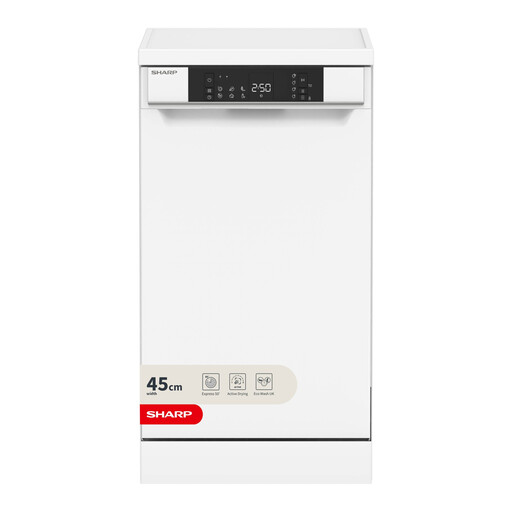
Sharp QW-NS1EF49E0W-EN 45 cm dishwasher, white
Consider this model if you need a narrow dishwasher for one person’s daily containers and dishes. Its listed noise level is 49 dB and its stated energy class is E.
Before relying on a short programme for lunchboxes, check its stated soil conditions. Measure for pipework and door opening as well as appliance width.
View on Joybuy
 No image available
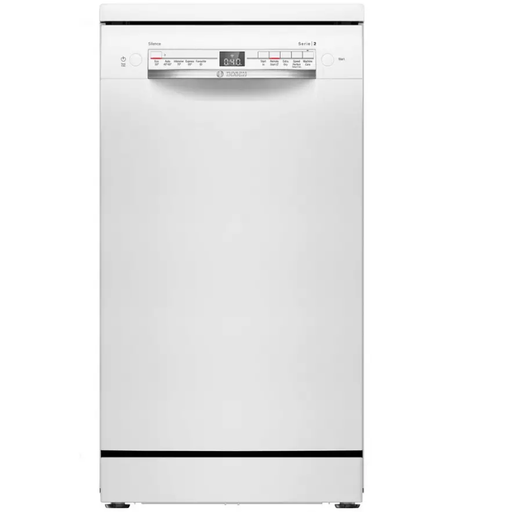
Bosch Series 2 SPS2IKW01G 45 cm freestanding dishwasher
This nine-place-setting model is a freestanding option if your kitchen has a suitable gap and connections. The product name identifies Home Connect and ExtraDry; check the functions’ requirements for your intended use.
If frequent small loads matter, confirm whether the exact model has a half-load function. Check its energy label before comparing efficiency, and allow room for rear connections and the open door.
View on Joybuy
 No image available
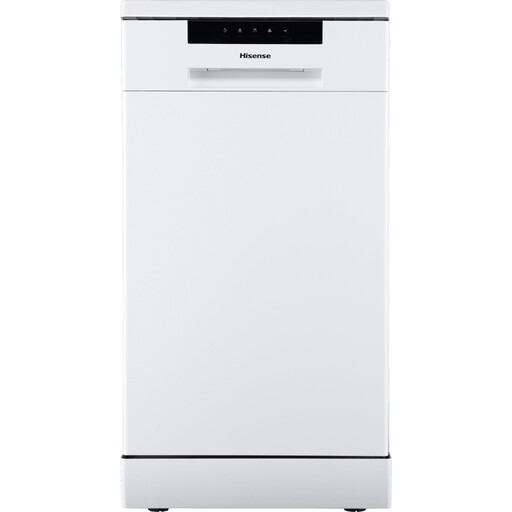
Hisense HS523E15WUK 45 cm freestanding dishwasher
This nine-place-setting freestanding model is worth considering where a 45 cm appliance suits the planned kitchen space. The product name lists a white finish and E energy class.
Check the basket arrangement against your lunchboxes and lids. If you plan to run small or quick loads regularly, confirm the exact functions and programme conditions before choosing.
View on Joybuy
 No image available
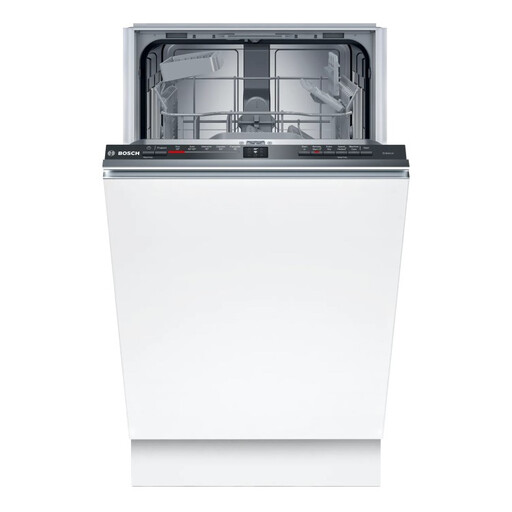
Bosch Series 2 SPV2HKX42G integrated dishwasher with fixed-door hinge kit
Choose this fully integrated format only if your kitchen is designed for an appliance behind a furniture door. Its product name identifies a black control panel, fixed-door hinge kit, Wi-Fi connection and E energy class.
Confirm the required niche, furniture-door arrangement and connections. Check small-load functions separately if one person’s dishes rarely fill the machine.
View on Joybuy
 No image available
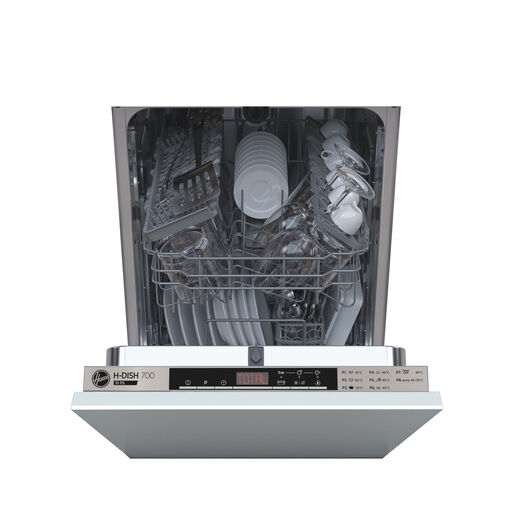
Hoover H-Dish 500 HDIH 2T1047-80 integrated dishwasher
This ten-place-setting slimline model is an integrated option for a kitchen with a suitable cabinet opening. Its product name states an E energy class.
Check the niche, connections and furniture-door fit before selecting it. If small loads or short cycles are important, confirm the exact model’s programme details and soil-level guidance.
View on Joybuy
Questions about fit and daily use
Will a 45 cm slimline dishwasher fit a 45 cm kitchen gap?
Not necessarily: the quoted width is only one part of the fit check. Measure the available height and depth, allow for rear pipework, and make sure the door can open for loading. Dishwasher fitting guidance also highlights the need for space around pipework.
Is a half-load function useful for one person?
It can be useful when your lunchboxes and daily dishes make up less than a full load. Check how the function works on the exact model: Beko lists one for the DVS05C20, and Hotpoint lists one for the HP2FE10CS90SUK, but neither example makes it a standard feature of all slimline machines.
Can I use a 30-minute cycle for lunchboxes every day?
Use a 30-minute cycle when the load meets the manufacturer’s conditions, rather than simply because the containers are dishwasher-safe. Beko and Hotpoint describe their cited short cycles for lightly soiled dishes; for dried-on or heavier residue, check the lunchbox care instructions and choose a suitable longer programme.
What should I compare on a dishwasher energy label?
Compare the exact models’ efficiency classes and Eco-programme information on the same basis. Energy Saving Trust explains the A-to-G rating scale; for this one-person routine, consider those figures alongside basket fit and any small-load function rather than treating the letter alone as the whole decision.
Should I choose a freestanding or integrated slimline model?
Choose according to how your kitchen is built: a freestanding model remains visible, while an integrated model is designed to sit behind a furniture door. Either route still needs its own dimensions and connections checked; integrated models also require the correct niche and door arrangement.


