24/7 Customer Support

Free returns

Same-day & Next-day Delivery

Quality Guaranteed

Unlock Your Welcome Offers: FREE Delivery | Up to 80% OFF | Free 30-day JoyPlus trial
Download the APP
Words by Joybuy Editorial Journal | 10 July 2026
There is a quiet choreography to life in a British home. It is a dance of accommodation, performed daily in narrow Victorian hallways, compact new-build kitchens and the thoughtfully converted spaces of city flats. We learn to move with an awareness of corners and clearances, arranging our lives within a footprint that is often more modest than we might wish. For decades, the unyielding dimensions of our essential appliances have dictated the layout of our most functional rooms, demanding a standard depth that carves out precious square footage.
This has created a familiar spatial problem. The utility area becomes a bottleneck. The kitchen feels a fraction more confined. We accept it as a necessary compromise, a trade-off for the convenience these machines provide. Yet, a shift in design philosophy is suggesting a different way forward. It proposes that our tools should adapt to our homes, not the other way around.
The principle is simple: reclaim the lost space. The standard 60cm depth of a washing machine is a legacy measurement, a convention that has remained largely unchallenged. But in a home where every centimetre counts, this depth can be the difference between a cluttered walkway and a clear, breathable passage. The emergence of the narrow depth washing machine is less a story of shrinkage and more one of intelligent redistribution.
By re-engineering the internal components, designers can now achieve generous capacity within a much shallower profile. A 40cm depth washing machine, for instance, can be tucked neatly under a shallower worktop or placed in an alcove without protruding. This is the essence of a space saving washing machine. It is not about doing less with less, but about achieving full function within a more considered form. This act of spatial reclamation has a profound effect on the feeling of a room. It creates an uninterrupted visual line, reduces physical obstruction and contributes to a pervasive sense of calm and order. The home begins to breathe.
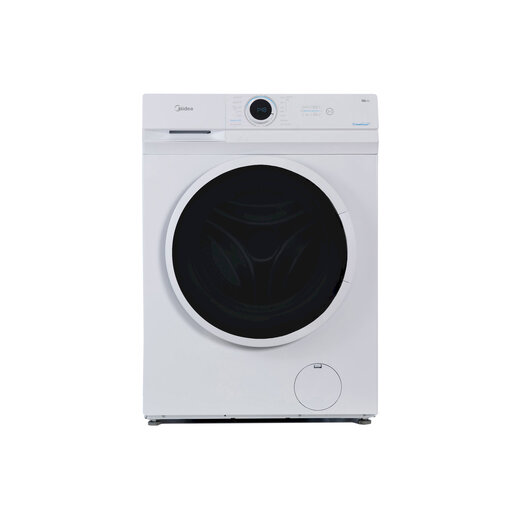
When an object is designed with respect for its environment, it ceases to be a mere utility and becomes part of the home’s quiet rhythm. This is particularly true for appliances, which are often the largest and most permanent fixtures in a room. A freestanding washing machine 7kg model that offers a full-size capacity for a couple or small family, yet occupies a minimal footprint, is an exercise in thoughtful design. The Midea MF100W70 7 kg Freestanding Slimline Washing Machine exemplifies this approach. Its ultra-slim 40cm depth allows it to integrate into spaces previously deemed unusable, transforming a tight corner in a small kitchen into a functional laundry zone. The design is intentionally minimalist, favouring a clean fascia and an intuitive ‘Lunar Dial’ that combines the cycle selector and display into a single, elegant element. This removes visual clutter and simplifies the daily ritual of washing. Features such as a 15-minute quick wash cycle acknowledge the pace of modern life, offering efficiency without sacrificing the core purpose of the machine.
This philosophy of compact utility extends to the entire ecosystem of the home. In a kitchen where space is at a premium, every object must justify its presence. A microwave, for example, should not dominate the worktop. A model like the Haden Cotswold Solo Microwave Oven complements this ethos. Its gentle retro lines and considered sage green colour add a touch of warmth and personality, while its compact form ensures it provides function without demanding unnecessary space. When our tools are designed with such intention, they harmonise with our living spaces, supporting our routines with a quiet and unassuming grace. They become not just objects we own, but partners in creating a more ordered and tranquil home.
For those seeking to explore a wider curation of objects designed with these principles, the complete [车载微波炉](https://www.joybuy.co.uk/explore/车载微波炉/aQBIu63I) registry offers further inspiration.