Shared-kitchen queue reducers
When several people use the same plates, bowls, glasses and cutlery, usable capacity and flexible loading matter alongside cycle time. Check whether a quick programme covers the load and soil level you expect.


Choose a freestanding slimline dishwasher if the kitchen has a suitable gap and accessible connections but no compatible cabinet-door arrangement. Choose an integrated model for a fitted kitchen only after confirming the appliance bay, furniture door and installation requirements. In either case, check whether its capacity, basket layout and programme conditions will keep everyday crockery moving between shared users.
When several people use the same plates, bowls, glasses and cutlery, usable capacity and flexible loading matter alongside cycle time. Check whether a quick programme covers the load and soil level you expect.
A narrow appliance gap makes a slimline model worth considering, but height, depth, room for pipework and space to open the door still determine whether it will fit.
If cycles run near a shared living area or later in the day, compare the stated noise level and programme options for the exact model rather than relying on a general description of it as quiet.
Settle the installation route before comparing features: a freestanding machine needs a suitable position and connections, while an integrated one must also work with the kitchen furniture. Then compare loading space and everyday programmes, followed by noise and operating information.
| Concern | What to check | Who this matters to |
|---|---|---|
| Everyday capacity | Compare place settings and basket layout; check the load and soil conditions of any quick programme. | If crockery piles up between shared meals, I need racks that take our usual mix of items, not just an appealing place-setting figure. Around 33% of consumers put everyday throughput first. |
| Fit and installation | Measure height, width, depth, rear pipework space and open-door clearance; check furniture-door compatibility for integrated models. | A narrow gap is useful only if I can install the machine and open it for loading. Roughly 27% of consumers make physical fit their primary concern. |
| Noise | Compare the exact model’s stated dB figure and any quieter programme, including its conditions. | When a cycle runs beside the living space, I want to know how noticeable that particular machine may be. About 20% of consumers prioritise lower-disturbance operation. |
| Ongoing use | Compare the energy label and product information sheet; check programme water-use figures and drying features for the exact model. | I need operating information I can compare and a drying arrangement that suits how we unload dishes. Around 20% of consumers put these ongoing-use details first. |
A machine can fit a narrow gap yet be too tall or deep, leave too little room for pipework, or obstruct the door when opened.
Measure the whole appliance bay and check the model’s installation dimensions and open-door clearance before ordering.
A short cycle intended for lightly soiled dishes or a smaller load may not clear a shared kitchen’s normal pile of crockery.
Check the stated load and soil conditions as well as the duration of the exact programme.
An integrated dishwasher must suit the appliance bay and furniture-door arrangement; matching its nominal width is not enough.
Confirm cabinet and door compatibility, connections and who will carry out the installation.
Energy class does not describe basket capacity, noise, drying features or how the machine fits the kitchen.
Use the energy label and product information sheet for each shortlisted model alongside its installation and loading details.
The freestanding DVS05C20 is a reference point for comparing capacity and programme conditions in a narrow format.
The freestanding SPS2IKW01G is a 45cm option for buyers comparing connected features with available loading space.
The 45cm FFB62417ZW gives noise-sensitive households a model-specific figure to compare.
The HP2FE10CS90BUK and HP2ID10CS80UK provide freestanding and integrated slimline examples respectively.
These freestanding and integrated models offer different ways to fit a slimline dishwasher into a shared kitchen. Compare the installation route first, then check capacity and the features stated for each model.
 No image available
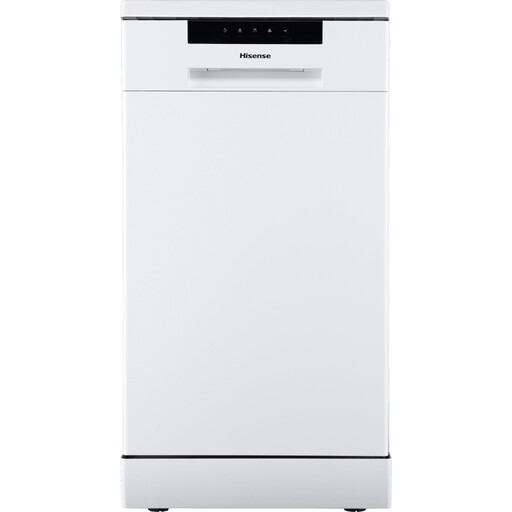
A freestanding option to consider when the shared kitchen has a suitable narrow gap and accessible connections.
45cm wide; nine place settings; energy class E. Check whether nine place settings accommodate your usual mix of crockery and cookware.
 No image available
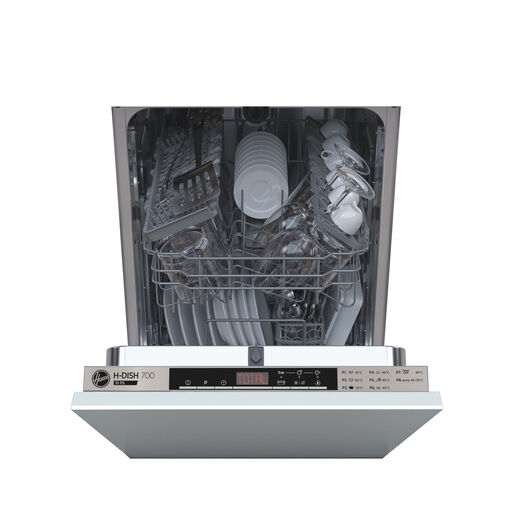
An integrated option for a fitted kitchen, provided the appliance bay and furniture-door arrangement are compatible.
Ten place settings; energy class E. Confirm the installation requirements and the load conditions of any rapid programme before relying on it for shared-kitchen turnaround.
 No image available
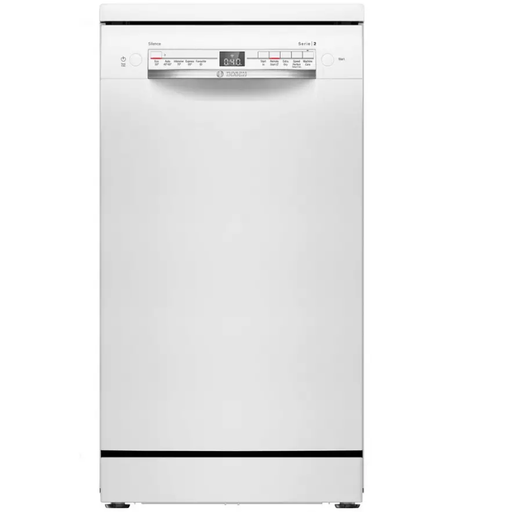
A freestanding choice when a 45cm appliance fits and nine place settings cover the kitchen’s usual load.
Home Connect, ExtraDry and energy class F are listed for this model. Check the programme conditions if faster turnaround is important.
No image available
Consider this model for a fitted kitchen only after checking the cabinet opening, furniture door and fixing arrangement.
The product name specifies Wi-Fi connectivity, a black control panel, a fixed-door hinge kit and energy class E. Confirm exactly what the installation requires and includes.
No. Measure the available height, width and depth, allow room for pipework behind the appliance, and check that its door can open for loading. An integrated model also needs a compatible furniture-door arrangement.
Choose according to what accumulates between runs, not the number alone. Ten place settings indicate greater nominal capacity than nine, but bowls, tall glasses and bulky cookware can change how much fits in the baskets.
That depends on the exact model and programme. Hotpoint describes a rapid cycle for a small, lightly soiled load, while Beko describes the DVS05C20’s 30-minute Mini programme as taking a full 10-place-setting load. Check the stated conditions before planning around the cycle time.
Compare the energy label and product information sheet for the exact dishwasher, rather than relying on its product title. UK guidance from the Department for Energy Security and Net Zero and the Office for Product Safety and Standards says products in scope must display an energy label at the point of sale, including on a website.