
24/7 Customer Support

Free returns

Same-day & Next-day Delivery

Quality Guaranteed

Unlock Your Welcome Offers: FREE Delivery | Up to 80% OFF | Free 30-day JoyPlus trial
Download the APP
A slow cooker promises to be the ultimate kitchen ally for busy families and professionals across the UK. The dream is simple: load it in the morning and return home to a perfectly cooked, flavourful meal. Yet, the reality can often be a frustrating and expensive mismatch. Many find themselves with an appliance that either overcooks, is a nightmare to clean or simply doesn't fit the joint of meat it was bought for.
As a Joybuy Product Recommendation Officer, my role is to help you navigate past the marketing clutter. Before you invest, let's look at the common pitfalls that lead to buyer's remorse and how to sidestep them.
To ensure you get a machine that genuinely makes your life easier, focus on these core parameters.
The right size is crucial and depends entirely on your household.
The material of the inner pot, or crock, dictates how you can use the appliance.
Your lifestyle can help determine which control type is a better fit.
Based on these practical considerations, here are a few models matched to different user needs.

Why This Fits Their Persona: This model is built for family life. The 6.5L capacity is perfect for batch cooking or feeding a crowd, and the hob-proof pot allows you to sear meat directly on the stove before slow cooking, saving time and washing up.
It directly solves the cleaning headache. The removable aluminium pot is lightweight and fully dishwasher-safe, making cleanup effortless.
The all-in-one sear and stew function streamlines the cooking process significantly. Its large, oval shape easily accommodates joints of meat.
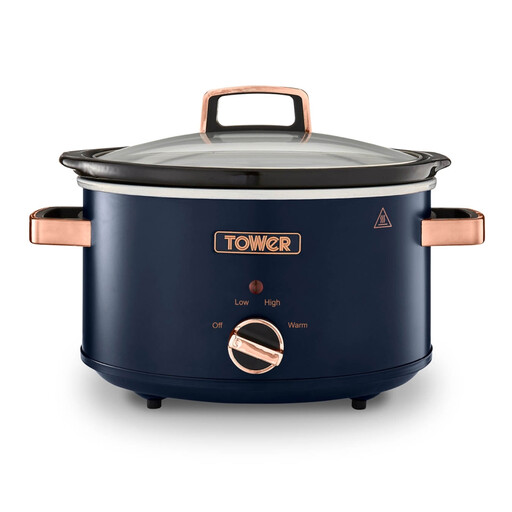
Why This Fits Their Persona: For those who see kitchen appliances as part of their decor, this retro slow cooker delivers. Its midnight blue and rose gold finish adds a touch of style, while the 3.5L capacity is perfectly proportioned for couples or small meals.
It avoids the trap of over-complication. With simple Low, High and Keep Warm settings, it focuses on doing one job well. The removable ceramic slow cooker pot is also dishwasher safe, ensuring convenience.
Its compact footprint and elegant design make it an appliance you won't want to hide in a cupboard. The cool-touch handles add a practical safety element.

Why This Fits Their Persona: For those who want maximum functionality from a single appliance, this multi cooker is a strong contender. It offers dedicated, well-executed programs for pressure cooking, sautéing and slow cooking, all controlled via a clear digital interface.
It avoids the "all-in-one" illusion by having smart, distinct programs. The slow cook function is properly calibrated for gentle heat, unlike less sophisticated models. The ceramic non-stick pot is also easy to clean.
Its versatility is its main strength, replacing several kitchen gadgets. The 14 preset programs and manual controls offer a high degree of precision for various cooking styles.
We have compiled a complete, real-time list of products that fully satisfy these strict selection criteria and UK safety regulations.
1. How much does it cost to run a slow cooker all day? Slow cookers are remarkably energy-efficient. A typical 3.5L model uses around 150-200 watts on its low setting. Even if left on for 8 hours, this equates to just 1.2-1.6 kWh of electricity. Based on current UK energy prices, this often costs less than 50p for a full day's cooking, making it one of the more economical ways to cook.
2. Can I safely leave a slow cooker on while I'm out of the house? Modern slow cookers are designed with safety in mind for unattended cooking. They operate at low, stable temperatures and are built to be left on for many hours. For peace of mind, always place the cooker on a flat, stable, heat-resistant surface away from the edge of the counter and ensure the cord is not in a position to be pulled.
3. Do I really need to brown meat before putting it in a slow cooker? While not strictly necessary for safety, browning meat in a pan (or in a hob-proof slow cooker pot) before slow cooking makes a significant difference to the final flavour. This process, known as the Maillard reaction, creates a rich, savoury depth that you won't get from simply placing raw meat into the pot. It's an extra step, but one that is well worth the effort for most stews and casseroles.