Shared-house batch cooks
If you are making several portions of chicken and barley soup, you need a pot that suits the batch, somewhere to refrigerate leftovers and a straightforward clean-up after using the communal kitchen.


For chicken and barley soup serving roughly four people, a 3.5L slow cooker is a useful starting point if its dimensions fit the shared kitchen and its pot holds your planned recipe. Choose a timer and automatic keep-warm function when housemates eat at different times; consider a hob-safe insert only if you want to brown ingredients in the same pot and it suits the shared hob. Check appliance rules, socket access and fridge space for leftovers before buying.
If you are making several portions of chicken and barley soup, you need a pot that suits the batch, somewhere to refrigerate leftovers and a straightforward clean-up after using the communal kitchen.
If housemates eat at different times, a cooking timer and automatic keep-warm function may make serving easier to coordinate. Check how the exact model behaves when its cooking time ends.
If you want to brown chicken or sauté vegetables before slow cooking, a hob-safe insert could save using a separate frying pan. Its compatibility with the shared hob is essential.
For chicken and barley soup, work out the batch size, washing-up and leftover arrangements first. Then decide whether staggered serving or browning in the same pot justifies particular controls or an insert.
| Concern | What to check | Who this matters to |
|---|---|---|
| Chicken handling and leftovers | Check how the removable parts are cleaned and whether the shared fridge has space for saved soup. | I need to keep raw chicken preparation separate and put saved portions away after the meal; around 31% of consumers put safe shared-kitchen use and leftovers first. |
| Space, portions and clean-up | Compare the planned recipe volume with the model’s capacity, then measure its storage space and check pot-care instructions. | With limited cupboard space and shared washing-up, I want enough soup without a pot that is awkward to store; around 31% of consumers prioritise space, portion size and cleaning. |
| Staggered serving | Check the timer range and what the cooker does when cooking ends; confirm that household rules permit its planned use. | When housemates return at different times, I want a defined cooking period and a workable serving window; around 23% of consumers put timing flexibility first. |
| Browning in one pot | Check that the exact insert suits the shared hob and that you actually intend to brown ingredients for this soup. | If I brown ingredients before adding the liquid, avoiding another pan matters to me; around 15% of consumers make one-pot browning their primary concern. |
Hob-safe does not mean compatible with every hob. Tower specifies that its T19065BLK insert is not for induction hobs.
Check the exact cooker instructions against the shared kitchen’s hob before choosing a model for one-pot browning.
If the insert cannot be used on your hob, browning the ingredients will require a separate suitable pan and more washing-up.
Manufacturers describe different 3.5L models as serving roughly three to five people. Your portion sizes, barley and plans for leftovers affect how useful that guidance is for this soup.
Plan the recipe volume and number of servings, then check the exact cooker’s capacity, dimensions and space for refrigerated leftovers.
A keep-warm setting helps with serving after cooking; it is not a substitute for handling chicken carefully or refrigerating soup saved for later.
Keep raw chicken preparation separate, cook the soup thoroughly, clean shared surfaces and refrigerate saved portions rather than leaving them out after the meal.
Leicestershire Fire and Rescue Service advises avoiding extension leads for high-powered kitchen appliances and using one plug per socket.
Agree which suitable wall socket the cooker can use, and keep its lead away from water, heat and clutter.
For staggered meals, Crock-Pot UK describes the 3.5L CSC113X as serving three to four people, with an adjustable timer from 30 minutes to 20 hours.
Morphy Richards UK lists both 3.5L and 6.5L slow cookers, giving households a capacity choice to compare against their portions and storage space.
Tower describes 3.5L slow cookers with manual heat settings as well as the T19065BLK sear-and-stew model.
These 3.5L models are options to consider for a shared-kitchen soup batch. Compare their controls, pot care and fit against your cooking and clean-up plans rather than assuming they offer the same timing or hob features.
 No image available
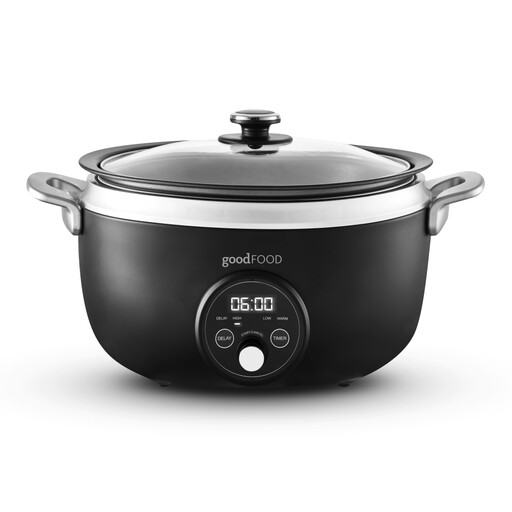
Consider this model if a defined cooking schedule matters for your shared-kitchen soup; check the timer range and what happens when cooking ends.
The product title specifies a removable aluminium pot, 170W rating, LED display, delay function and timer. If you intend to brown ingredients in the pot, confirm its compatibility with the shared hob; do not rely on it for an induction hob.
 No image available
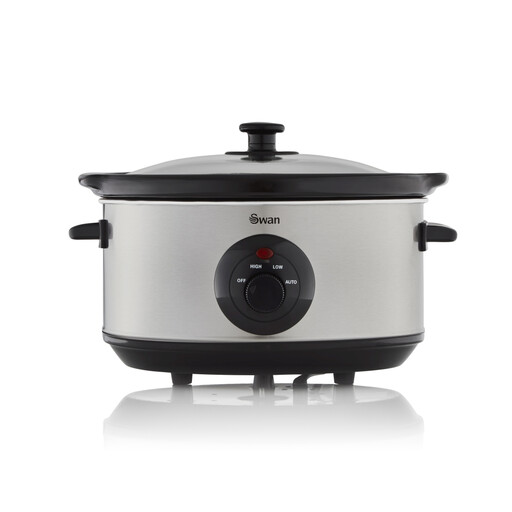
This is an option for a modest soup batch where you can manage cooking and serving without relying on a confirmed programmable finish.
The product title specifies 200W and three cooking settings. Check the pot-care instructions, timer functions and dimensions against the household’s cleaning and storage needs.
 No image available
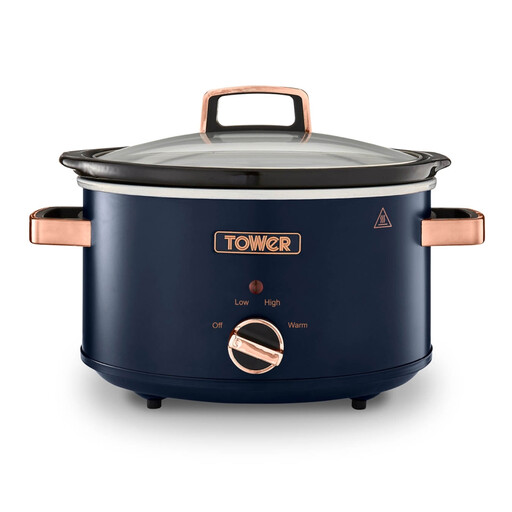
Consider this model when the priority is a modest soup batch and a removable pot for shared-kitchen clean-up.
The product title specifies three heat settings, a removable pot and cool-touch handles. Check its pot-care instructions and whether its controls meet any need for timed cooking.
A 3.5L model is a useful starting point for roughly four portions if it fits your storage space and planned recipe. Crock-Pot and Tower describe different 3.5L models as serving around three to five people, so check the exact model and allow for your portion sizes and leftover plans.
A timer is worth considering when you need to set a cooking duration rather than manage a manual dial yourself. Crock-Pot says its CSC113X has a 30-minute-to-20-hour timer and changes to keep-warm after cooking; saved portions still need an appropriate refrigeration plan.
Only use the insert on a hob if the exact cooker instructions specify that it is suitable for your hob type. Tower describes hob browning with its T19065BLK pot but excludes induction hobs, so a shared induction kitchen would need another approach.
Plan to use a suitable wall socket and follow the cooker’s instructions and the kitchen’s appliance rules. Leicestershire Fire and Rescue Service advises avoiding extension leads for high-powered kitchen appliances and using one plug per socket; keep the cooker and lead clear of water and heat.
Sharing a private household meal is different from running a food business. If you plan to trade as a food business in England, Wales or Northern Ireland, GOV.UK says you must register with the local authority at least 28 days before trading; check with the local authority if you are unsure how a planned food activity is classified.