Regular small-batch scone bakers
If you bake a few cheese scones frequently, focus on whether the supplied tray holds your intended batch and whether the oven has a setting suitable for your chosen recipe.


For occasional small batches of cheese scones, use your existing oven if it accommodates a lined tray and reaches your recipe’s temperature; that avoids buying and storing another appliance. Consider a countertop oven if you want a dedicated small-batch appliance or would use its other cooking modes, but check usable tray space, baking controls and ventilation clearance before choosing.
If you bake a few cheese scones frequently, focus on whether the supplied tray holds your intended batch and whether the oven has a setting suitable for your chosen recipe.
A compact appliance still needs room around it while operating. Check its external dimensions and the clearance specified in its manual before deciding where it could sit.
Additional modes may matter if you would also use the appliance for tasks such as toast, grilling or air frying. Compare the modes you would actually use with the space and cleaning the appliance requires.
Start with whether your existing oven meets the recipe and tray requirements. If you are considering a second appliance, assess its usable baking area before its litre capacity or extra modes.
Choose it when: You make scones occasionally and can fit a lined tray while following your recipe’s oven setting.
Trade-off: You avoid storing another appliance, but using the full oven for only a few scones may be less convenient.
Choose it when: You bake small batches regularly or want a separate oven, provided its tray fits your batch.
Trade-off: It occupies worktop space and needs the ventilation clearance stated for the particular model.
| Concern | What to check | Who this matters to |
|---|---|---|
| Usable tray space | Compare the supplied tray or internal width and depth with your lined tray and the spacing you want between scones. | I want to bake my intended batch without squeezing the scones together; around 45% of consumers put usable tray space first. |
| Baking control | Look for a Bake setting and a temperature range covering your recipe. The National Trust cheese-scone recipe specifies 180°C, or 160°C fan. | If I follow a short-bake recipe, I need a suitable setting and a chance to check browning; roughly 36% of consumers prioritise baking control. |
| Other uses and upkeep | Compare modes you would use, cleaning instructions and the manual’s worktop-clearance requirements. | I would use the appliance beyond scones, but it also needs to be practical to place and clean; around 19% of consumers make multi-use value their primary concern. |
A capacity figure does not tell you whether your tray and intended scone spacing will fit.
Compare your planned tray with the oven’s internal width and depth and the dimensions of its supplied accessories.
The maximum setting is not necessarily the setting your cheese-scone recipe calls for. Excessive heat can brown the topping before the bake is complete.
Start with your chosen recipe’s temperature and time, preheat as directed and watch the first batch for its browning pattern.
A countertop oven needs ventilation space, and its exterior can become hot during use.
Check the specific manual before installation. Russell Hobbs instructs owners of the 26680 to leave 150mm around the appliance and place it on a stable, heat-resistant surface.
Crumbs need regular attention, while registration can help the manufacturer contact you about a product-safety issue. Electrical Safety First recommends registering electrical appliances for that reason.
Follow the model’s crumb-tray cleaning instructions and register the appliance if the manufacturer offers registration.
Its 26680 is a 20-litre countertop option to examine if you want Bake alongside other cooking modes.
A dial-controlled 20-litre option worth comparing when published cavity dimensions matter to your tray choice.
The 17-litre TOA60U provides a compact, multi-function specification reference.
This multi-function air-fryer oven is a compact option to consider if you would use cooking modes beyond small-batch baking. Check its Bake setting, usable tray area and installation instructions against your cheese-scone plans.
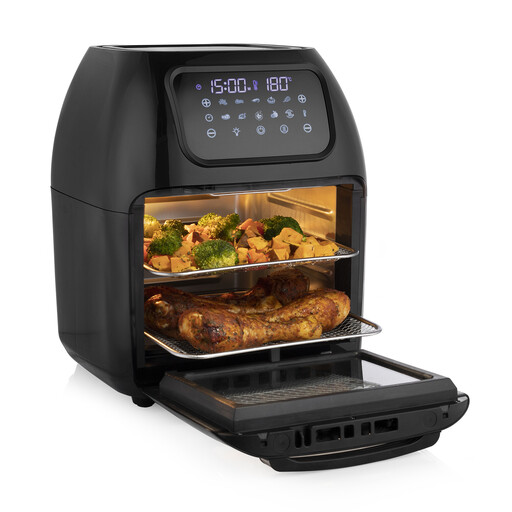 Image unavailable
Consider this for small-batch scones if its supplied tray accommodates your intended spacing and its Bake setting suits your recipe.
The product title specifies 10L, 1800W, touch-screen controls and 10 programmes. Check the manual for ventilation clearance and which parts are dishwasher-safe.
Use the setting in your chosen recipe, not the oven’s maximum temperature. The National Trust recipe specifies 180°C, or 160°C fan, and a 10–15-minute bake; other recipes may differ.
A 20-litre capacity does not establish whether your planned tray and scone spacing will fit. For comparison, the B&Q listing gives the Quest 20-litre oven’s internal dimensions as 31 x 22 x 25cm; also check the dimensions of the tray you would actually use.
Follow the manual for the exact model. Russell Hobbs specifies 150mm around its 26680 for airflow and calls for a stable, level, heat-resistant surface; do not assume that figure applies to another oven.
Register it if the manufacturer offers registration. Electrical Safety First says registration makes it easier for a manufacturer to contact you if a purchased appliance is found to be faulty or dangerous.