Small-batch oat-bar makers
You make a few bars at a time and mainly want help preparing nuts, dates or other additions. If those ingredients need little chopping, you may be able to stir the mixture by hand, as in Good Food’s oat-bar recipes.


For classic oat bars, start with a bowl and spoon: Good Food recipes stir the oats and additions into the binder rather than processing the whole mixture. A mini chopper makes sense if you regularly prepare small amounts of nuts or fruit; choose a food processor if you will also use its slicing, grating or other preparation functions. Check usable working capacity and cleaning requirements before choosing either appliance.
You make a few bars at a time and mainly want help preparing nuts, dates or other additions. If those ingredients need little chopping, you may be able to stir the mixture by hand, as in Good Food’s oat-bar recipes.
You want an appliance for oat-bar additions and routine chopping, slicing or grating, but need its working capacity and storage footprint to suit a limited space.
You make oat bars alongside a wider range of food-preparation jobs and may have reason to compare larger working bowls and published parts-support terms.
Choose this when: Your recipe calls for stirring oats and additions into a binder, and you do not need an appliance to prepare the additions.
Trade-off: Firm nuts or dried fruit still need preparing separately if you want smaller pieces.
Choose this when: Chopping small quantities of additions is your main appliance task.
Trade-off: A chopper does not replace a processor’s dedicated slicing and grating discs.
Choose this when: Oat bars are one of several regular jobs and you will use functions such as slicing or grating.
Trade-off: Extra attachments take storage space and add pieces to clean; a larger bowl size alone does not establish a suitable quantity for a small recipe.
| Concern | What to check | Who this matters to |
|---|---|---|
| Whether an appliance is needed | Read your recipe: does it call for a stirred mixture or a finely processed ingredient? | If my oats and additions only need stirring into the binder, I would rather keep the preparation simple. Around 40% of consumers put avoiding an unnecessary appliance first. |
| Small-quantity chopping | Compare the usable quantity for your ingredients and whether the controls include a pulse setting. | When I want smaller pieces of nuts or fruit without turning the whole oat mixture into a paste, controlled chopping is my priority. Roughly 30% of consumers put that need first. |
| Use beyond oat bars | Check the supplied functions, working capacity, storage dimensions and which parts can be cleaned in a dishwasher. | If I also prepare vegetables or other ingredients regularly, the appliance needs to earn its cupboard space across those jobs. About 30% of consumers prioritise wider food preparation. |
Good Food’s oat-bar recipes stir oats and other ingredients into the binder before the mixture goes into a tin. An appliance is not necessary for that step in those recipes.
Check whether your recipe instead calls for finely chopped or puréed additions before choosing a machine.
An appliance used only for this step also needs cupboard space, assembly and washing-up.
Total capacity and working capacity can differ. Kenwood lists a 1.3 L bowl but a 0.75 L dry working capacity for the MultiPro Go FDP23.140GR.
Compare the stated working capacity with the amount and type of ingredient you plan to process in one run.
A chopper may cover small chopping tasks, while a processor’s slicing and grating accessories make more sense when those are regular jobs too.
Write down the preparation jobs you expect to do regularly, then check which accessories the exact model includes.
Electrical Safety First says registration helps a manufacturer contact owners about a faulty or dangerous appliance. The Office for Product Safety and Standards also publishes product recalls and alerts.
Keep the model details, register the appliance where that option is offered and check official recall information, particularly when buying an older item.
Kenwood’s MultiPro Go FDP23.140GR is a compact processor to consider when you want a chopping blade as well as slicing and grating discs.
KitchenAid’s 5KFC0516 is a chopper to consider when small quantities of additions are the main preparation job.
Bosch’s MCM3501MGB is a processor to compare if oat bars are part of more varied household food preparation.
Magimix’s 3200XL is more relevant to frequent cooks comparing a processor for jobs beyond occasional oat bars.
These food choppers are options for preparing additions such as nuts, rather than a reason to process a whole oat-bar mixture. Compare the quantity you actually need to chop with each model’s usable capacity before choosing.
 No image available
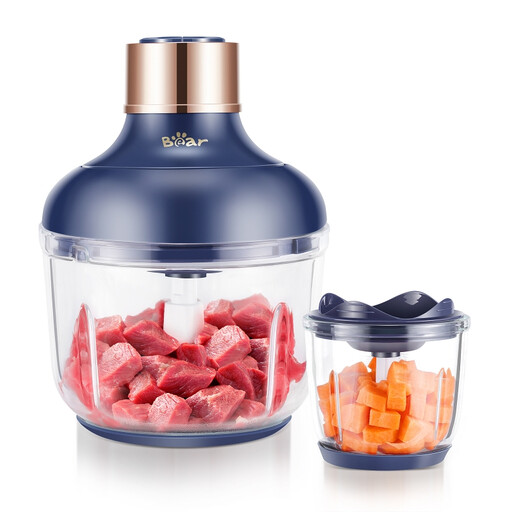
Consider the smaller bowl if you mainly chop additions for a few oat bars. The product name lists two glass bowls with capacities of 0.6 L and 2 L, plus a 300 W rating; those bowl figures are not usable working capacities. Check how much of your chosen ingredient the smaller bowl can handle, and confirm the applicable product-safety information for your purchase.
No image available
Consider the separate containers if you prepare different ingredients as well as oat-bar additions. The product name lists a 300 W rating and two speed settings, but its 2 L and 1.8 L figures are bowl capacities, not working quantities for a small batch. Confirm a suitable minimum quantity, the correct continuous-use limit in the instructions and the applicable product-safety information before use.
No, not for a classic mixture that is stirred together. Good Food’s oat-bar recipes combine oats and additions with the binder by stirring; a chopper or processor becomes useful when your recipe calls for finely chopped or puréed ingredients.
Compare working capacity with the quantity you intend to prepare, not just the total bowl size. Kenwood lists a 1.3 L bowl and 0.75 L dry working capacity for the MultiPro Go FDP23.140GR, while Magimix lists 2.6 L total and 1 L working capacity for the 3200XL; the figures describe different models and should be checked against your ingredients.
A mini chopper can cover small chopping or puréeing jobs if those are the functions you need for your oat-bar additions. If you also regularly slice or grate ingredients, compare a processor supplied with the relevant discs instead.
Check the instructions for the exact model and component. Kenwood lists the MultiPro Go FDP23.140GR pusher, lid, bowl, knife blade and slicing/grating discs as dishwasher-safe, while Bosch describes the MCM3501MGB accessories as dishwasher-safe; neither statement should be extended to every part of every model.
Keep the model details and check for relevant recalls or alerts through the Office for Product Safety and Standards. Electrical Safety First also recommends registering appliances where possible so manufacturers can contact owners about safety issues; when using a feed chute, use its intended food pusher rather than reaching towards the blades.