Who these dishwashers suit

Small households with daily crockery loads

If plates, bowls, cups and cutlery accumulate each day but a full-width dishwasher will not fit, a six-place-setting tabletop model is one format to assess. Check your actual plate sizes and loading layout rather than relying on the place-setting figure alone.

Renters without a permanent water feed

A dishwasher designed for manual tank filling may suit a home where a permanent water connection is impractical. You will still need a workable way to fill it, drain wastewater and accommodate its smaller stated load.

Households short of worktop space

When depth is the deciding constraint, measure beyond the appliance footprint: hoses, the open door and access for loading all affect whether a countertop position works.

What matters when buying

Six-place-setting tabletop model

Consider it when: Your usual load is several place settings and you have space and suitable water and waste connections.

Allow for: A worktop footprint of about 55cm by 50cm for the cited Candy and Russell Hobbs models, before checking connections and door clearance.

Tank-fed compact model

Consider it when: A permanent water feed is impractical and a smaller crockery load suits your routine.

Allow for: Manual filling and wastewater drainage. The cited Comfee model holds approximately two to three place settings.

Concern What to check Who this matters to
Water and drainage Confirm the exact model’s permitted inlet method, drain arrangement and connection reach. If I cannot install a permanent water feed, manual filling could make a dishwasher practical, provided I can also drain it. Around 30% of consumers would put a workable connection route first.
Crockery capacity Compare your widest plate and tallest glass with the model’s clearance and rack layout, as well as its stated place settings. When dinner plates and bowls build up each day, I need enough room for my own crockery, not just a capacity label. For around 30% of consumers, fitting the daily load would be the main concern.
Worktop fit Measure width, depth and height, allowing for rear connections and the open door. A machine that blocks a cupboard or leaves no room to load it will not work in my kitchen. Worktop space and access would come first for around 20% of consumers.
Everyday operation Compare declared water and energy figures on the same cycle basis; check noise, programmes and drying details. If the dishwasher will run regularly, I want its declared resource use and day-to-day operation to suit my routine. Around 20% of consumers would make that balance their primary concern.

Common buying mistakes

  • Choosing by place settings without measuring dishes

    A place-setting figure does not tell you whether your largest dinner plate will fit. Russell Hobbs states a 25cm maximum plate size for its cited six-place-setting model; the cited HOMCOM tank-fed model states 20cm.

    Measure the widest plate, tallest glass and any pan you intend to wash, then check the exact model’s clearance and rack layout.

  • Measuring only the machine

    Hoses and an open door can make a seemingly suitable worktop position difficult to use. General dishwasher fitting guidance suggests around 5–7cm of space at the rear for pipes and connections; follow the chosen model’s installation instructions.

    Check the available width, depth and height, then make sure the door can open and the racks remain easy to load.

  • Assuming a water tank removes all setup requirements

    A manually filled tank avoids the need for a permanent water feed on models designed for it, but wastewater still needs to go somewhere suitable.

    Check the model’s filling and drainage instructions and plan its position before ordering.

  • Assuming compact means more economical

    Which? cautions that compact dishwashers can involve energy, water-use and loading compromises. Size alone does not establish resource use for the amount of crockery you wash.

    Compare declared Eco-cycle figures on the same basis and choose a capacity that accommodates your normal load.

Relevant brands for reference

Candy

Candy lists the CP 6E51LW-80 as a six-place-setting tabletop dishwasher measuring 550 × 501 × 443mm.

  • Candy states that this model has a half-load option and uses 6.5 litres per cycle.
  • Its listed energy class is E and its noise declaration is 51dB; compare those figures on the relevant basis rather than assuming a compact machine is quieter or uses fewer resources.

Russell Hobbs

Russell Hobbs presents the RHTTDW6W six-place-setting tabletop model for settings including small kitchens and flats.

  • Its product information lists six programmes, 6.5 litres per cycle and 49dB.
  • The stated maximum plate size is 25cm for this model. Confirm plate fit and current availability on the exact listing.

Bosch

Bosch’s SKS62E32EU provides a six-place-setting compact model for comparing dimensions and features.

  • Bosch lists dimensions of 450 × 551 × 500mm and features including Extra Dry, Glass 40°C and AquaStop.
  • Bosch marks this exact model as no longer available, so use it as a comparison reference rather than a current purchase choice.

Comfee

The Comfee CDWMT201DW-UK represents the smaller, tank-fed countertop format.

  • Its Joybuy product information states a 5-litre internal tank, an optional tap connection, approximately two to three place settings and dimensions of 420 × 435 × 435mm.
  • Check the exact listing’s drainage arrangement and plate clearance before treating its smaller footprint as suitable for your kitchen.

Joybuy countertop dishwashers

This six-place-setting tabletop model is relevant if your priority is fitting everyday crockery into a small kitchen. Check its physical fit and permitted water and drainage setup before deciding whether it suits your space.
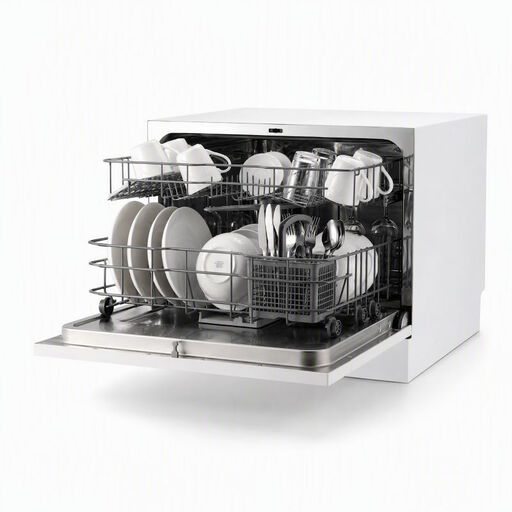
ochama Mini Tabletop Dishwasher, six place settings

ochama Mini Tabletop Dishwasher, 6 Place Settings

Consider this freestanding countertop model for routine crockery loads if six stated place settings suit your household.

The listing states eight programmes, a 30-minute quick wash and a 24-hour delayed start. Check the appliance dimensions, your largest plate’s fit and the required water and drainage connections for your intended position.

View on Joybuy

Questions and answers

How much worktop space does a countertop dishwasher need?

Allow for the exact machine dimensions, rear connections and a fully open door. Candy lists its CP 6E51LW-80 at 550 × 501 × 443mm; General fitting guidance suggests around 5–7cm of rear space for pipes and connections, but the chosen model’s instructions determine its required clearance.

Can I use one without a permanent water connection?

Yes, if the exact model is designed for manual tank filling and you can follow its drainage instructions. The Comfee CDWMT201DW-UK product information states that its 5-litre tank can be filled manually and that a tap connection is an alternative.

Will my dinner plates fit?

Check your widest plate against the exact dishwasher’s stated clearance; a place-setting figure is not enough. The cited Russell Hobbs model states a 25cm maximum plate size, while the cited HOMCOM model states 20cm.

Is a compact dishwasher automatically a better fit than a larger one?

No: it saves space, but loading and resource-use trade-offs still matter. Which? cautions that compact dishwashers can be awkward to load and maintain and can use substantial energy and water; if you have floor space and wash larger loads, consider whether a slimline dishwasher better accommodates your crockery.

What should I do with an old dishwasher in the UK?

Check an electrical-equipment collection or take-back route rather than putting it in ordinary household waste. UK government guidance explains that waste electrical and electronic equipment rules are intended to support recovery and recycling; confirm the available arrangements with your retailer or local authority.