For open-world gaming at a small desk, start with a 27-inch QHD monitor if its stand fits: it offers more room for scenery, maps and menus than Full HD without the graphics demands of 4K. Choose a compact 24-inch Full HD screen when space takes priority; consider OLED for contrast-rich scenes or 4K for finer detail only after checking your hardware, desk fit and, for OLED, panel-care requirements.
Who each screen suits
Small-desk quest explorers
If you want room to read maps and inventories but cannot comfortably accommodate a larger display, compare the footprint of a 27-inch QHD monitor with a compact 24-inch Full HD option. The stand and your viewing distance matter as much as the screen diagonal.
Cinematic HDR-focused players
If dark scenes, contrast and colour are central to your open-world games, a QHD or 4K OLED monitor may be worth considering. Weigh those priorities against the demands of 4K where applicable and the need to follow OLED panel-care guidance.
Space-first PC gamers
If a 27-inch monitor would crowd your keyboard and mouse, a roughly 24-inch Full HD gaming screen keeps the display physically smaller. Accept that Full HD shows less fine scenery and text detail than QHD at the same viewing conditions.
What matters when choosing
Choose the screen size that fits the desk first, then decide whether QHD detail, compact Full HD or an OLED-focused viewing experience deserves priority. Treat 4K as a separate resolution decision: check the performance your own games and hardware can deliver.
Compact Full HD
Choose it when: A roughly 24-inch screen is the comfortable physical fit for your desk.
Trade-off: Full HD gives you less fine detail and workspace than QHD or 4K.
27-inch QHD IPS
Choose it when: Your desk fits a 27-inch monitor and you want more detail than Full HD without targeting 4K.
Trade-off: It needs more physical room than a compact screen and does not offer 4K pixel density.
QHD or 4K OLED
Choose it when: Contrast-rich scenes are a leading priority and you are prepared to follow the model’s OLED-care guidance.
Trade-off: Static desktop use calls for panel-care consideration; a 4K model also places greater demands on graphics hardware than QHD.
| Concern |
What to check |
Who this matters to |
| Desk footprint |
Measure usable width and depth against the monitor’s dimensions with its stand. If using an arm, check the mounting pattern and the arm’s supported load. |
I need space left for my keyboard and mouse, so the stand footprint could decide whether a screen works on my desk. Around 25% of consumers put physical fit first. |
| Detail and smooth play |
Compare native resolution with the performance your PC or console can deliver; check refresh modes through the intended port and cable. |
I want maps and distant scenery to look clearer without choosing a resolution my setup cannot run as I expect. For around 42% of consumers, that balance is the primary concern. |
| Contrast and HDR |
Compare the exact panel and HDR specification. For OLED, read the model’s care guidance and consider how much static desktop use it will see. |
Dark interiors and night-time exploration matter most to me, and I am willing to consider OLED ownership requirements. Roughly 33% of consumers prioritise that visual experience. |
Buying pitfalls
-
Choosing by diagonal size alone
A 27-inch panel can fit a small desk, but its stand may take up more usable depth than expected. BenQ lists the EX2710Q at 252.5 mm deep with its stand, while Dell specifies a fixed tilt stand for the SE2726D.
Measure the space available behind your keyboard and mouse, then check the exact model’s dimensions and stand adjustment. If you plan to use an arm, confirm mounting and load compatibility.
-
Expecting the labelled refresh rate in every game
A monitor’s refresh capability does not establish the frame rate your open-world games will achieve. The game, graphics hardware, resolution and connection all affect the mode you can use.
Check performance for the games you play at the monitor’s native resolution, along with the supported output modes of your PC or console, port and cable.
-
Treating OLED care features as a burn-in guarantee
ASUS describes OLED Care Pro on the PG27UCDM as a way to reduce burn-in risk, not eliminate it. Long periods with static desktop elements remain relevant to an OLED purchase.
Read the care guidance for the exact OLED model and consider whether its protective settings suit your normal gaming and desktop use.
-
Assuming every HDR label means the same experience
HDR labels alone do not establish how different panels will present dark scenes and highlights. LG’s DisplayHDR True Black 400 specification applies to its 27GS95QE-B OLED model, not to an unrelated IPS display.
Compare the exact panel type, HDR specification and stated test conditions rather than relying on an HDR label by itself.
Brands to consider
ASUS ROG
The PG27UCDM is a 26.5-inch-viewable 4K QD-OLED option for players considering fine detail and OLED contrast in a roughly 27-inch format.
- ASUS ROG UK specifies 240Hz, HDMI 2.1 and DisplayPort 2.1a for the PG27UCDM.
- Its 4K resolution calls for a hardware check, while ASUS describes OLED Care Pro as risk reduction rather than freedom from panel care.
LG UltraGear
The 27GS95QE-B represents a 27-inch QHD OLED route when contrast matters more to you than moving up to 4K.
- LG UK specifies QHD OLED, DisplayHDR True Black 400 and 240Hz for this model.
- Treat its published brightness and contrast figures as manufacturer specifications under their stated conditions, not as a direct comparison with another screen.
Dell
Dell’s SE2726D and G2725D illustrate two 27-inch QHD IPS configurations rather than a single set of gaming features.
- Dell UK lists the SE2726D at 144Hz; its G2725D specification lists up to 180Hz through DisplayPort and up to 144Hz through HDMI.
- The SE2726D has a fixed tilt stand. Dell marks its G2725D listing unavailable, so check current availability before planning around that model.
AOC / AGON
The AOC 24G4X is a compact Full HD IPS option when desk space takes precedence over QHD detail.
- AOC UK specifies a 23.8-inch Fast IPS panel, 180Hz and Adaptive Sync for the 24G4X.
- Full HD is a deliberate detail trade-off against the QHD and 4K routes.
BenQ MOBIUZ
The EX2710Q combines a 27-inch QHD IPS screen with stand adjustment and integrated speakers.
- BenQ specifies 100 mm of height adjustment and 100 × 100 mm VESA mounting for the EX2710Q.
- BenQ lists a 252.5 mm depth with the stand; measure the available desk depth before choosing it.
Joybuy product choices
These choices cover QHD OLED screens for contrast-focused play, a 27-inch 4K IPS option for finer detail, and a compact 24-inch Full HD option. Check each monitor’s stand footprint and the modes your gaming setup supports before choosing.
 No image available
Samsung Odyssey G6 S27DG612 27-inch QHD OLED
Consider this 27-inch QHD OLED model if contrast-rich scenes are your priority and your desk can accommodate the screen and stand.
The product title specifies 240Hz and 0.03ms. Check the supported modes for your device and connection, as well as the model’s OLED-care guidance.
Joybuy
 No image available
Acer X Predator X27U W3 26.5-inch QHD QD-OLED
This QHD QD-OLED model is an option if you want an OLED screen and can make room for its 26.5-inch display.
The product title specifies 240Hz, HDR10 and FreeSync Premium Pro. Confirm the stand depth, supported connection modes and OLED-care guidance for the exact model.
Joybuy
 No image available
MSI MAG 271QP QD-OLED X28 27-inch QHD
Consider this QHD QD-OLED model if OLED contrast and a high-refresh specification matter more to you than moving to 4K.
The product title specifies 280Hz and 0.03ms. Measure the actual stand footprint and check connection modes and OLED-care guidance before choosing it.
Joybuy
 No image available
LG UltraGear G8 27G850A 27-inch 4K Nano IPS
Choose this 4K IPS route only if finer detail is worth the graphics demands for the open-world games you play.
The product title specifies a 240Hz/480Hz dual mode, DisplayHDR 600 and HDMI 2.1. Check which resolution applies to each mode, what your device can output and whether the stand fits your desk.
Joybuy
 No image available
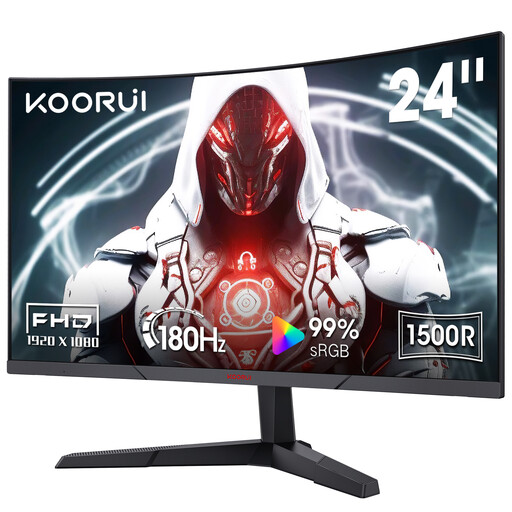
KOORUI MG24A12FV2 24-inch curved Full HD VA
The 24-inch format is worth considering when a larger monitor would crowd your desk, provided you accept less fine detail than QHD or 4K.
The product title specifies 180Hz, a 1500R curve, Adaptive Sync and VESA compatibility. Check the footprint and the refresh mode available through your chosen connection.
Joybuy
Common questions
Is a 27-inch gaming monitor too large for a small desk?
Not necessarily: a 27-inch monitor can work if its stand leaves enough usable depth and you can sit at a comfortable distance. Measure the exact model rather than relying on the diagonal; BenQ, for example, lists the EX2710Q at 252.5 mm deep with its stand.
Should I choose QHD or 4K for open-world games?
Choose QHD if you want more detail than Full HD while keeping graphics demands below those of 4K; consider 4K if fine scenery detail takes priority and your hardware can deliver the performance you expect. RTINGS notes that the suitable resolution and refresh combination depends on the games you play and your budget.
Will an HDMI 2.1 port let every device use the monitor’s highest refresh rate?
No: the exact monitor port, cable and source device must all support the mode you want. Dell, for example, specifies up to QHD 180Hz through DisplayPort on the G2725D, but up to QHD 144Hz through its HDMI ports.
How should I dispose of an old monitor in the UK?
Check an electrical-equipment collection or retailer take-back route before disposing of it. GOV.UK describes the UK’s waste electrical and electronic equipment framework as supporting recovery, reuse and recycling; confirm that your chosen collection point accepts monitors before travelling.


