Small-desk report reviewers
If you mainly read survey tables, annotate findings and use a mouse for filters or charts, keeping space beside the keyboard may matter more than having a dedicated number pad.


Choose a compact keyboard without a number pad if reviewing survey results mainly means reading tables, writing comments and using a mouse for charts and filters. If you regularly enter or check figures, a compact keyboard with an integrated number pad gives you direct number entry but takes more desk width. Check the exact footprint, key layout and connection against your workspace and work devices before deciding.
If you mainly read survey tables, annotate findings and use a mouse for filters or charts, keeping space beside the keyboard may matter more than having a dedicated number pad.
If you repeatedly enter response codes, totals or spreadsheet figures, direct access to a number pad may justify a wider compact layout.
If you move between a computer and portable devices, check whether a keyboard can connect to each one using methods your workplace permits.
Start with how often you enter figures: that determines whether a number pad earns its place on a small desk. Then compare the keyboard's footprint and connections with the space and devices you actually use.
| Concern | What to check | Who this matters to |
|---|---|---|
| Desk and mouse space | Compare the keyboard's width and depth with the space available for your mouse and a hand-rest area in front. Check the actual key arrangement, not just a compact-layout label. | If I spend more time reading reports and working with charts than entering figures, I want room to use my mouse comfortably; around 44% of consumers put desk and mouse space first. |
| Direct numeric entry | Check whether there is an integrated number pad and whether the resulting keyboard width fits your desk. | When I repeatedly check totals or enter response codes, I want number keys within direct reach; roughly 33% of consumers make direct numeric entry their main concern. |
| Device and layout fit | Confirm the physical UK key layout, supported connection method and compatibility with your work devices and workplace rules. | If my survey work moves between devices, I need a connection and key layout that suit each setup; about 23% of consumers prioritise device and layout fit. |
A compact board may omit a number pad or place navigation functions differently. A QWERTY label alone does not establish that the physical layout is UK-ISO.
Inspect photos and the exact variant label for the keys you use. If you need UK-ISO, select a version explicitly identified as such.
A keypad-free layout leaves more flexible desk space, but repeated entry of survey figures is less direct without an integrated number pad.
Think through a typical review session. If entering or validating figures is a regular task, compare compact boards with integrated number pads as well as smaller layouts.
A separate numeric keypad is another item to place and connect if the chosen layout does not meet your number-entry needs.
Keyboard size is only one part of a screen-work setup. The Health and Safety Executive advises leaving space in front of the keyboard for resting hands and wrists and keeping wrists straight while keying.
Arrange the keyboard, mouse and other equipment together. For work involving daily display-screen use in continuous periods of an hour or more, the Health and Safety Executive says employers must assess the workstation.
Bluetooth, USB-receiver and wired options differ by model, while workplace rules may restrict wireless peripherals.
Before ordering, check your devices' supported connections, available ports and workplace policy. If a cable is necessary, confirm that the particular keyboard offers a wired mode.
Its compact models illustrate different ways to balance mouse space, device switching and direct number entry.
A reference point for UK-ISO options and compact mechanical layouts that can retain a number pad.
The KW 9200 MINI is relevant when connection choice matters more than an integrated number pad.
These keyboards offer compact layouts to consider for a small survey-review desk. Compare the room each leaves for your mouse with the keys you need for entering figures and navigating reports; the listed models do not all serve those tasks in the same way.
 No image available
Consider this model if you enter survey figures regularly but still need to fit a mouse beside the keyboard. Check its full footprint and number-pad placement against your available space, and confirm compatibility with your work devices.
 No image available
For mouse-led review, compare this compact layout with the space and navigation keys you need. Check its wired connection against your computer's available ports before ordering.
 No image available
This 60% layout is worth considering when mouse space matters more than dedicated keys. Check how you would access the navigation functions used in reports, and confirm the physical key layout you require.
 No image available
Consider this wireless model if you review results across compatible devices and want a compact key arrangement. Check its physical dimensions against your desk and inspect the exact keys if direct number-pad access matters.
 No image available
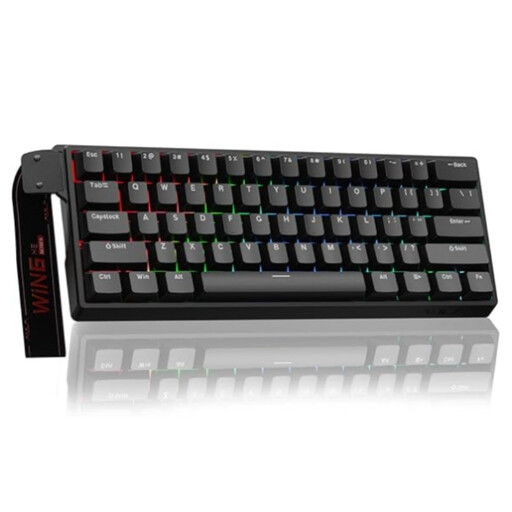
For a fixed computer setup, this 60% wired model may suit mouse-led survey review. Check its dimensions, physical key layout and access to navigation keys before choosing it for report work.
Not if you mainly read, comment on and filter results. If you frequently enter or validate figures, compare compact keyboards with integrated number pads: Logitech identifies the K780 as a compact model with a number pad, and Keychron specifies one on its 96% K17 Max.
Choose a connection your work devices and workplace rules allow. If you need more than one option, CHERRY specifies Bluetooth, 2.4 GHz wireless and wired modes for the KW 9200 MINI; check device compatibility and available ports for the exact model you buy.
Consider the whole workstation, not just the keyboard. The Health and Safety Executive says employers must assess workstations for workers who use display screen equipment daily in continuous periods of an hour or more; it also advises space in front of the keyboard for resting hands and wrists and straight wrists while keying.
Use a suitable electrical-equipment collection or recycling route rather than putting it in general waste where such a route is available. UK government guidance explains that the waste electrical and electronic equipment regime encourages recovery, reuse and recycling.