Small-batch dessert planners
If you are making one topping, dessert or fruit component, a smaller tin may leave less to store after preparation. Match the fruit amount to the dish rather than relying on tin size alone.


For one small festival-food topping or dessert, start with a 220–227g tin if you want to limit opened leftovers. Check the drained weight where it is given, then choose slices, pieces or mixed fruit to suit the dish; a larger tin makes more sense when you have a plan for sharing or storing the remainder.
If you are making one topping, dessert or fruit component, a smaller tin may leave less to store after preparation. Match the fruit amount to the dish rather than relying on tin size alone.
A tin can be stored unopened before the event. If you will not use all its contents at once, plan how to refrigerate and use the remainder according to that product's label.
The choice is not just pineapple versus peaches: pieces, slices and mixed fruit serve different dishes. Packing liquid, ingredients, nutrition and drained weight also need checking on the exact tin.
Decide how much fruit the dish needs, then check its shape and packing liquid on the tin you intend to use.
| Concern | What to check | Who this matters to |
|---|---|---|
| Opened leftovers | Compare the amount your dish needs with the pack size and drained weight, where stated. Gross weight includes the packing liquid. | Making one small topping can leave part of a larger tin unused, with nowhere convenient to keep it. About 42% of consumers put limiting opened leftovers first. |
| Fruit shape | Look for slices, pieces, chunks or fruit cocktail according to how you will serve the dish. | If the fruit needs to be mixed through a dessert, slices may not give the intended finish; a topping may call for a recognisable piece. Getting the right format comes first for about 33% of consumers. |
| Packing liquid and label | Check whether the exact variant is in juice or syrup, then compare its ingredients and nutrition panel. | When a recipe calls for a particular liquid, or I want to compare what is in the tin, pack size cannot answer that question. For about 25% of consumers, the liquid and label are the primary concern. |
The liquid counts towards the total. Sainsbury's lists its Del Monte pineapple chunks tin as 435g overall but 260g drained, a distinction that matters if the dish specifies an amount of fruit.
Use drained weight for planning where the label supplies it, and check the amount your recipe actually requires.
Tesco Groceries lists 220g fruit cocktail and peach slices alongside 227g pineapple slices, with products described as packed in juice or light syrup. A suitable tin size does not settle the fruit shape or liquid.
Choose the fruit and shape for the dish first, then confirm the packing liquid on that variant.
Opened-fruit directions differ by product. Sainsbury's says to transfer its 227g pineapple pieces to a non-metallic container, refrigerate and use within three days; its Del Monte pineapple chunks listing gives a three-to-four-day period after transfer and refrigeration. Food Standards Scotland advises following the label's storage and open-life instructions.
Arrange refrigerated storage before opening a tin you may not finish, and follow the directions on the exact pack.
Tesco Groceries lists its own-label Pineapple Slices In Juice 227G alongside larger pineapple tins.
Tesco Groceries lists Princes fruit cocktail and peach slices at 220g, plus pineapple slices at 227g.
Tesco Groceries lists 227g Del Monte peach slices, while Sainsbury's lists Del Monte pineapple chunks at 435g overall and 260g drained.
Sainsbury's describes its Pineapple Pieces in Juice 227g as a one-serving pack and lists pineapple and pineapple juice as ingredients.
The M&S tinned-fruit category lists 560g rhubarb chunks and 540g grapefruit segments.
The 220g peach-slice tin suits a small fruit component; the larger tins are options when you are making a shared dish or have a plan for the remainder. Choose the fruit shape as well as the tin size.
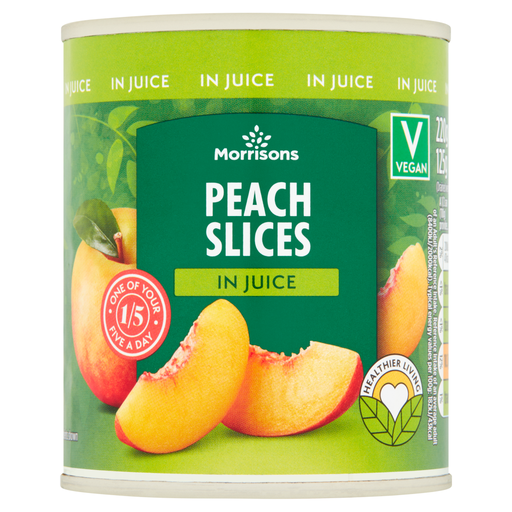 No image available
Consider this smaller tin for a peach-slice topping or dessert where you want to limit the amount left open. Its stated 220g weight is for the tin's contents, so check the pack's drained weight if the dish needs a precise amount of fruit.
 No image available
Pineapple chunks can be mixed into a shared fruit dessert or salad. This 432g tin is a larger choice than a small single-dish format; decide how you will use any remainder and follow its opened-storage directions.
 No image available
Choose slices when the dish calls for visible pieces of pineapple. At 435g, this tin is more suited to a larger preparation or planned further use than one small topping; check the drained weight on this exact pack before measuring fruit for a recipe.
 No image available
Mixed fruit is an option for a shared dessert when you do not need one fruit type or a particular slice shape. This 415g tin may leave a remainder after a small dish, so check its storage directions before opening it.
 No image available
Peach halves suit a dish that calls for larger, recognisable fruit pieces. The 415g tin is a larger format than the small single-dish options; compare the pack's drained weight with your recipe and check how to store anything left over.
Compare the amount your dish needs with the exact pack's serving statement and drained weight, where supplied. Sainsbury's calls its Pineapple Pieces in Juice 227g a one-serving pack, while its Del Monte pineapple chunks listing distinguishes 435g overall from 260g drained.
Choose the packing liquid that fits your recipe or preference, then compare the ingredients and nutrition panel on the exact variant. Sainsbury's lists pineapple and pineapple juice in its 227g pineapple pieces; Tesco Groceries also lists small-format fruit described as packed in light syrup.
Follow the exact product label rather than applying one tin's open-life period to another. Sainsbury's directs you to transfer its 227g pineapple pieces to a non-metallic container, refrigerate and use within three days; its Del Monte pineapple chunks listing calls for covered, refrigerated storage and use within three to four days. Food Standards Scotland also advises checking label-specific storage instructions.
No. UK government food guidance says acceptability after a best-before date depends on the product, storage conditions and brand. Once the tin is open, follow the manufacturer's open-life instructions.