What to check before choosing
Choose the panel and resolution that match your games and PC, then check the physical fit and the signal modes available from each device.
Roughly 27-inch 4K OLED
Choose it when: 4K detail and OLED contrast are central to the cinematic games you play, and your PC can make useful use of 4K.
Accept: Static-image care remains part of OLED ownership; protection features do not eliminate image-retention risk.
Roughly 27-inch QHD OLED
Choose it when: You want OLED contrast but do not plan to run games at native 4K.
Accept: QHD has fewer pixels than 4K, and the panel still needs attention to prolonged static content.
Roughly 27-inch 4K IPS
Choose it when: Native 4K detail matters but you prefer an IPS panel to an OLED one.
Accept: Do not assume the same dark-scene appearance as OLED from a 4K resolution or HDR badge alone.
| Concern |
What to check |
Who this matters to |
| Cinematic image |
Compare native resolution, panel type and the exact model’s HDR specification; check whether your PC can run your intended settings. |
If dark scenes and fine environmental detail draw you into a game, you may put image presentation ahead of other features. Around 33% of consumers put cinematic contrast and detail first. |
| Desk fit |
Measure usable depth and cable clearance; compare the supplied stand or check VESA compatibility for an arm. |
When the keyboard already takes up a shallow desk, the base can matter as much as the screen diagonal. Roughly 33% of consumers make fit and sharpness their primary concern. |
| Device compatibility |
Check the resolution, refresh rate and VRR supported by the intended input, source device and game. |
If you switch between a PC and a console, you need the intended video mode to work on the port you will actually use. Around 17% of consumers prioritise platform compatibility. |
| Static use and energy |
Read OLED-care and warranty terms; compare available energy-label figures in kWh per 1,000 hours. |
If work windows or paused menus remain on-screen, panel care may shape your choice more than peak refresh rate. For about 17% of consumers, static-use and ownership considerations come first. |
Joybuy product choices
These choices cover a QHD OLED route and two 4K IPS routes for cinematic gaming at a roughly 27-inch desk setup. Compare their native resolutions and panel types before deciding which route fits your priorities.
 No image available
MAG 274QP QD-OLED X24, 27-inch QHD
Consider this QHD OLED model if OLED contrast matters more to you than native 4K detail.
The product name specifies 2560 × 1440 resolution, 240Hz and Adaptive-Sync. Check the stand footprint and the exact OLED warranty terms against your desk and usage plans.
View on Joybuy
 No image available
LG UltraGear G8 27G850A, 27-inch 4K Nano IPS
Consider this IPS model if native 4K detail is important and you prefer not to choose an OLED panel.
The product name specifies dual modes of 4K at 240Hz and Full HD at 480Hz, plus DisplayHDR 600, DisplayPort 2.1 and HDMI 2.1. Measure your desk before relying on the supplied stand, and check the energy label for the exact model.
View on Joybuy
 No image available
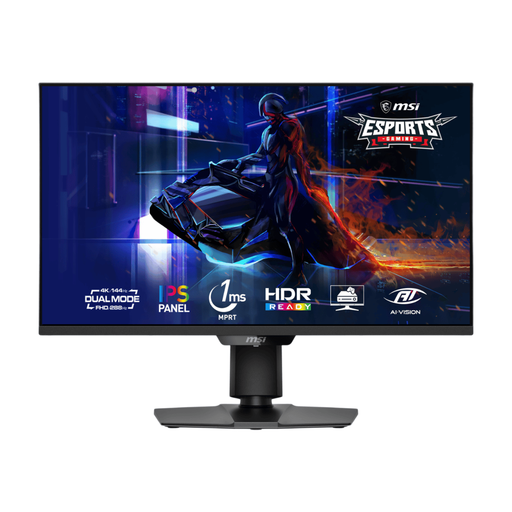
MSI MAG 275UPD E14, 27-inch 4K
Consider this 4K IPS route if you want native 4K detail alongside a high-refresh gaming mode.
The product name specifies 4K at 144Hz and a Full HD 288Hz mode. Check the stand footprint and energy label for your setup; the HDR Ready description alone does not establish how HDR games will look.
View on Joybuy
Frequently asked questions
Should I choose 4K or QHD for cinematic games at a small desk?
Choose 4K if native detail is your priority and your PC can run your games at settings you find acceptable; choose QHD OLED if you want OLED contrast without planning around native 4K output. Joybuy Insights notes that achieving high frame rates at 4K calls for a capable graphics card.
Will a PS5 use a monitor’s 120Hz and VRR modes?
A PS5 offers settings for 120Hz output and VRR, but the result depends on the game and the connected display’s supported modes. Sony advises checking the relevant output settings; before buying, confirm the intended resolution, HDMI input, 120Hz, VRR and HDR combination in the monitor’s documentation.
Can I choose OLED if I also work at this desk?
You can consider OLED, but prolonged static desktop content makes panel care and warranty terms important to the decision. ASUS advises using OLED-care features, setting a shorter screen-sleep time and avoiding the same maximum-brightness image for long periods; compare IPS too if static work dominates your use.
What energy and disposal information should I check?
Compare the exact monitor’s energy label, including its stated consumption in kWh per 1,000 hours, when assessing energy use. GOV.UK identifies monitors as electrical and electronic equipment within the UK WEEE framework; when disposing of one, check the electrical-equipment collection options offered by your local authority or retailer.


