What matters when choosing
Countertop dishwasher
Choose it when: Your regular load is small and you have a suitable worktop position but no full appliance bay.
Allow for: Lost worktop space, limited loading room and the exact model’s filling and drainage arrangements.
Freestanding slimline dishwasher
Choose it when: A permanent narrow appliance space lets you combine breakfast dishes with a larger daily load.
Allow for: Floor space and access to water, a drain and power.
Integrated slimline dishwasher
Choose it when: A kitchen installation or refit includes a suitable cabinet opening and furniture door.
Allow for: A closer match between the appliance, niche, hinges and door panel than a freestanding installation requires.
Once you know where the dishwasher can go, check its usable loading space and connections before comparing programmes or energy-label figures.
| Concern |
What to check |
Who this matters to |
| Footprint and placement |
Measure width, height and depth, including door-opening and hose clearance. Compare full model dimensions, not just a 45 cm or countertop description. |
I need the dishwasher to fit without taking over the only useful preparation area or blocking a cupboard. Around 33% of consumers put physical fit first. |
| Room for the daily load |
Check basket layout against your largest bowl, mugs and any cookware. The place-setting definition includes plates, a bowl, glassware, a cup, saucer and cutlery—not a count of bowls alone. |
Breakfast dishes may be only the start of what I want to wash together, so loading space matters more to me than a small footprint alone; around 27% of consumers make capacity their primary concern. |
| Water and installation |
Confirm whether the exact model uses a manual-fill tank, a tap connection or permanent plumbing, and how waste water is drained. The product information advises checking space and access to power, water and drainage for a conventional installation. |
Without a workable connection, the appliance cannot serve my routine, however well it fits. For around 27% of consumers, installation feasibility comes first. |
| Programmes and label figures |
Check rapid-programme soil conditions separately from Eco-programme consumption. GOV.UK dishwasher-label data specifies energy use in kWh per 100 cycles and water use in litres per cycle; compare noise figures on the same label basis. |
Once I know the machine will fit and connect, I want a cycle suited to lightly soiled dishes and label figures I can compare. Around 13% of consumers prioritise these operating details. |
Relevant dishwasher brands
These brands provide examples of the formats and features to compare; their specifications apply to the named models or ranges, not every dishwasher bearing the brand.
Beko
Beko offers freestanding slimline dishwashers for narrow permanent appliance spaces.
- Beko specifies a 44.8 cm width, 10 place settings and an adjustable upper basket for the BDFS16030.
- Beko describes that model’s 30-minute programme for lightly soiled loads; check the conditions and dimensions of any different model separately.
Bosch
Bosch’s built-in range includes 45 cm and 60 cm options for cabinet-led kitchen designs.
- Bosch distinguishes standard and tall installation heights, giving renovators a reason to check the exact cabinet opening.
- The compact SKS62E32EU reference model is marked by Bosch as no longer available; its specifications should not be treated as those of a current alternative.
Miele
Miele has a 45 cm freestanding slimline option with specified basket, programme and drying features.
- Miele lists a cutlery tray, ExtraComfort baskets, QuickPowerWash, AutoOpen drying and 44 dB noise for the G 5740 SC SL.
- Those are specifications for the G 5740 SC SL; check its complete dimensions and energy-label figures against your kitchen and other candidates.
Joybuy dishwashers for small kitchens
These Joybuy choices cover freestanding slimline machines for a permanent narrow space, an integrated model for a suitable cabinet installation and a countertop model for a smaller routine load. Choose the format before comparing individual features.
 No image available
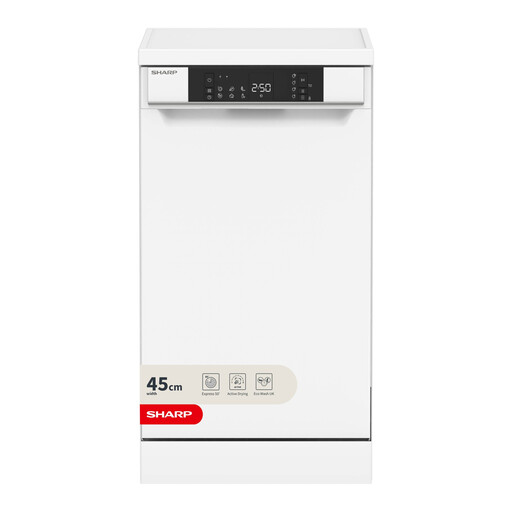
Sharp QW-NS1EF49E0W-EN 45 cm dishwasher, white
Consider this model if you have a permanent narrow appliance position rather than worktop space for a countertop machine. The product name states 49 dB and an E energy rating; check the current energy label and the full height and depth against your space.
Confirm water, drainage and power access, and check the programme instructions before relying on a short cycle for your usual dishes.
View on Joybuy
 No image available
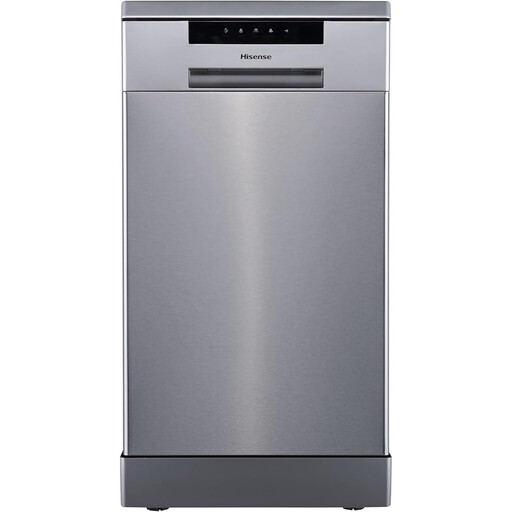
Hisense HS523E15XUK 45 cm freestanding dishwasher, stainless steel
This freestanding slimline model is a candidate for a permanent narrow space when breakfast dishes will be washed with a larger daily load. Its product name states nine place settings and an E energy rating.
Check the full installation dimensions and water, drain and power access. If a short cycle matters, confirm its duration and suitable soil level in the programme instructions.
View on Joybuy
 No image available
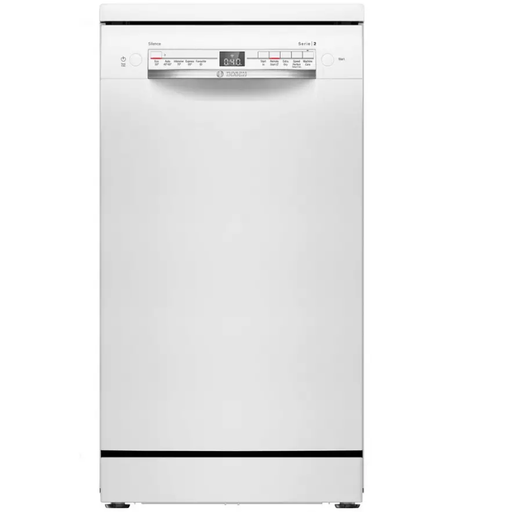
Bosch SPS2IKW01G 45 cm freestanding dishwasher, white
Consider this slimline model for a permanent narrow appliance space and a mixed daily load. Its product name states nine place settings and identifies Home Connect and ExtraDry features.
Check the current energy label before comparing running figures, as the available product descriptions give conflicting energy classes. Confirm the full installation space, connections and available programmes as well.
View on Joybuy
 No image available
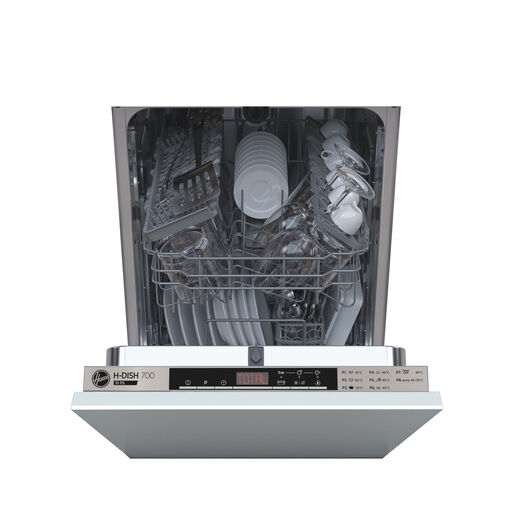
Hoover HDIH 2T1047-80 H-Dish 500 integrated slimline dishwasher
This integrated model is relevant when a kitchen refit or existing cabinet system can accommodate it. The product name states 10 place settings and an E energy rating.
Compare the installation drawing with the niche and furniture door, including the required clearances and hinge arrangement. Check the programme instructions if a rapid wash is important.
View on Joybuy
 No image available
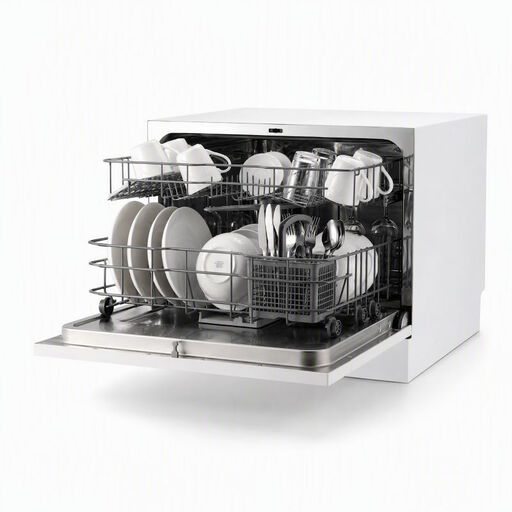
ochama Mini Tabletop Dishwasher, six place settings
This countertop model is worth considering for a small routine load when a full appliance bay is unavailable. Its product name states a 30-minute quick wash, a 24-hour delayed start and eight functions; check which dishes and soil levels suit the quick programme.
Measure the worktop and required clearances, and confirm the water-supply and waste-water arrangements before choosing it. Do not assume that a tabletop model has a manual-fill tank.
View on Joybuy
Common questions
Is a countertop dishwasher enough for breakfast bowls?
It can be enough when your regular load is only a few bowls, mugs, glasses and pieces of cutlery. Compare the interior layout with your own dishes:the product information lists a tabletop example with six place settings, while the Joybuy-listed Comfee CDWMT201DW-UK is a smaller model stated to hold around two to three. The word ‘compact’ alone does not establish usable capacity.
Can I use a dishwasher without a permanent water connection?
Some portable models permit manual filling, but countertop dishwashers do not all work that way. The Joybuy-listed Comfee CDWMT201DW-UK specifies a 5-litre manually filled tank and an alternative tap connection; check the chosen model’s filling instructions, power requirements and waste-water route.
What do I need for a conventional dishwasher installation?
You need a location that fits the appliance and provides access to power, a water supply and a drain, as the installation guidance explains. Check the model’s full dimensions and hose routes; an integrated machine also needs a compatible niche and furniture-door arrangement.
Which energy-label figures should I compare?
For UK dishwasher labels, compare like-for-like Eco-programme figures, including energy use in kWh per 100 cycles and water use in litres per cycle. GOV.UK’s dishwasher-label data also covers rated capacity, programme duration and noise emissions. A quick-wash duration describes a different programme and should be checked against its own load and soil conditions.


