Tight-space batch cooks
If you portion mash or other leftovers but have limited kitchen space, measure the opening beneath the worktop as well as the space needed behind the appliance and in front of its open door.


Start with a freestanding under-counter freezer if you have a measured space beneath a worktop and want dedicated storage for portions of cooled mashed potato. Check the full installation space, door swing and drawer layout before choosing by capacity; a built-under model needs a compatible cabinet arrangement. If avoiding manual defrosting or regularly adding several cooled portions matters to you, compare those features on the exact model rather than assuming all compact freezers include them.
If you portion mash or other leftovers but have limited kitchen space, measure the opening beneath the worktop as well as the space needed behind the appliance and in front of its open door.
If you store mash alongside other frozen food, compare the freezer’s stated capacity and internal layout with the containers or bags you intend to use.
If day-to-day maintenance matters, compare each model’s defrost method, energy information and noise figure after confirming that it fits your kitchen.
Confirm that the freezer can be installed and opened in your kitchen, then compare space for portions and the upkeep required by the exact model.
| Concern | What to check | Who this matters to |
|---|---|---|
| Fit and door swing | Measure height, width and depth; check the model’s installation clearances and whether the door and drawers can open fully. | I have a narrow gap and cannot use a freezer whose door blocks the kitchen, even if its width fits. Around 36% of consumers would put correct fit and access first. |
| Portion storage | Compare stated freezer capacity and drawer dimensions with the containers or bags you plan to freeze. | When I freeze several portions at once, I need room to keep them accessible alongside other food. Usable storage would be the main concern for around 36% of consumers. |
| Upkeep and energy use | Check the exact defrost method, energy label and annual kWh figure; consider a documented fast-freeze function if you often add several cooled portions. | I want to know how much defrosting a compact freezer requires and what its energy information says before choosing one. For around 28% of consumers, ongoing upkeep and use would come first. |
A freezer can fit between cupboards yet leave too little room for rear obstructions or for its door to open. General freezer measurement guidance also calls attention to depth and door clearance.
Measure the whole opening, note sockets and pipework, and compare your measurements with the exact model’s installation instructions.
Frost-free, auto-defrost and Low Frost are different descriptions. For example, the Indesit I55Z1 112S UK is listed as Low Frost, without a No Frost system.
Check the defrost method for the model you intend to buy and follow its manual for maintenance.
A model requiring manual defrosting also requires time for that task.
External dimensions do not tell you whether your mashed-potato containers fit in the available compartments.
Compare stated freezer capacity and the internal layout with the size and number of portions you expect to store.
Energy Saving Trust explains that appliance labels include energy-use information as well as an A–G efficiency rating. The class alone does not tell you which suitably sized freezer meets your storage needs.
Once you have identified models that fit, compare their stated annual kWh figures, capacity and noise information.
These examples illustrate model-specific features to compare, not features shared by every freezer from each brand.
Beko has freestanding under-counter models relevant to kitchens with a measured space beneath the worktop.
The freestanding GTV15NWEBG gives buyers a documented compact model to measure against their available space.
The I55Z1 112S UK is a freestanding under-counter example for buyers comparing storage layout and frost management.
These choices include a built-under freezer for a compatible cabinet arrangement and a freestanding under-counter freezer. Check which installation type suits your kitchen before comparing their features.
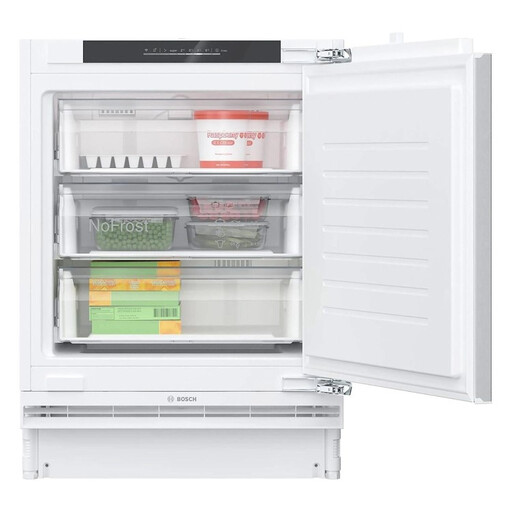 No image available
Consider this built-under model if your kitchen has a compatible cabinet arrangement; check the furniture-door fit, ventilation requirements and available opening before ordering.
The product name specifies No Frost and an E energy rating. Compare the product fiche if annual energy use affects your choice.
 No image available
Consider this freestanding format if you have space beneath a worktop. Check the exact installation clearances and door opening against your kitchen layout.
The product name states 85 L, 55 cm and an E energy rating. Confirm the usable capacity and internal layout against the containers you intend to freeze; allow for the manual defrosting described for this model.
Start with the measured opening, not an under-counter category label. Beko specifies its UFS4584 at 84 × 54 × 59 cm, while Bosch specifies its GTV15NWEBG at 85 × 56 × 58 cm; also check the selected model’s required clearances and door swing.
Choose a compartment documented for the frozen-food storage you need rather than assuming any ice box is equivalent to a freezer. Check the appliance’s freezer rating and instructions before relying on it to store portions.
Cool it promptly before putting it in the fridge or freezer. NHS guidance for children’s food says to cool food as quickly as possible, ideally within 1 to 2 hours; it also advises using frozen food within 24 hours of defrosting, or straight away if defrosted in a microwave.
Compare annual energy use among models that fit your kitchen and provide enough storage. Energy Saving Trust explains that the A–G label includes information beyond the efficiency class; capacity and noise are also useful checks when choosing a specific freezer.