Small-gap kitchen shoppers
If you are replacing an appliance in a narrow or awkward opening, its closed-door dimensions are only part of the fit. The hinge, open door and ventilation space also have to work in that position.


For an open gap in a small kitchen, start with a narrow freestanding fridge-freezer whose full installation clearances and door swing fit the space; choose an integrated model only if it matches an existing tall cabinet and hinge system. For cucumber slices, check usable fridge space for a covered container and monitor the compartment with a fridge thermometer. Frost Free can reduce freezer maintenance, but it does not replace those storage checks.
If you are replacing an appliance in a narrow or awkward opening, its closed-door dimensions are only part of the fit. The hinge, open door and ventilation space also have to work in that position.
If you regularly chill prepared cucumber slices and other vegetables, look beyond total capacity. Fridge space, drawer layout and room on the shelves for your covered containers matter more directly.
If avoiding manual freezer defrosting is important to you, consider Frost Free after checking that the appliance fits and still leaves enough space for chilled food.
Decide whether the appliance belongs in an open gap or an existing tall cabinet, then compare the space available for chilled food and the freezer maintenance you are willing to do.
Consider it when: You have an open floor-space gap and do not want to alter fitted cabinetry.
Allow for: The door swing and model-specific ventilation space, which can make the required opening wider than the appliance itself.
Consider it when: You already have a suitable tall cabinet and want the appliance behind its door.
Allow for: The exact cabinet aperture, hinge system and installation requirements; an integrated model is not a substitute for a freestanding appliance in an open gap.
| Concern | What to check | Who this matters to |
|---|---|---|
| Fit and access | Measure width, height and depth at the tightest point. Compare the exact model’s door-opening and ventilation requirements with the available space; for an integrated model, check the cabinet and hinges too. | If I have a narrow opening, I need to open the fridge and reach its shelves without the door hitting a wall or cabinet. Around 42% of consumers put workable fit and access first. |
| Chilled-food space | Compare fridge litres separately from freezer litres, then inspect the drawer and shelf layout for your usual lidded containers. Check the temperature with a fridge thermometer. | When I prepare cucumber in advance, I want covered slices to have a convenient place in the fridge rather than relying on the total appliance capacity. For around 33% of consumers, usable chilled storage is the primary need. |
| Freezer maintenance | Check whether the exact model is Frost Free or Low Frost, and compare its energy label and product information where applicable. | If I want to spend less time defrosting the freezer, I still need the fridge compartment and installation fit to work for me. Avoiding freezer-maintenance work comes first for around 25% of consumers. |
A narrow fridge-freezer can still be unsuitable if its door cannot open fully or it lacks the ventilation space required for that model.
Measure the available opening at its tightest point and compare it with the exact appliance dimensions and installation instructions before ordering.
Total capacity combines chilled and frozen storage. It does not tell you whether the fridge shelves and drawer will accommodate containers of prepared cucumber.
Compare the fridge and freezer volumes separately, then check the shelf and drawer layout against the containers you normally use.
Frost Free concerns freezer defrosting. It does not establish the temperature inside the fridge or keep uncovered prepared food protected.
Use a fridge thermometer and keep prepared cucumber slices in a clean, covered container. The Food Standards Agency identifies 5°C as the maximum recommended fridge temperature.
A model can remain useful for comparing dimensions after it leaves a manufacturer’s catalogue; Hotpoint identifies the HBNF 55181 S UK as no longer in its catalogue.
Before ordering any exact model, check its current listing, energy label, warranty and delivery or installation terms.
A reference point for comparing the dimensions and separate compartment volumes of a narrow freestanding model.
Relevant if reducing manual freezer defrosting is part of your choice between suitable fridge-freezers.
Relevant when a small kitchen has an existing tall housing unit for an integrated fridge-freezer.
Its HBNF 55181 S UK provides an example of a 54 cm-wide freestanding format for comparing space and compartment allocation.
These choices include narrow freestanding models for open gaps and an integrated model for a compatible tall cabinet. Compare each appliance with your measured space and the room you need for covered fresh-food containers.
 No image available
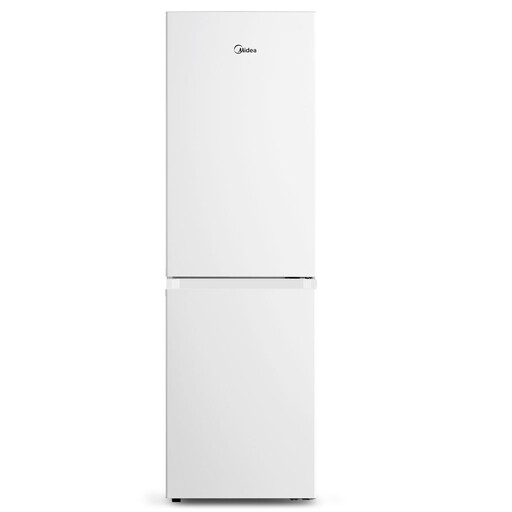
Consider this freestanding model if you need a narrow opening for chilled produce storage. Its listed width is 55 cm and it is described as Total No Frost; check the door swing and ventilation requirements before deciding whether it fits.
Confirm the energy rating against the exact model’s energy label before comparing running information.
 No image available
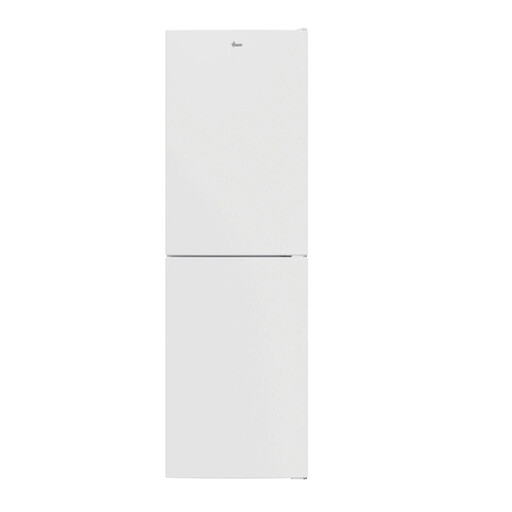
Consider this freestanding model for an open gap where container access matters. Its title lists a height of 176 cm, a width of 55 cm and an E energy rating; measure for door opening and ventilation as well.
Low Frost should not be treated as a promise that manual freezer defrosting will never be needed.
 No image available
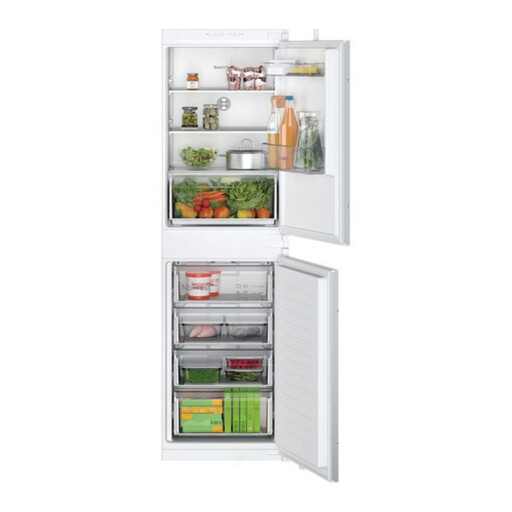
Consider this model only for a compatible tall cabinet, rather than an ordinary open gap. Its title lists a 177 cm height, 249 L total capacity, a 50/50 format and an E energy rating.
Check the exact cabinet aperture, sliding-hinge compatibility and ventilation instructions before ordering.
 No image available
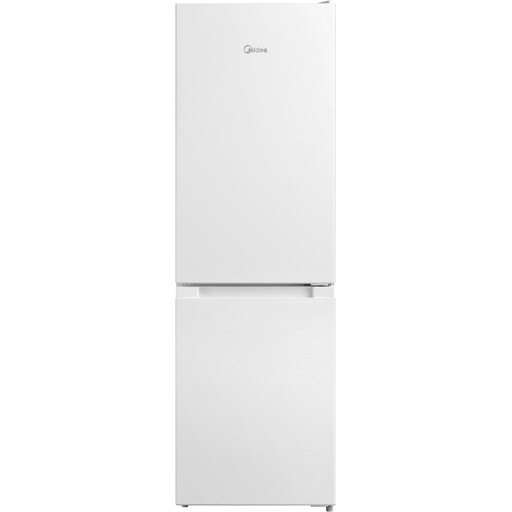
Consider this model when a narrower open gap limits your choices. Its title lists a 50 cm width and an E energy rating; compare its installation requirements with your measured space.
If freezer maintenance affects your choice, confirm the exact defrost system for this model before buying.
 No image available
Consider this model if the open gap is particularly narrow. Its title lists a 47 cm width, 144 cm height and E energy rating; confirm the full installation space before choosing it.
Low Frost does not establish that manual defrosting is unnecessary. Check that the fridge layout accommodates your usual covered containers.
Aim for 5°C or below and check it with a fridge thermometer. The Food Standards Agency identifies 5°C as the maximum recommended fridge temperature; keep prepared cucumber slices in a clean, covered container rather than assuming a fridge-freezer feature confirms their storage temperature.
No: compare the dimensions of the exact model, not the word “slim” or a nominal width. Which? has reported testing fridge-freezers ranging from 48 cm to 93 cm wide; the space you need also depends on that model’s door opening and installation clearances.
Only if its installation instructions permit that arrangement. Measure the gap and check the exact model’s required ventilation and door-opening space before purchase; its stated cabinet width alone cannot establish a safe fit.
For an in-scope new fridge-freezer, compare the exact model’s energy label and product information sheet rather than inferring energy use from its width or brand. UK government guidance from the Department for Energy Security and Net Zero and the Office for Product Safety and Standards says in-scope products must display an energy label at the point of sale, including online.