One-pan small-kitchen cooks
If you make stir-fry in one wok or frying pan and put the hob away afterwards, a single-zone induction model is a straightforward option—provided your pan is compatible.


For vegetable stir-fry in a small kitchen, start with a single-zone portable induction hob if you normally use one pan and its base is induction-compatible. A dual-zone model makes more sense when you regularly need a second pan, but takes up more worktop space; if keeping non-magnetic cookware is the deciding factor, consider a portable ceramic hob and check the exact model’s requirements. Before buying, confirm the pan fit, supplied plug, electrical load and space needed for safe use.
If you make stir-fry in one wok or frying pan and put the hob away afterwards, a single-zone induction model is a straightforward option—provided your pan is compatible.
If you often heat rice, sauce or vegetables alongside a stir-fry, two portable induction zones let you use a second pan. Allow for the appliance’s worktop footprint and its total power rating.
If replacing an aluminium, copper, glass or other non-magnetic pan is not appealing, a ceramic electric hob is worth considering. Check the cookware and operating requirements of the particular portable model.
Choose the number of zones around how many pans you actually use, then check whether your existing cookware works with the hob type. In a small kitchen, the space needed to cook safely matters as well as the space needed to store the appliance.
| Concern | What to check | Who this matters to |
|---|---|---|
| Controllable heat | Compare the exact model’s power settings and stated pan-base size range; a wattage alone does not establish stir-fry results. | If I cook vegetables in one pan, I want to adjust the heat as the food cooks. Roughly 36% of consumers would put one-pan heat control first. |
| Worktop space and storage | Check the full width and depth, plus the space the hob needs for ventilation on a stable, heat-resistant surface. | When my worktop must be cleared after cooking, I need a hob I can use and store without crowding the kitchen. Around 29% of consumers would make compactness their primary concern. |
| A second cooking zone | Check the appliance’s total rating, how the zones share output and whether two pans fit on the available worktop. | If I prepare rice or sauce while stir-frying, using a second pan matters more than the smallest footprint. About 21% of consumers would prioritise two-pan cooking. |
| Existing cookware | Test the intended pan’s base with a magnet before choosing induction; for ceramic, check the exact model’s cookware guidance. | If my preferred pan is not induction-compatible, I would rather assess a ceramic hob than replace it. Roughly 14% of consumers would put cookware compatibility first. |
An induction hob needs compatible cookware. CIARRA Appliances UK specifies a magnetic base and a 12–26 cm cookware range for its CBTIH1-OW model; another hob may have different requirements.
Test your intended pan with a magnet and compare its flat base with the exact model’s stated size range.
An incompatible pan may mean using different cookware.
A dual-zone hob gives you another cooking position, not necessarily two positions that can each use the appliance’s full rated output. CIARRA Appliances UK gives the CUTIH2-OW a 2800 W total rating.
Choose two zones if you regularly cook a side at the same time; otherwise, compare single-zone models against your available worktop and storage space.
Electrical Safety First warns that overloaded sockets and extension leads pose a fire risk. It gives a single socket’s limit as 13 A, or about 3 kW, and notes that some extension leads have lower ratings.
Check the hob’s rating and the marked rating of any lead. Use a suitable wall socket where possible, and do not connect extension leads in a chain.
Stir-frying can leave splashes, while a crowded worktop can obstruct a portable hob’s ventilation. Electrical Safety First also warns about damaged leads and unattended appliances in kitchens.
Let the hob cool before cleaning it according to its manual, keep vents clear, inspect the cable and plug, and stay with the appliance while cooking.
Its IH201840 is a single-zone induction option for one-pan cooking.
Its portable range includes single- and dual-zone induction models; CIARRA also describes ceramic hobs for a wider choice of heat-resistant cookware.
Its PIC01BLMUK is a portable induction option for cooks interested in additional controls and accessories.
These portable, single-zone induction hobs are options to assess for vegetable stir-fry when you have a compatible pan. If using a second pan or keeping non-magnetic cookware is your priority, make that decision before comparing these models.
 No image available
Consider this for one-pan stir-fry if your pan has a compatible flat, magnetic base.
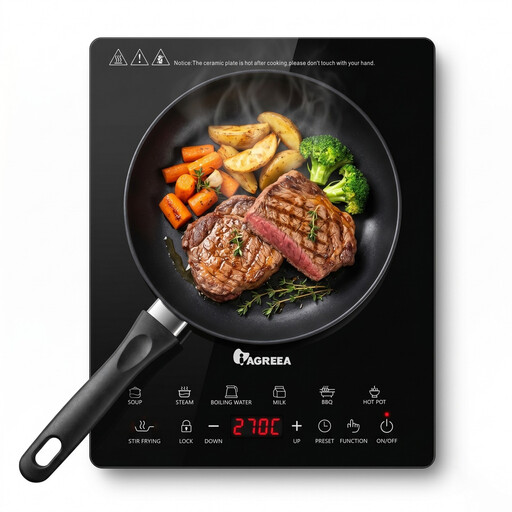
The product title specifies eight power levels, 60–270°C temperature control, seven preset functions, a three-hour timer and a 12–26 cm suitable cookware range.
Check the full worktop dimensions and supplied plug against your space and electrical setup before ordering.
 No image available
Consider this for one-pan cooking if you want adjustable settings and have induction-compatible cookware.
The product title specifies ten power settings, six functions, touch controls and a safety lock.
Confirm that your pan fits, and check the hob’s full dimensions and supplied plug for your kitchen.
It will work only if the wok is induction-compatible and its base fits the particular hob’s stated range. Test the base with a magnet, then check its flat contact area against the model’s cookware guidance; a ceramic electric hob is another option to assess if keeping a non-magnetic pan is essential.
Use a standard UK socket only when the particular hob is supplied and specified for that connection, following its instructions and checking its rating. Electrical Safety First gives a single socket’s limit as 13 A, or about 3 kW; avoid overloading it with other appliances.
Only use an extension arrangement that is suitable for the hob’s electrical load. Electrical Safety First advises checking the lead’s marked rating, avoiding overload and never connecting one extension lead to another; a suitable wall socket is preferable where possible.
Put it on a stable, heat-resistant surface with the ventilation space required by its instructions, away from water and trailing cables. Electrical Safety First advises keeping electrical equipment clear of kitchen water hazards and not leaving appliances unattended while they are in use.