Small-kitchen granola maker
If the worktop needs clearing after each batch, compare stored dimensions and decide whether a folding scale or a slim flat one fits your drawer or cupboard.


Choose the storage shape first: a folding scale suits a narrow drawer, while a slim flat scale needs a wider space but can store vertically. If a mixing bowl would cover the reading, consider a sliding or pull-out display instead. For honey and successive granola ingredients, look for tare or add-and-weigh operation, use gram readings, and check that the capacity accommodates your bowl and batch.
If the worktop needs clearing after each batch, compare stored dimensions and decide whether a folding scale or a slim flat one fits your drawer or cupboard.
If you add honey, oats, seeds and nuts to one bowl, a tare or add-and-weigh function lets you reset the reading between ingredients.
If your mixing bowl covers a conventional screen, consider a scale with a sliding or pull-out display that remains visible while the bowl is in place.
Check where the scale will be put away as well as where the bowl will sit: a small worktop does not necessarily mean a narrow drawer.
| Concern | What to check | Who this matters to |
|---|---|---|
| Storage footprint | Compare stored width, depth and height with your drawer or vertical storage space; check dimensions in the folded position where applicable. | I need to clear the worktop after making granola, so the scale must fit its storage space. Around 42% of consumers put the stored footprint first. |
| One-bowl weighing | Confirm tare or add-and-weigh operation, then compare maximum capacity with the weight of your bowl and intended batch. | When I add honey to the mixing bowl, I want to reset the reading before adding oats rather than use another container. Roughly 33% of consumers prioritise that one-bowl workflow. |
| Reading and cleaning | Check whether your usual bowl leaves the display visible and follow the model’s instructions for wiping up spills. | With a wide bowl in place, I need to see when to stop pouring honey and clean up any drips. Around 25% of consumers put bowl-side visibility and handling first. |
Stored shapes differ: Lakeland lists its EasyStore folding scale at 7 cm wide and 23 cm deep when folded, whereas Salter lists its Ultra Slim flat scale at 17.4 × 18.4 cm.
Measure the usable drawer width, depth and clearance, then compare all three with the scale’s stored dimensions.
A displayed increment does not establish how consistently a scale reads at different loads. Good Housekeeping UK describes repeating checks with calibrated 50 g, 500 g and 1,000 g weights in its scale testing.
If measurement consistency is important for your recipes, look for testing that explains its method as well as the stated increment, and weigh on a stable, level surface.
A wide bowl may cover the reading just as you approach the intended honey weight. Joseph Joseph describes a sliding display on Vision, while OXO describes a pull-out display designed to avoid bowl or plate shadowing.
Compare your bowl with product photos and dimensions, or choose a display designed to remain visible with a bowl in place.
An ml setting should not be assumed to represent honey’s weight.
Weigh honey in grams unless the scale’s manual confirms a conversion appropriate to honey.
Salter’s Ultra Slim is a flat-platform option for storing in a shallow space or vertically. Salter lists it at 1.6 × 17.4 × 18.4 cm.
OXO offers different approaches to keeping a reading visible: its glass scale has a backlit display, while its stainless-steel scale has a pull-out display.
Joseph Joseph’s TriScale folds for utensil-drawer storage, while Vision has a sliding display intended to remain visible beside larger bowls.
These two kitchen scales offer gram-measurement options for granola preparation. Before choosing either for a small kitchen, check its stored fit, tare operation and display visibility with your usual bowl.
 Image unavailable
Consider this model for weighing honey and granola ingredients if its storage size and bowl clearance suit your kitchen.
Check tare operation before relying on it to measure successive ingredients in one bowl. Use grams for honey unless the manual confirms an appropriate conversion for another unit.
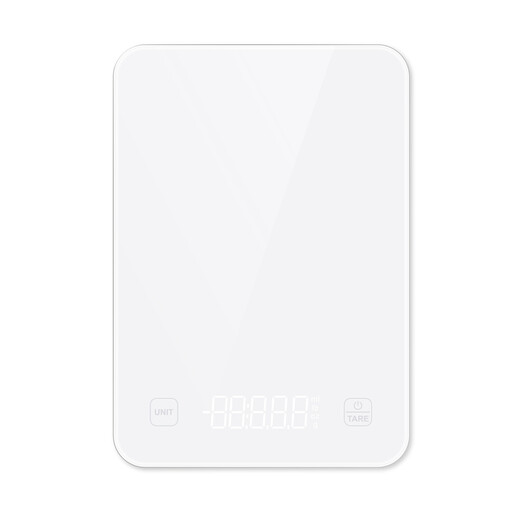 Image unavailable
Consider its listed 10 kg capacity if your bowl and granola batch require that limit, but check that the scale fits where you intend to store it.
The product name specifies a 1 g increment and tempered glass. Confirm tare operation and screen visibility with your bowl; an increment alone does not establish measurement consistency.
Use the gram setting and tare the empty bowl before adding honey. If your scale has an add-and-weigh function, reset it between honey and each dry ingredient so you can continue using the same bowl.
Use grams for honey unless the scale’s manual explicitly confirms a honey-appropriate ml conversion. An ml setting by itself does not establish how the scale converts honey’s volume to weight.
Follow the cleaning instructions for your specific model rather than immersing it or assuming it is waterproof. Joseph Joseph instructs owners to wipe its Vision scale with a damp cloth; instructions for another scale may differ.