Small-room planning facilitators
If several people contribute around one table, you need to consider quieter voices and interruptions as well as the person nearest the device.


Choose a speakerphone by the distance to the furthest seat and how the planning meeting unfolds, rather than by the unit’s size alone. Compare published pickup or room guidance with your seating plan, then check full-duplex audio and echo handling if people often speak over one another. USB suits a regular laptop host; Bluetooth or Teams controls matter when the devices and meeting workflow call for them.
If several people contribute around one table, you need to consider quieter voices and interruptions as well as the person nearest the device.
If meetings move between desks and small rooms, consider how you will connect each host device and carry the speakerphone, without overlooking coverage at the furthest seat.
If Teams is the usual platform, check whether a dedicated control or a particular variant fits the host device and your organisation’s meeting workflow.
For a planning meeting with people in the room and on a call, start with the seating layout. Then consider how often voices overlap and which device will host the meeting.
| Concern | What to check | Who this matters to |
|---|---|---|
| Voices around the table | Measure the distance from a central position to the furthest seat. Compare it with the model’s published pickup distance and any room-size or attendee guidance. | If I’m leading a meeting, I need remote colleagues to hear the person at the far end, not just whoever sits beside the unit. Around 42% of consumers put seating coverage first. |
| Overlapping conversation | Look for stated full-duplex capability and echo handling, then consider whether room noise or reverberation will affect placement. | When discussion moves quickly, I want an interruption to reach the call without losing the other speaker. Conversation handling comes first for around 33% of consumers. |
| Host connection | Check the laptop’s ports, whether a phone or tablet will host calls, and the exact variant’s conferencing controls. | If different people start the meeting from different devices, I need a connection that fits their usual setup. For around 25% of consumers, that workflow is the primary concern. |
A compact unit may not fit a wide table or a group larger than its stated attendee guidance. The distance to the furthest seat is more useful than the room label.
Plan a central position and compare your layout with the particular model’s published pickup, room-size or participant guidance.
Full duplex, beamforming and echo or noise reduction are relevant features, but manufacturer descriptions do not mean every voice will remain clear in a noisy or reverberant space.
Place the unit centrally, reduce avoidable noise and try the meeting setup with a remote participant before an important session.
USB ports, Bluetooth roles and Teams controls differ by model and variant. A suitable microphone is little help if the meeting host cannot connect as intended.
Check the host device, conferencing platform and exact variant, including which cables, adapters or dongles come with it.
A port mismatch may require an adapter or delay the start of a meeting.
A speakerphone is electrical equipment, so disposal needs a suitable recycling route rather than the general household bin.
Ask the retailer about its electrical-equipment take-back arrangements or use an appropriate collection route. GOV.UK provides guidance on retailer take-back responsibilities.
These examples illustrate different published room guidance and workflows; the details apply to the named models, not every product from each brand.
Jabra positions the Speak2 55 for flexible professional use, with published guidance that helps assess a small planning room.
The Poly Sync 40 is a huddle-room option with published coverage guidance.
The EXPAND 40T is relevant when a portable speakerphone must fit a Teams-led meeting process.
Yealink positions the portable CP700 for calls and meetings of up to four people.
The compact P710e combines a device stand with USB and Bluetooth connection.
These choices address two ways to host a small-room meeting: a Bluetooth conference unit for a changing setup and a wired unit for a more fixed one. Check seating coverage and the host connection for the exact room before choosing either.
 No image available
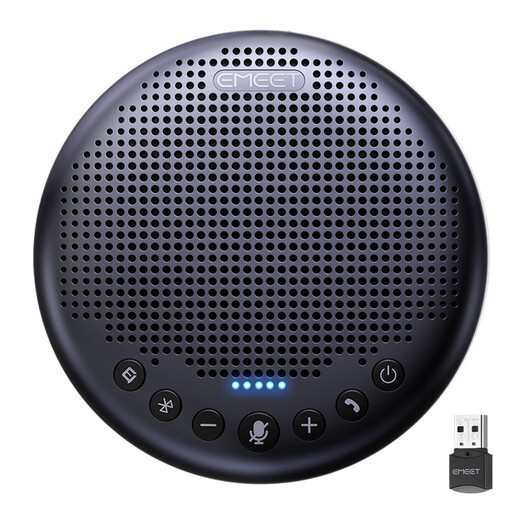
Consider this for a meeting host who needs a Bluetooth connection and a speakerphone that can be moved between setups.
The product name specifies eight microphones, 360° voice pickup, dual connection and a 5W speaker. A 360° pickup description does not establish how far away a participant can sit; check the seating distance and any stated requirements for connecting a second unit if your group needs one.
 No image available
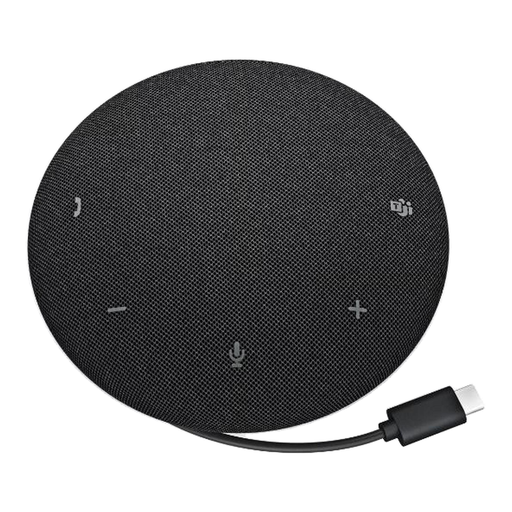
Consider this for a meeting that normally uses one fixed, wired host, provided its connection fits the host device.
Before choosing the SP325, compare its pickup guidance with the furthest seat and check its exact connector. If participants regularly interrupt one another, confirm its full-duplex and echo-handling features for this variant.
Compare the furthest seat with the model’s published microphone pickup distance, assuming a central position. Jabra specifies up to 2.3 m for the Speak2 55 and rooms up to 4.5 m × 4.5 m; HP specifies up to 2.5 m for the Poly Sync 40 and rooms up to 5 m × 5 m. These are manufacturer specifications, not a guarantee for every seating layout or room acoustic.
Put it near the centre of the seated group so that the furthest participant falls within the model’s stated pickup guidance. Keep it clear of noisy equipment and objects that obstruct sound; noise processing does not replace sensible placement.
A wired USB connection may suit a regular laptop host if its ports match the speakerphone. Bluetooth becomes more relevant when a phone or tablet hosts calls or the device changes hands; check the particular model’s supported host devices rather than assuming Bluetooth works identically with every computer.
For an eligible online purchase from a trader, GOV.UK says customers generally have 14 days after receiving an item to notify the seller that they want to cancel. Check the applicable cancellation conditions and the seller’s return instructions before testing the speakerphone; a change-of-mind cancellation is distinct from remedies for goods that are faulty, damaged or misdescribed.