Small-space snack makers
If the worktop needs clearing after each use, look for a maker that produces small portions and has a storage spot. Salter describes its Mini Bite Maker as compact and specifies nine mini bites per batch.


Choose a mini-bite maker if small portions and cupboard space matter most, but check whether its fixed plates will be practical for everyone to clean. A deep-fill maker suits larger waffles rather than miniature snacks; an interchangeable-plate maker makes more sense when housemates will also use it for paninis or toasties. Whichever format you choose, check the cleaning method, footprint, cable reach and plug arrangement against the shared kitchen.
If the worktop needs clearing after each use, look for a maker that produces small portions and has a storage spot. Salter describes its Mini Bite Maker as compact and specifies nine mini bites per batch.
Where several people use the appliance, decide whether cooled-down wiping is enough or removable plates would make the agreed clean-down routine easier. Cleaning matters particularly when ingredients contain allergens.
If paninis or toasties will be made as well as waffles, interchangeable plates may be more useful than the smallest dedicated waffle format. Check which plates come with the exact appliance.
Choose when: Small, shareable pieces and compact storage are the priorities; Salter specifies nine mini bites for its Mini Bite Maker.
Trade-off: That Salter model has fixed plates, so they need wiping after the appliance has cooled rather than removing for washing.
Choose when: Larger, thicker waffles matter more than miniature portions; Salter lists adjustable temperature control on its Deep Fill Waffle Maker.
Trade-off: Its stated 1600 W rating and full-size waffle format call for particular attention to socket placement and the space it will occupy.
Choose when: Housemates will also make paninis; Tefal supplies waffle and panini plates with the SW343D40.
Trade-off: Further plate sets are separate accessories that also need storage.
| Concern | Buying checks | Who this matters to |
|---|---|---|
| Small portions and storage | Check the plate format and waffle output, then measure the appliance against its storage spot. | When cupboard space is tight, I want small pieces to share without leaving another appliance on the worktop; around 33% of consumers would put portions and storage first. |
| Cleaning between users | Check whether plates are fixed or removable and follow the maker’s cooling and cleaning instructions. | If housemates take turns, I need to clear batter and ingredient residue before handing the maker over; cleaning would be the primary concern for around 45% of consumers. |
| Uses beyond waffles | Confirm which plates are included with the exact model and where any additional sets would go. | When one appliance must also make paninis or toasties, I need its other uses to justify the cupboard space; for around 22% of consumers, versatility would come first. |
A small appliance can still have plates shaped for a conventional waffle rather than several little pieces.
Check the stated waffle output and plate format. Salter specifies nine mini bites for its Mini Bite Maker, while its Deep Fill model is intended for larger waffles.
Fixed plates cannot be lifted out for washing, which may complicate handover when several people use different ingredients.
If a thorough wash between uses matters, check for removable plates and the exact model’s washing instructions. Otherwise, agree how users will clean the fixed plates after cooling.
Electrical Safety First warns that using large appliances together on an extension lead can overload it and create a fire risk.
Check the maker’s wattage and whether its cable reaches a suitably located wall socket. Keep hands dry around electrical equipment and do not leave the maker running unattended.
An interchangeable-plate system can accept more snack formats without supplying every plate set in the box.
Check the included plates and compatibility of any additional sets with the exact model.
Additional plate sets need a separate purchase and clean, dry storage space.
Salter’s UK listings provide examples of both a compact mini-bite maker and a larger deep-fill format.
Tefal’s snack-maker range is relevant when one shared appliance needs more than a waffle function.
Lakeland’s Electric Mini Waffle Maker illustrates a dedicated, one-waffle-at-a-time format.
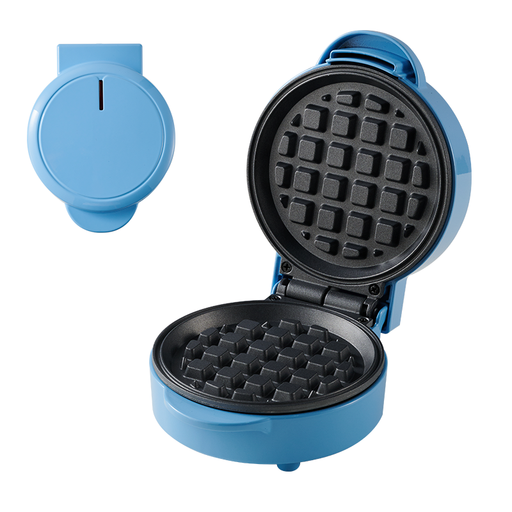
This mini-waffle maker relates to the small-snack route. Check its portion size, cleaning method and fit with your shared kitchen before choosing it.
 No image available
Consider this mini format for small waffle snacks. Its product name states a 550 W rating, non-stick coating and double-sided heating.
Before sharing it, check the waffle size and batch output, whether the plates can be removed for cleaning, and whether the footprint, cable length and plug arrangement suit your kitchen.
Look for an explicitly stated mini-bite output rather than relying on the appliance’s overall size. Salter specifies nine mini bites per batch for its Mini Bite Maker; its Deep Fill model is for larger waffles.
They are worth considering if users need to wash the plates thoroughly between turns. Tefal supplies removable waffle and panini plates with the SW343D40, but check the cleaning instructions for the exact model; fixed plates must be cleaned in place after cooling.
Do not assume a crowded extension lead is suitable. Electrical Safety First warns that running large appliances together on one can cause overloading; check the maker’s wattage and use a suitably located wall socket where possible.
Agree that each user cleans the maker and utensils according to their instructions before handing them over. Food Standards Agency guidance addresses cleaning food equipment and preventing allergen and other contamination; a non-stick surface alone is not a substitute for cleaning.
Check that the exact maker’s supply requirements and plug arrangement suit the intended socket, and that its cable reaches without creating an awkward route across the shared worktop. Follow its instructions for use and cleaning, and keep hands dry around electrical equipment, as Electrical Safety First advises.