
24/7 Customer Support

Free returns

Same-day & Next-day Delivery

Quality Guaranteed

Unlock Your Welcome Offers: FREE Delivery | Up to 80% OFF | Free 30-day JoyPlus trial
Download the APP
Upgrading your home's lighting is no longer just about replacing a bulb. The right ceiling light can transform a room's atmosphere, improve focus and even integrate with your daily routines. However, navigating the world of the smart ceiling light can feel overwhelming with its array of features, from voice control to adjustable colour temperatures.
This guide is designed to help you understand the key features to look for. We will explore what makes a modern light fitting truly practical for UK homes and highlight a few recommendations that balance innovative technology with functional design.
Before you decide, consider these three key aspects to ensure your new light fitting meets your household's needs.
The core appeal of a smart light is convenience. Most models offer app control via your smartphone, but for true hands-free operation, check for compatibility with voice assistants. An Alexa compatible light, or one that works with Google Home and SmartThings, allows you to adjust brightness or change colours with simple voice commands. This is particularly useful when your hands are full in the kitchen or when you’re settling down in the bedroom.
Modern LED lighting offers more than just illumination. Look for these features to tailor your room's atmosphere:
The physical design of the light is just as important as its technology. For many modern UK homes, a flush ceiling light for low ceilings is a necessity. These slim, low-profile designs sit close to the ceiling, maximising headroom and creating a clean, unobtrusive look. Also, consider the materials. A kitchen light fitting, for example, benefits from a sealed, easy-to-clean design that is resistant to dust and moisture.
Here are a few smart ceiling light options that cater to different needs and spaces.
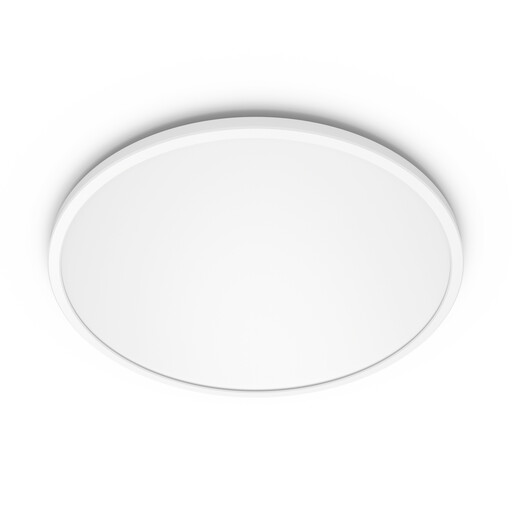
Why It Stands Out: This Philips model prioritises sleek, minimalist design and simplicity. While not a fully "smart" light with app connectivity, its three distinct brightness settings offer more flexibility than a standard fitting. Its key advantage is its incredibly slim profile.

Why It Stands Out: This Yeelight model is built for creating immersive experiences. Its standout feature is the SideGlow technology, which uses RGB ambient lighting to cast a colourful glow onto the ceiling while the main light illuminates the room. The RGBICWW technology allows for flowing, multi-zone colour effects.
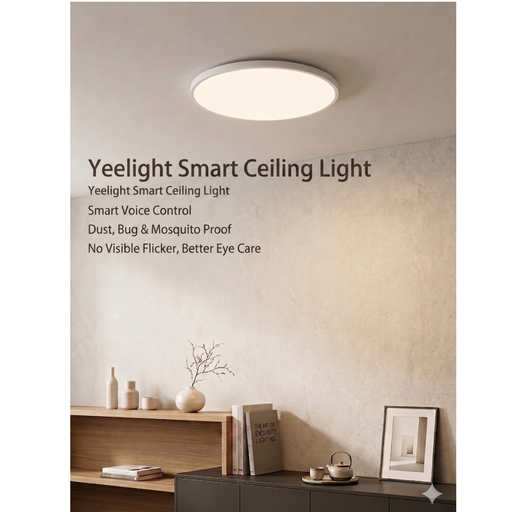
Why It Stands Out: This model is a versatile all-rounder that focuses on comfort and practicality. It is an eye-safe led light with an RG0 certification, indicating it is flicker-free and has a low blue-light hazard. Its sealed design and unique Moonlight Mode make it highly functional for everyday living.
If these recommendations aren't quite what you had in mind, or you wish to browse different styles and sizes, there is a wider selection available. Explore our full collection to find the perfect fit for your home.
[Explore our full range of dimmable LED ceiling lights](https://www.joybuy.co.uk/explore/dimmable-led-ceiling-lights/QaWqScfl)
1. Can I install a smart ceiling light myself? Some simpler models are designed for self-assembly. However, for many smart lights, especially those connecting directly to your home's mains wiring, professional installation by a qualified electrician is required for safety and compliance with UK electrical codes. Always check the manufacturer's instructions; for instance, the Yeelight SideGlow model explicitly states it must be installed by a professional.
2. Do smart ceiling lights use a lot of electricity? No, quite the opposite. Smart ceiling lights use LED technology, which is significantly more energy-efficient than traditional incandescent or halogen bulbs. Features like dimming and scheduling can further reduce energy consumption, as you only use the precise amount of light needed at any given time.
3. What is the difference between tunable white and RGB?Tunable white light refers to the ability to adjust the shade of white light, from a warm, yellowish tone to a cool, bluish-white. This is used to match the light to the time of day or a specific activity. RGB ambient lighting refers to the ability to produce millions of different colours (like red, green, purple, etc.) for decorative or atmospheric purposes. Many advanced smart lights offer both features.