Unevenly matched pairs
If you often play someone with more experience, look for separate assistance settings for the two sides of the same physical game. Bryght Labs describes this use for ChessUp 2.


For two people playing each other, prioritise a board that lets you set guidance separately for each side; Bryght Labs’ UK-facing ChessUp 2 listing explicitly describes assistance for either player. Choose a robot when you want a physical AI opponent instead, but adjustable AI difficulty alone does not show that two human players can receive different help. Before buying, check the exact local-play mode, which lights remain at the lowest guidance setting and whether the features you want require an account.
If you often play someone with more experience, look for separate assistance settings for the two sides of the same physical game. Bryght Labs describes this use for ChessUp 2.
If you want move guidance while keeping the pieces on the board, check which hints can be reduced and whether legal-move lights remain when strategic help is turned down.
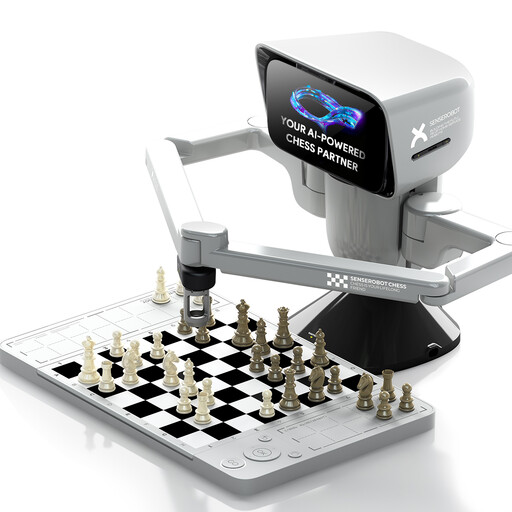
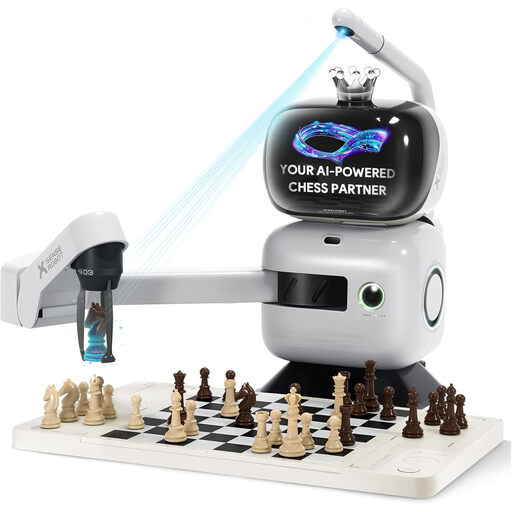
If you would rather play against a physical AI opponent, a robotic board may suit that use better than a board whose main role is to guide two people playing each other. SenseRobot describes robotic movement and adaptive practice for its chess robot.
For a mixed-skill face-to-face game, start by deciding whether the priority is different help for each person, guidance that can be reduced, a moving opponent or fewer connected-service requirements.
| Concern | What to check when buying | Who this matters to |
|---|---|---|
| Balancing two players | Check for separate assistance settings in local two-player mode, including whether either side can have no strategic help. | If I want a beginner and a stronger player to share one game without giving both the same hints, this is my priority; around 36% of consumers put balancing two local players first. |
| Guidance that can recede | Check whether move suggestions and legal-move indicators have separate controls, and whether the settings work in a local game. | When I want guidance to become less prominent as we learn, I need to know exactly what the lowest setting leaves visible; around 29% of consumers prioritise learning during shared games. |
| A moving opponent | Confirm that the exact model moves pieces and which AI or connected modes use that feature. | If I want to play against an opponent whose moves appear on the physical board, rather than balance two people at the same table, around 21% of consumers make automatic movement their main priority. |
| Connected accounts | Check which desired modes work without a profile and review the age and privacy settings of any linked service. | For families who want to limit online accounts or manage a child’s connected play, checking the service matters before creating a profile; around 14% of consumers put limiting connected-service use first. |
AI difficulty changes the challenge posed by the machine opponent; it does not, on its own, establish that two human players can receive different assistance.
Check the exact local two-player settings if separate help for family members or friends is the main reason for buying.
A ChessUp support reply distinguishes turning off strategic assistance from legal-move lights, which may still appear.
Check what remains visible at the lowest setting if you want players to work out every move without illuminated prompts.
Chessnut says Evo recognises its included pieces but does not support pieces from Chessnut GO or Chessnut Move.
Check the exact model’s piece compatibility and what is included before relying on an existing set.
A regional page label alone does not establish the delivery destination, currency or final delivery terms for a particular order.
Confirm those details at checkout before treating a listing as a suitable UK purchase option.
A smart-board option for two local players who want different levels of move guidance.
A robotic chess route for people interested in AI practice and physical piece movement.
Particula’s GoChess range offers a move-guidance route for players who still move the pieces themselves.
Chessnut offers distinct board approaches, including position recognition on Evo and a self-moving route with Move.
These Joybuy product choices cover SenseRobot robotic chess options for portable play and AI-led practice. Their listed features do not establish separate assistance settings for two people playing each other.
 No image available
For consumers prioritising a portable chess option, the product name describes it as a travel chess game.
The product name lists app connection and support for 3D-printed DIY pieces.
 No image available
Consider this option if AI practice and guided learning matter more than separate hints for two human players.
The product name lists 25 AI levels, 1,200+ exercises, endgame training, classic game replay, voice coaching, Lichess integration and app sync. Product descriptions count available AI levels differently, so check the exact modes.
Screen-free operation requires initial Wi-Fi setup. Keep fingers, loose clothing, hair and jewellery away from the robotic arm’s path. Small parts present a choking hazard: it is not suitable for children under 3, and adult supervision is required for children aged 3–6.
Bryght Labs describes independently customised guidance for each player in a local ChessUp 2 game. A ChessUp support reply says legal moves may still appear when one side’s strategic assistance is set to none, so check the light behaviour if you want an unlit board.
Not by itself: AI difficulty sets the machine opponent’s challenge. For two humans, check for separate assistance settings in local play; the consulted SenseRobot material describes adjustable AI but does not establish an equivalent per-side setting.
Check that the pieces are recognised and set the intended guidance level for each player before starting. For a moving board, keep the movement area clear and do not force pieces while the board is moving, as Chessnut instructs for Move.
It depends on the service and its lawful basis for processing personal data. The Information Commissioner’s Office says that where a service offered directly to a child relies on consent, parental authorisation is required for a child under 13; consent is not necessarily the service’s only possible lawful basis. Check the particular service’s age and account terms.
For online services within the UK Children’s code, Information Commissioner’s Office guidance identifies high-privacy defaults, controls for children and parents or carers, and non-essential location tracking switched off. Check the board’s service and any separately linked playing platform rather than assuming one account’s settings cover both.