
24/7 Customer Support

Free returns

Same-day & Next-day Delivery

Quality Guaranteed

Unlock Your Welcome Offers: FREE Delivery | Up to 80% OFF | Free 30-day JoyPlus trial
Download the APP
As the evenings draw in, finding an efficient and convenient way to keep your home comfortable becomes a priority. Traditional portable heaters often come with a trade-off: warmth at the cost of high energy bills and a lack of precise control. A modern smart convection heater offers a solution, providing targeted warmth exactly when and where you need it, all managed from your smartphone or with a simple voice command.
Navigating the options can be challenging. This guide is designed to help you understand the key features to look for in an app controlled electric heater and to highlight some practical choices available for UK homes. We will focus on the specifications that matter, helping you find a heating solution that fits your lifestyle and space.
Before choosing, consider these key factors to ensure you select a heater that meets your needs for convenience, efficiency and performance.
The defining feature of a smart heater is its connectivity. Look for models with WiFi capabilities that connect to a dedicated smartphone app. This allows you to turn the heater on or off, adjust the temperature and set schedules from anywhere. For those with a connected home, finding an Alexa compatible heater in the UK or one that works with Google Home adds another layer of convenience, allowing for hands-free voice control.
A heater's power, measured in watts (W) or kilowatts (kW), determines its heating capacity. A 2.2kW convection heater is generally suitable for providing supplemental warmth in small to medium-sized living rooms or bedrooms. However, power alone doesn't equal efficiency. An electric heater with a thermostat and timer is crucial for managing energy use. The thermostat maintains your desired temperature by automatically switching the unit on and off, while a timer lets you schedule heating to avoid running it unnecessarily.
While this guide focuses on convection models, which circulate warm air to heat a room evenly, you will also encounter ceramic fan heaters. These use a ceramic element and a fan to provide rapid, directional heat. Many modern units are designed as a quiet portable heater, making them suitable for bedrooms and offices. Always check for essential safety features, such as overheat protection and an automatic tip-over switch, which are standard on reputable models. A freestanding heater for a living room should be stable and have a cool-touch exterior if it will be used around children or pets.
Here are a few models that offer a compelling combination of smart features, performance and practical design for different needs and spaces.

Why It Stands Out: This model combines powerful convection heating with a full suite of smart controls. Its 2.2kW output is substantial enough for medium-sized rooms, and the integrated turbo fan can be used to circulate warm air more quickly when you need an instant boost of heat.
Pros:
Who is it for? Ideal for those seeking a primary smart heating solution for a home office, bedroom or living room. Its combination of power and comprehensive smart integration makes it a versatile choice for the tech-savvy homeowner.
View Details for the BLACK+DECKER Smart Heater

Why It Stands Out: The DREO Atom Core uses PTC ceramic technology for rapid, efficient heating in a very compact and modern design. Its standout feature is its quiet operation, with sound levels as low as 34-40dB, making it an excellent choice for spaces where noise is a concern.
Pros:
Who is it for? Perfect for use in bedrooms, nurseries or on a desk in a home office. If you need a quiet portable heater that provides fast, localised warmth without disrupting your environment, this is a strong contender.
View Details for the DREO Atom Core Heater
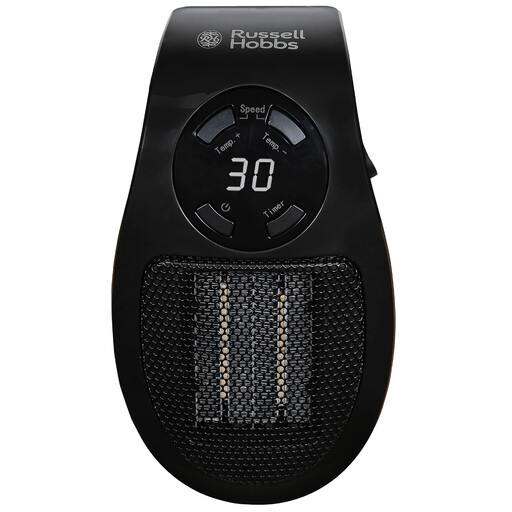
Why It Stands Out: This heater from Russell Hobbs redefines portability. It plugs directly into a wall socket, requiring no floor space or cables. Its 500W output is designed for personal, targeted heating, making it a practical tool for warming up your immediate space.
Pros:
Who is it for? This is the perfect solution for someone who needs to take the chill off a small, personal area, such as by a desk, next to a sofa or in a chilly corner of a room. It is not designed for heating an entire room but excels at providing direct, immediate warmth.
View Details for the Russell Hobbs Plug-in Heater
The models above represent a few of the smart heating solutions available. Many users also find that PTC ceramic heaters offer an excellent balance of rapid heating and energy efficiency. These heaters are known for their durability and self-regulating temperature capabilities.
For a wider selection of efficient heating solutions, explore our full range of PTC ceramic heaters.
1. Are smart heaters an energy efficient electric heater? Yes, their features contribute to greater efficiency. A wifi portable heater with a precise thermostat and programmable timer allows you to heat rooms only when necessary and maintain a steady temperature without wasting power, which can be more efficient than a basic heater left running continuously.
2. Can I control a smart heater when I'm not at home? Absolutely. An app controlled electric heater connects to your home's WiFi network. This enables you to use its companion smartphone app to turn it on or off, change settings and monitor its status from anywhere with an internet connection.
3. What size smart heater do I need for my living room? A general guideline is to allow for 10 watts of power for every square foot of room area. For an average-sized UK living room, a heater in the 1500W to 2200W range often provides adequate supplemental heat. A model like a 2.2kW convection heater would be a suitable choice for this purpose.