What to check before buying
Start with the function you actually need, then check its remaining update support and the data controls involved. If remote access, app alerts or voice assistance add little for your household, weigh those benefits against the account and connectivity they require.
| Concern |
What to check when buying |
Who this matters to |
| Remaining security-update support |
Find the manufacturer’s UK statement for the exact model and, where relevant, hardware version. Check the end date and distinguish security updates from feature or operating-system upgrades. |
If I plan to keep a connected device for years, I want its exact support end date so I can judge how much stated support remains. Around 33% of consumers put remaining security-update support first. |
| Personal data and controls |
Read what the manufacturer says about collection and sharing. Check the model’s recording, microphone, camera and privacy controls, along with the app permissions it requests. |
If I am choosing a camera, doorbell, speaker or TV, I want to understand what it may record or collect before enabling connected features. Around 27% of consumers prioritise data collection and controls. |
| Account security and setup |
Confirm network and app requirements, how firmware updates are applied, and whether the associated account offers two-step verification. |
If I want a device I can manage and keep updated with my household’s network, phone and account setup, I need those requirements to be clear. Around 20% of consumers put account security and practical setup first. |
| Useful function and ongoing cost |
Decide whether you need live use, saved recordings or remote alerts. Check storage and power arrangements, and which functions require a paid plan. |
If I need a particular connected function, I want to know whether installation, storage or a continuing plan affects how I can use it. Around 20% of consumers prioritise function and ongoing cost. |
Relevant brands to compare
These references relate to the named product lines and policies, not every product from each brand. Check the exact model’s update statement and controls before deciding.
Ring
For households comparing video doorbells and cameras by model-specific update dates and recording controls.
- Ring publishes minimum security-update dates for named devices and describes Privacy Zones.
- Ring says Privacy Zones are unavailable on specified older or pan-and-tilt models, and motion may still be detected behind a blocked zone.
TP-Link Tapo
For households comparing camera and doorbell privacy controls, app-managed firmware and model-specific support information.
- Tapo describes a privacy mode that stops streaming and recording on supported cameras. TP-Link says Tapo and Kasa firmware is updated through the app.
- TP-Link says automatic-update support varies by model. Check the exact model’s update period and available controls.
Amazon Echo
For households comparing voice devices against published support dates for named Echo products.
- Amazon publishes minimum security-update dates for named Echo products.
- Amazon’s additional four-year purchase-based commitment is conditional on buying new from Amazon as seller on Amazon.co.uk. Check the device table if buying elsewhere.
Google Nest
For households comparing update information for connected speakers, cameras and doorbells.
- Google publishes a security-update table for connected-home devices.
- Google says its general five-year minimum runs from the date sales start on the US Google Store, not from a UK buyer’s purchase. Check the named model’s applicable information.
Samsung
For households weighing smart-TV functions against model-specific update and viewing-data considerations.
- Samsung UK advertises up to seven years of Tizen OS upgrades on its TV page.
- Samsung’s separate security-software statement says at least three years from product launch. Neither statement establishes seven years of security updates for every TV; check the exact model.
EZVIZ
For households considering doorbells with multiple camera views and on-device storage.
- EZVIZ describes the EP8 Ultra as a dual-camera doorbell with included storage and privacy zones.
- For an update-support-led choice, check the EP8 Ultra’s model-specific minimum security-update end date rather than relying on its feature set alone.
Joybuy product choices
These Joybuy options focus on household video monitoring, with indoor and outdoor cameras and video doorbells. For any connected camera or doorbell, check the exact model’s UK security-update statement and recording and privacy controls before buying.
 No image available
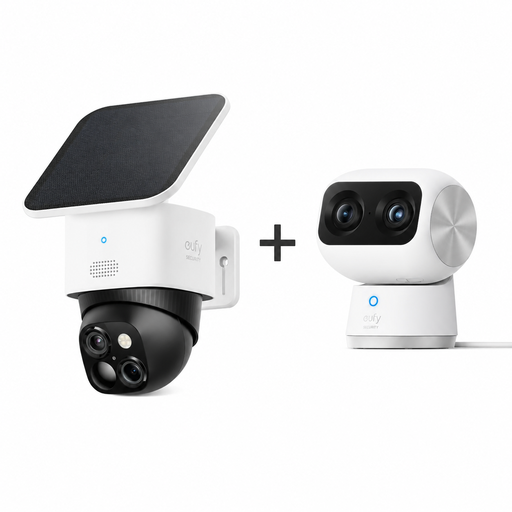
eufy Indoor Cam S350 and SoloCam S340 Camera Kit
For households wanting indoor baby or pet monitoring alongside outdoor coverage, this kit combines an indoor camera with an outdoor camera.
The listing describes 4K UHD for the Indoor Cam S350 and 3K for the SoloCam S340, with dual-camera designs for both.
Joybuy
 No image available
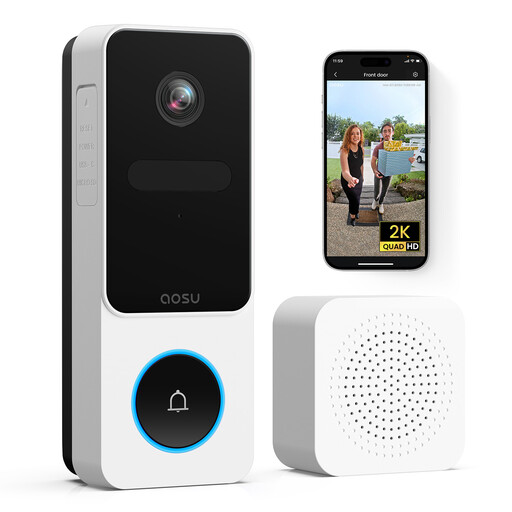
aosu 2K HD Wireless Video Doorbell with Gong
For doorstep monitoring and two-way visitor communication, the listing describes a wireless video doorbell with human and package detection.
Listed features include 2K video, a 170° view, night vision, two-way audio, 2.4GHz Wi-Fi and Alexa compatibility.
Joybuy
 No image available
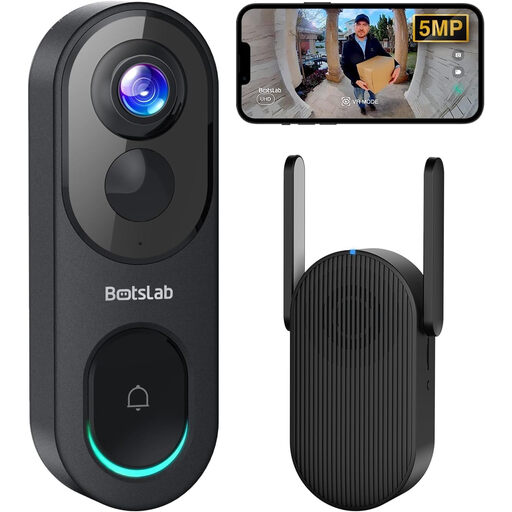
BOTSLAB R810 5MP Video Doorbell Camera
For doorstep and package monitoring with local recording, the listing describes human and package detection and an included SD card.
It specifies 5MP video, a 5200mAh battery, a Wi-Fi base station and 32GB SD storage; cloud features are described as optional.
Joybuy
 No image available
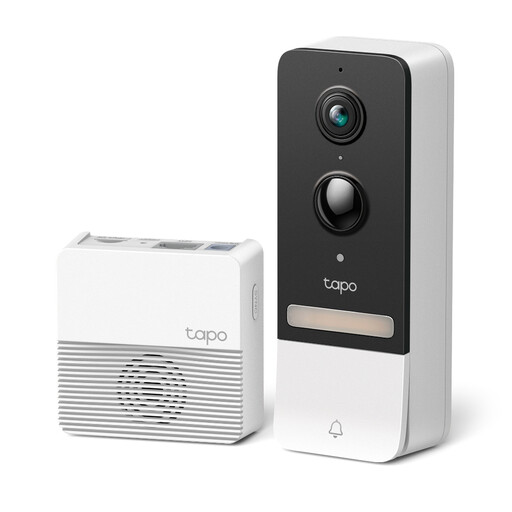
Tapo D230S1 Smart Battery Video Doorbell
For doorstep monitoring with visitor communication and a choice of recording arrangements, the listing describes remote viewing and two-way audio.
Listed features include 5MP video, a 160° view, colour night vision and an included chime; storage options include microSD or cloud storage.
Joybuy
 No image available
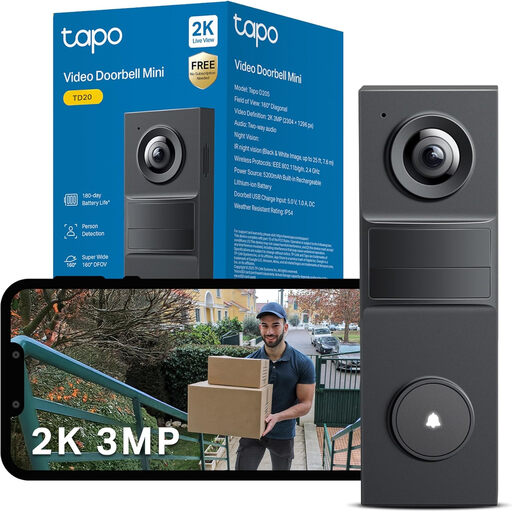
Tapo TD20 Smart Video Doorbell Camera
For doorstep alerts and visitor communication, the listing describes person detection, call notifications and two-way audio.
It specifies 3MP HD video, night vision, a 160° view and a 5200mAh battery. The app connection requires a 2.4GHz Wi-Fi network; storage options include microSD or Tapo Care cloud services.
Joybuy
Frequently asked questions
Does UK law set the same number of security-update years for every smart device?
No. For relevant consumer connectable products, manufacturers must state the minimum period for which important security updates will be provided, but the requirement does not set one uniform number of years for every device. The National Cyber Security Centre explains the disclosure requirement; the UK regime took effect on 29 April 2024 and has product and territorial exceptions.
Do all connected products fall within the UK security regime?
No. The UK government describes exceptions, including specified medical devices, smart meters and some non-cellular computers, as well as a qualified exception for Northern Ireland. Check the product’s scope before applying the update-disclosure requirement to an unusual device.
What should I check when setting up a connected device?
Check how the device receives updates, review app permissions and enable two-step verification if the device or app offers it. The National Cyber Security Centre recommends two-step verification where available; controls and update methods vary between models.
When can a home camera or smart doorbell raise UK data-protection obligations?
The Information Commissioner’s Office says data-protection law applies if a home CCTV system captures someone else’s property, a public area or a communal space. Where possible, position the camera to capture only your own property. The ICO notes that its household CCTV guidance is under review following the Data (Use and Access) Act.
Does a promised TV operating-system upgrade period establish its security-update end date?
No. Samsung’s UK TV page gives a Tizen OS upgrade statement, while its separate security-software statement gives a different period. Check the exact TV model’s security-support information rather than using an operating-system upgrade figure as its security-update end date.


