
24/7 Customer Support

Free returns

Same-day & Next-day Delivery

Quality Guaranteed

Unlock Your Welcome Offers: FREE Delivery | Up to 80% OFF | Free 30-day JoyPlus trial
Download the APP
Buying a television in the UK can quickly become confusing. A low price may hide an outdated smart platform, while impressive terms such as QLED, HDR and 120Hz may not deliver the experience you expect in your room.
The main pitfalls are easy to avoid if you know what to check:
A 4K smart TV has a resolution of 3840 × 2160 pixels, providing four times the pixels of Full HD. This is particularly useful on larger screens such as a 55-inch, 65-inch or 75-inch TV, where lower resolution can look less detailed at close viewing distances.
For smaller spaces:
Measure both the wall or furniture and the route into the room. Check the television’s width with its stand fitted, not only the diagonal screen measurement. If wall mounting, confirm the VESA mounting pattern and allow space around ventilation areas.
LED televisions use a backlight behind the LCD panel. QLED TVs add a quantum-dot layer designed to improve colour volume and brightness. Mini-LED TVs use smaller backlight elements and local dimming zones to provide more precise control between bright and dark areas.
HDR formats can include HDR10, HLG, HDR10+ and Dolby Vision. Format support does not guarantee identical results across televisions. Compare the listed brightness, panel type, contrast technology and local-dimming features as well.
A direct-LED Full HD model can still be sensible for a secondary room, but shoppers seeking detailed cinema, sports or console gaming pictures will usually want a 4K HDR TV.
The operating system affects app availability, navigation and voice control. Google TV combines streaming services, recommendations and Google Assistant, while Samsung smart TV models use Tizen. Hisense smart TV models commonly use VIDAA, and selected Coocaa smart TV models use TiVo OS.
Check that your preferred services are available before ordering. UK viewers should also consider Freely TV, which can stream compatible live and on-demand channels over Wi-Fi without an aerial, satellite dish or external set-top box. Availability and channel access can depend on the service and location.
For gaming, look beyond the word “gaming TV”. Check for:
A television supporting Dolby Atmos can process compatible audio, but the built-in speaker arrangement and room acoustics still influence the result. Look at speaker power, eARC support and whether a soundbar may be required.
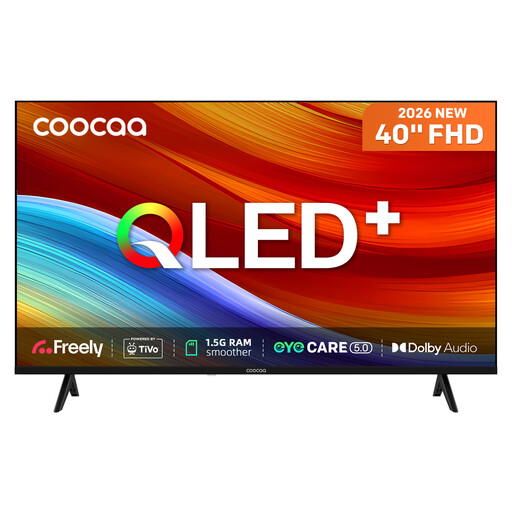
Why This Fits Their Persona: Its 40-inch format suits a bedroom, studio flat or smaller lounge, while built-in Freely and TiVo OS reduce the need for additional television equipment.
The specification clearly states Full HD resolution rather than presenting it as 4K, making it easier to match expectations to price and room size.
QLED display, HDR10 and HLG support; two HDMI inputs, two USB ports and Dolby Audio.
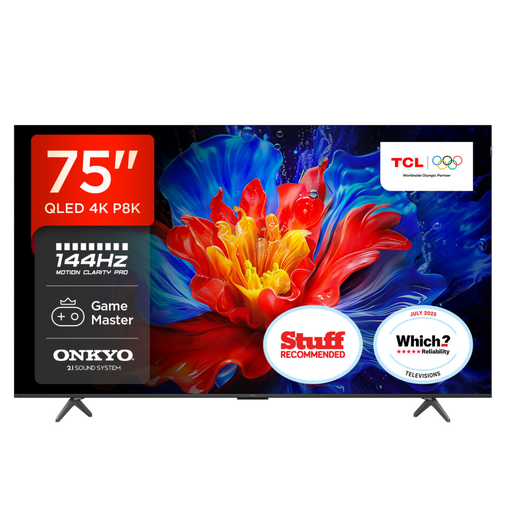
Why This Fits Their Persona: Designed for a spacious UK lounge, this large-screen model combines Google TV, QLED colour and integrated Onkyo audio for film, streaming and sports viewing.
Its gaming and audio specifications are stated separately, helping buyers distinguish 4K viewing from higher refresh-rate gaming modes.
Four HDMI 2.1 inputs with VRR and ALLM; 35W 2.1-channel Onkyo audio with Dolby Atmos support.
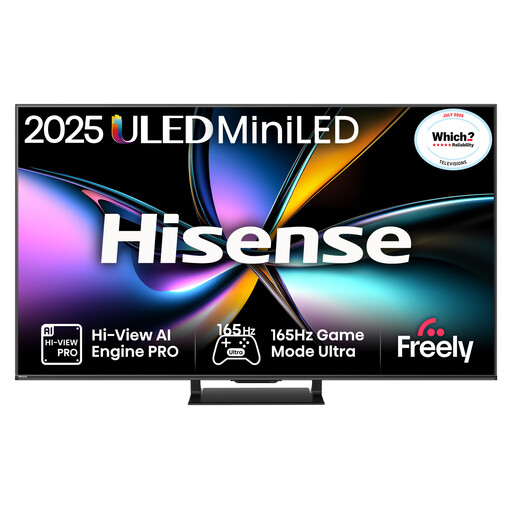
Why This Fits Their Persona: A suitable option for users who divide their time between console gaming, live sport and films, with a more compact footprint than a 75-inch television.
The specification identifies native 165Hz performance, HDMI 2.1, VRR and ALLM, rather than relying on an unspecified motion-enhancement label.
Mini-LED local dimming and QLED colour; 2.1.2-channel audio with Dolby Atmos support.
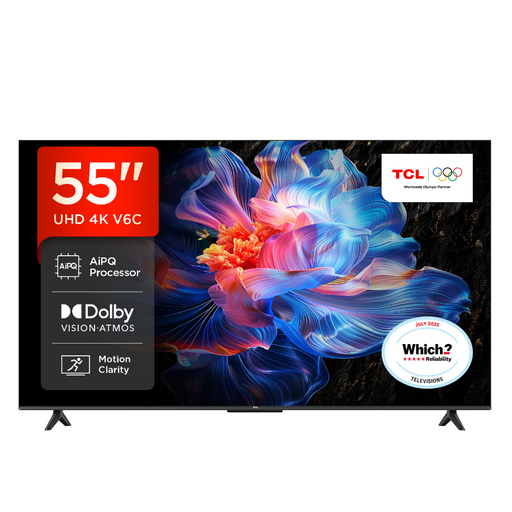
Why This Fits Their Persona: This mid-sized television suits households wanting straightforward access to streaming apps, voice control and console-friendly connections.
Its Direct LED panel, 4K resolution and supported HDR formats are listed clearly, so buyers can compare it with QLED and Mini-LED alternatives on specification rather than terminology.
Google TV with Google Assistant; Dolby Atmos support, HDMI 2.1, VRR and ALLM.
We have compiled a complete, real-time list of products that fully satisfy these strict selection criteria and UK safety regulations.
It can be, particularly if you sit close to the screen or plan to keep the television for several years. However, a 4K panel is not automatically necessary for a 32-inch TV used occasionally. Prioritise viewing distance, app support and available connections.
Running costs depend on screen size, brightness, picture mode and viewing hours. Check the UK energy label and the stated consumption per 1,000 hours. Larger televisions generally use more electricity, and HDR viewing can consume more than standard dynamic range content.
Freely-compatible televisions can stream supported live and on-demand channels through an internet connection, so an aerial may not be required for those services. Confirm broadband reliability, app availability and regional channel access before relying on it as your only television source.