
24/7 Customer Support

Free returns

Same-day & Next-day Delivery

Quality Guaranteed

Unlock Your Welcome Offers: FREE Delivery | Up to 80% OFF | Free 30-day JoyPlus trial
Download the APP
Smart body composition scales can do more than display your weight. Depending on the model, they may estimate body fat, BMI, muscle mass and other measurements, then send readings to an app for longer-term tracking. However, more data does not automatically mean more useful data.
For UK households, the right choice depends on how you intend to weigh, where the scale will sit and whether you genuinely need app-connected features. This guide explains the main buying pitfalls, the specifications worth checking and a selection of models matched to different users.
Many body fat scales use bio-electrical impedance analysis (BIA). This sends a low-level electrical signal through the body to estimate composition. Readings can vary according to hydration, food intake, exercise, foot placement and the time of day.
Treat BIA figures as trend indicators, rather than medical measurements. For more consistent comparisons, weigh yourself under similar conditions, ideally at the same time of day and on the same hard, level surface.
Bluetooth bathroom scales can provide graphs, user profiles and links to health platforms. These are useful if you want to record progress over several weeks or months. They may be unnecessary if you only need a quick weight reading.
Before buying, check whether the app is compatible with your phone and preferred platform. Some app-connected scales also require account registration, Bluetooth permissions or location settings on Android devices.
A scale that works well on a tiled bathroom floor may give inconsistent results on carpet or soft vinyl. Glass platforms can also become slippery when wet. A small display may be difficult to read without bending down, particularly in a dim bathroom.
Check the maximum capacity as well. A 180kg bathroom scale offers more flexibility for family use, but capacity alone does not guarantee suitability. The platform should be stable, dry and large enough for comfortable foot placement.
Simple digital bathroom scales show body weight, usually in kilograms or pounds. A body composition monitor may additionally estimate:
A longer list of metrics is not necessarily a reason to pay more. Choose measurements that you understand and are likely to review consistently. If you want a straightforward routine, body weight scales with a clear LCD may be more practical than a feature-heavy model.
Bluetooth connectivity allows a scale to send readings to a smartphone. Look for compatibility with the relevant app and, where important, platforms such as Apple Health, Google Fit, Samsung Health or Fitbit.
For shared homes, check whether the device supports multiple profiles. Unlimited user profiles or automatic recognition can be more convenient than manually selecting a person before each measurement. Baby or pet modes may also be useful for families, although these functions should be used according to the manufacturer’s instructions.
Common points to verify include:
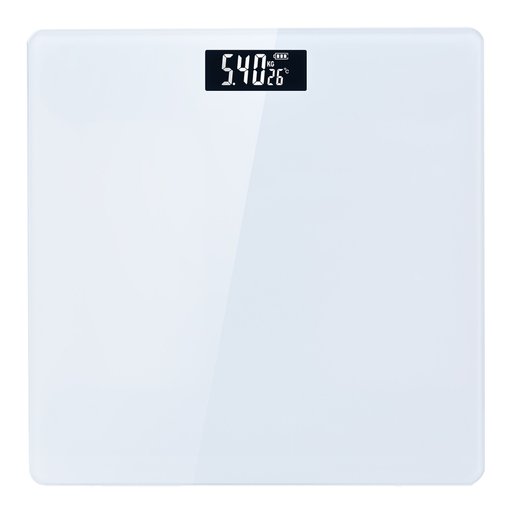
Why This Fits Their Persona: A simple choice for first-time buyers who want daily weight readings without app registration or Bluetooth setup.
It avoids unnecessary smart features and provides a direct LCD reading, while still offering a 180kg capacity and 0.05kg display increments.
4mm tempered glass, kg/lb switching and a compact 26 × 26cm format.
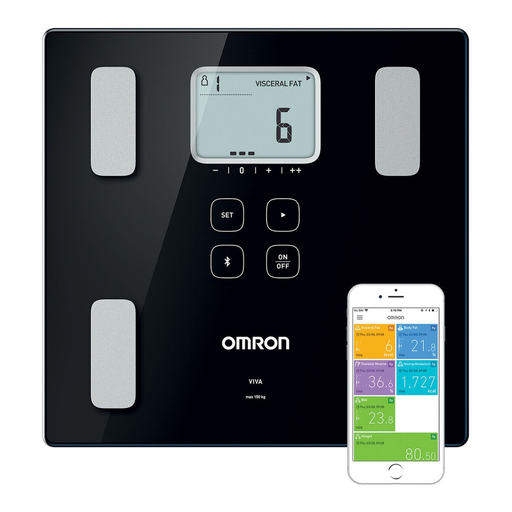
Why This Fits Their Persona: Suitable for users who prefer a recognised body composition monitor with a large display, app synchronisation and a defined set of six metrics.
The product listing clearly specifies six measurements and up to 30 stored readings, helping buyers avoid paying for an unclear or excessive metric list.
Bluetooth syncing with the OMRON connect app and a large, high-contrast LCD display.
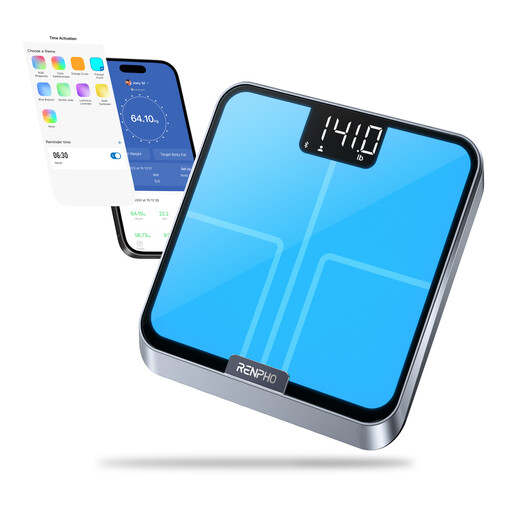
Why This Fits Their Persona: A practical match for people who want multiple body composition estimates and a history of measurements in a phone app.
The product specifies Bluetooth app storage, 13 metrics, unlimited user profiles and a weight-only mode, making its extra functions easier to assess before purchase.
180kg capacity, sound-activated connectivity and synchronisation options including Apple Health, Google Fit and Fitbit.
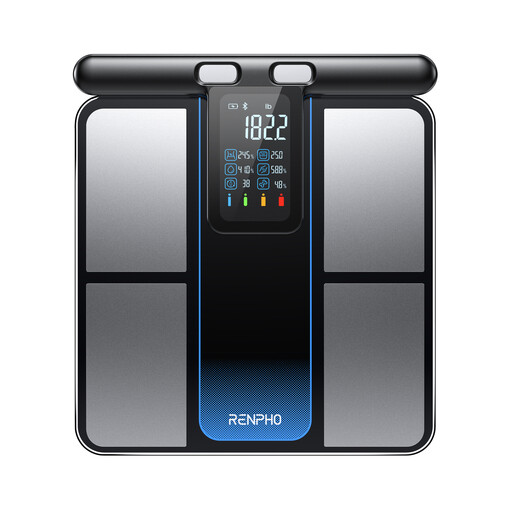
Why This Fits Their Persona: Designed for households wanting app-connected tracking, multiple profiles and a larger platform with handle-based measurements.
Its stated 180kg capacity and multi-user support address common family-use limitations. Buyers should still confirm app compatibility before ordering.
Retractable handle, bright LED display, Bluetooth app connection and third-party health app synchronisation.
We have compiled a complete, real-time list of products that fully satisfy these strict selection criteria and UK safety regulations.
Place the scale on a hard, level floor and keep it in the same position. Weigh at a consistent time, stand centrally with dry feet and remain still until the display settles. If a scale has been moved, follow its recalibration instructions before recording a result.
BIA functions should not be used by people with pacemakers or certain implanted medical devices unless the manufacturer and a healthcare professional confirm that use is appropriate. Pregnant users should follow the product guidance and generally use weight-only mode where advised. These products are for personal tracking, not diagnosis or treatment.
They can provide repeatable weight readings when used correctly. BIA estimates may fluctuate with hydration, meals, exercise and foot contact. Use the same routine each time and assess longer-term trends rather than reacting to one result.
Usually not. Most models can display weight without a phone, while Bluetooth transfers stored data when the app is available. Check the individual product instructions, as pairing, permissions and account requirements differ.
Battery-powered scales generally use very little energy because they activate only during weighing and return to standby afterwards. Smart models may use slightly more when connecting to an app, but there is no mains electricity cost. Check whether batteries are included: the Sparoma AD-26 listings specify that AAA batteries are not included.