
24/7 Customer Support

Free returns

Same-day & Next-day Delivery

Quality Guaranteed

Unlock Your Welcome Offers: FREE Delivery | Up to 80% OFF | Free 30-day JoyPlus trial
Download the APP
Smart scales can turn everyday weighing into a more organised routine, whether you are tracking weight, monitoring portions or recording food intake. However, not every product marketed as a “smart” scale offers the same type of information or convenience. A connected body scale, a Bluetooth kitchen scale and a basic digital bathroom weighing scale serve different purposes.
The following guide highlights common buying pitfalls, the specifications worth checking and our top recommendations for different household needs.
A scale may display weight clearly while its additional body composition readings require an app, bare feet and consistent measuring conditions. Body fat percentage, muscle mass and similar figures generated through Bio-electrical Impedance Analysis (BIA) should be treated as estimates for personal trend tracking, not medical assessments.
Read the product instructions carefully. For example, some users should avoid BIA functions, including people with certain implanted medical devices and pregnant people. Weight-only mode may be more appropriate in these circumstances, subject to the manufacturer’s instructions.
Bluetooth connectivity can be useful for viewing history, charts and nutritional information, but it also means downloading an app, creating a profile and keeping a compatible smartphone available. Check whether the scale connects to the health platforms you already use, such as Apple Health, Google Fit, Samsung Health or Fitbit.
If you only need an occasional reading, a straightforward digital bathroom weighing scale may offer better value than an app-connected model.
Even a high-precision scale can give inconsistent readings if it is placed on carpet, uneven flooring or a damp surface. Bathroom scales should normally sit on a solid, flat floor, with dry feet and no visible damage to the glass platform.
Also check the maximum capacity. A 180 kg limit is suitable for many households, but it should not be exceeded. Glass surfaces need careful handling and should be cleaned with a soft cloth rather than abrasive products or excess water.
For a body scale, check the displayed weight increments and maximum capacity. A 0.05 kg graduation, for example, offers more displayed detail than a scale using larger increments, although consistency of placement and weighing routine still matters.
For cooking, a nutritional kitchen scale with 1 g precision is more suitable for portion control, baking and recipe preparation. The required capacity is also different: a kitchen scale may support 3 kg or 10 kg, while a bathroom model commonly supports up to 180 kg.
A Bluetooth bathroom scale generally sends readings to a companion app rather than directly to the internet. Confirm:
Some app-connected weighing scales support unlimited user profiles, guest access or automatic user recognition. These functions can be practical for families, but each user should follow the pairing instructions to keep records separate.
Tempered glass is easy to wipe clean, but it should not be exposed to impact or standing water. Look for a display that is readable in the intended room and check how the product is powered.
Some models use replaceable AAA batteries, while others have a rechargeable battery with USB-C charging. A basic bathroom scale can be simpler to maintain, whereas a Bluetooth kitchen scale may benefit from rechargeable power if used frequently.
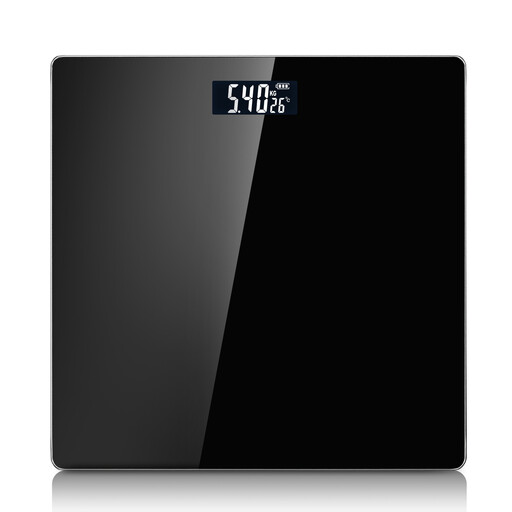
Why This Fits Their Persona: A practical choice for UK households wanting straightforward weight readings without app setup or Bluetooth pairing.
It does not rely on headline body composition features or an app. The 180 kg capacity and 0.05 kg displayed precision are clearly specified.
Large LCD display, 4 mm tempered glass and kg/lb measurement options.
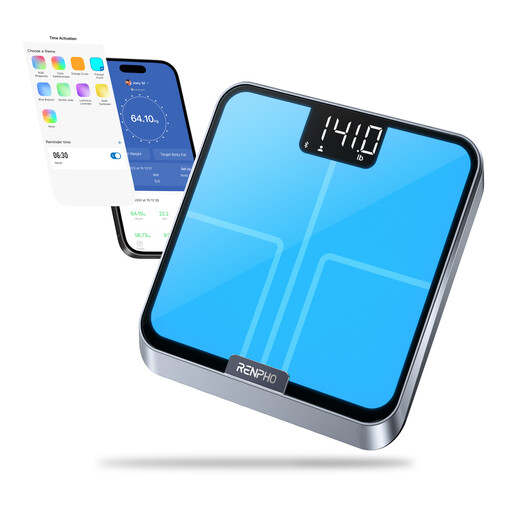
Why This Fits Their Persona: Suits users who want body composition trends, reminders and integration with established fitness platforms.
Its instructions explain the need for bare, dry feet, recalibration after moving and a solid floor, helping users set realistic expectations for readings.
Tracks at least 13 metrics, supports up to 180 kg, unlimited users and Baby Mode for children or pets.
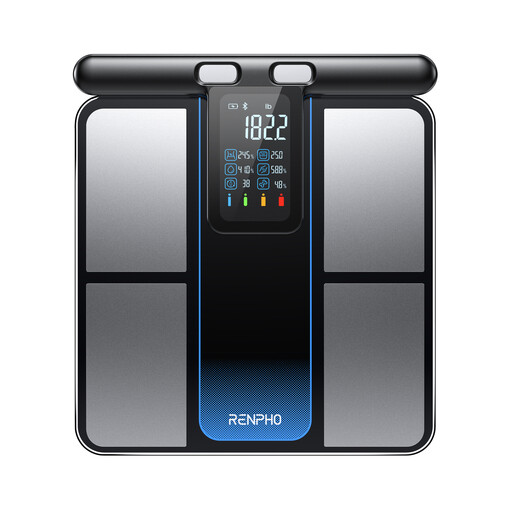
Why This Fits Their Persona: Designed for fitness-focused households seeking handle-based upper-body measurements and detailed app tracking.
It specifies eight electrodes, a retractable handle, Bluetooth app connectivity and a 180 kg limit rather than leaving the measuring method unclear.
Provides app-based trend charts, multiple user profiles and body metrics including weight, BMI, body fat and muscle mass.

Why This Fits Their Persona: A practical fit for meal planners, dieters and home cooks who want ingredient weights alongside nutrition records.
The stated 3 kg capacity and 1 g increments make its intended use clear, while the tare function helps separate container weight from ingredients.
Includes a removable 1-litre dishwasher-safe bowl, USB-C rechargeable power and Bluetooth nutrition tracking.
A smart body composition scale is designed for personal weight and body measurement trends. It normally uses a platform with foot electrodes and may require bare feet for BIA readings.
A Bluetooth kitchen scale is designed for ingredients and portion sizes. Look for:
Do not assume that an app-enabled kitchen scale can replace a bathroom scale. Their sensors, capacities and measurement ranges are built for different tasks.
We have compiled a complete, real-time list of products that fully satisfy these strict selection criteria and UK safety regulations.
They can provide consistent weight readings when used on a hard, level surface and under similar conditions. Body composition figures are estimates affected by factors such as hydration, foot contact and timing. Use the same routine when comparing personal trends, and do not treat these readings as a medical assessment.
Many Bluetooth scales can still display weight without a phone connected, but app history and additional data may require pairing. Check the specific product instructions before buying if offline weighing is important to you.
Running costs usually involve batteries or electricity for charging, plus any optional app-related costs. Models using AAA batteries require replacement batteries over time, while USB-C rechargeable models avoid regular disposable battery purchases. Check whether batteries are included and whether the app is free to download before placing an order.