A fruit smoothie can be a small drink with a festival meal, but it is not a zero-sugar choice simply because its label says ‘no added sugar’. The NHS advises limiting fruit juice, vegetable juice and smoothies to a combined 150ml a day and having smoothies at mealtimes; compare the sugars, ingredients and storage instructions on the bottle, and choose water for drinks between meals.
Who is this for?
Festival-goers avoiding added sugar
If you want a bottled fruit drink without added sugar, check the nutrition panel as well as the front of the pack. ‘No added sugar’ does not mean zero sugar, and the NHS’s combined 150ml daily guidance still applies to smoothies.
Shoppers looking for fruit and vegetables
Compare the ingredients and any stated vegetable or fibre content rather than assuming every smoothie has the same recipe. A smoothie may contribute to your 5 A Day, but a larger bottle does not count as several contributions.
Shoppers checking ingredients and storage
Added-vitamin or added-fibre recipes can contain ingredients beyond fruit. Check the exact pack for allergens, dietary suitability and chilled-storage instructions before taking it to a festival.
What should you check?
Start with the sugar wording and portion size, then choose a recipe whose ingredients and storage requirements fit your plans for the day.
| Priority |
What to check |
Your needs |
| Sugar and portion |
Read the ingredients and sugars line; ‘no added sugar’ does not mean zero sugar. Compare the pack volume with the NHS’s combined 150ml daily limit for juice and smoothies, and plan to have a smoothie with a meal. |
I want to know how much sugar is in the drink, rather than relying on a front-of-pack phrase. A large bottle also needs portioning if I plan to drink it myself. |
| Fruit, vegetables and fibre |
Compare the ingredients, any stated vegetable proportion and the fibre information. For a 5 A Day claim, check the serving rather than counting a larger bottle as multiple contributions. |
Vegetable ingredients or declared fibre matter more to me than the smoothie’s flavour name alone. |
| Dietary suitability |
Check the current pack for vegan suitability where relevant, the full ingredients list and highlighted allergens. Added-fibre or vitamin recipes may contain ingredients such as oats. |
I need a recipe that fits my ingredient requirements, not just a fruit-sounding description. |
| Chilled storage |
Read the refrigeration and after-opening instructions on the exact bottle. Consider whether you can follow them for the time you will be away. |
If I am carrying a smoothie around a festival, I need to be able to store it as the pack directs. |
Common buying mistakes
-
Reading ‘no added sugar’ as ‘zero sugar’
Fruit and vegetable sugars remain in a no-added-sugar smoothie. The NHS treats sugars released by blending as free sugars.
Read the sugars line and ingredients on the current pack. If you need to avoid sugar for a prescribed diet, seek individual advice rather than relying on front-of-pack wording.
-
Treating a large bottle as one portion
A 750ml bottle is larger than the NHS’s combined 150ml daily limit for juice and smoothies.
Compare the bottle volume with the amount you intend to drink, and follow its storage instructions if you keep any for later.
-
Using a smoothie as the main festival drink
The NHS’s portion guidance applies even when a smoothie is bought as a convenient drink, and it advises having smoothies at mealtimes rather than between meals.
Choose water for drinks between meals and, if you want a smoothie, plan it as a small drink with food.
-
Overlooking ingredients and chilled storage
An added-ingredient smoothie may not suit every dietary requirement. For example, M&S states that its Defend smoothie is unsuitable for people with coeliac disease or a wheat allergy.
Check the exact bottle’s allergen statement and storage instructions. Choose another option if you cannot follow the stated chilled conditions.
Brands and product ranges
These examples show why the recipe and current label matter more than the brand name alone.
Innocent
Innocent makes fruit and fruit-and-vegetable smoothies. Its no-added-sugar wording is relevant if you are avoiding added sugar, but it does not mean the drinks are sugar-free.
- Waitrose lists Innocent Fruit + Veg as 25% vegetables, with a fibre claim and a stated 5 A Day contribution.
- The listing also says its sugars occur naturally in fruit and vegetables. The NHS’s combined 150ml daily juice-and-smoothie guidance still applies.
M&S Food
M&S lists fruit smoothies as well as recipes with added ingredients. Check the particular recipe when choosing for fibre, vitamins or dietary suitability.
- M&S lists chicory fibre, linseed, oat drink and added vitamins in its Defend smoothie; its nutrition panel gives 8.7g sugars per 100g.
- M&S states that Defend is unsuitable for people with coeliac disease or a wheat allergy. Read the current label, as product information may change.
Naked
Naked Green Machine is an example to consider if vegan suitability and added vitamins are relevant to your choice.
- Tesco lists Green Machine as suitable for vegans and describes it as a fruit juice drink partially from concentrate with added vitamins.
- Vegan suitability and added vitamins do not establish that a drink is zero sugar. Check the current nutrition panel and ingredients.
A Joybuy smoothie option
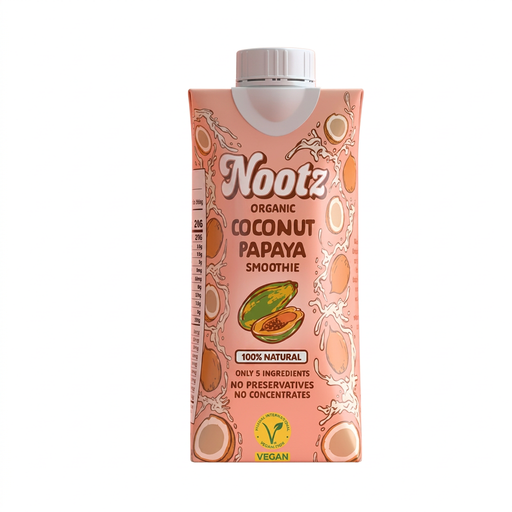
This coconut-milk-and-papaya smoothie is an option for a drink with a festival meal. Check its ingredients and portion size if your priority is avoiding added sugar or staying within the NHS’s combined 150ml daily juice-and-smoothie guidance.
 No image available
Nootz Coconut Milk Smoothie Papaya 180ml
The 180ml pack is larger than the NHS’s combined 150ml daily guidance for juice and smoothies, so consider how much you intend to drink with a meal. Its product information identifies organic cane sugar; do not treat it as a no-added-sugar or zero-sugar option. After opening, refrigerate and consume within 24 hours as directed.
Joybuy
Frequently asked questions
Does ‘no added sugar’ mean a smoothie is zero sugar?
No. Fruit and vegetables can contribute sugars to a smoothie even when no sugar has been added. The NHS treats sugars released by blending as free sugars, so check the drink’s nutrition panel rather than relying on a no-added-sugar claim.
How much smoothie does the NHS advise drinking?
The NHS advises limiting fruit juice, vegetable juice and smoothies to a combined 150ml a day. Compare that amount with the bottle size, and follow the pack’s storage directions if you save some for later.
Is a smoothie a good drink between festival meals?
The NHS advises having smoothies at mealtimes rather than between meals because blending releases sugars that can affect teeth. Choose water for drinks between meals.
Which label details matter before buying?
Check the exact bottle’s ingredients, highlighted allergens, dietary-suitability statements, sugars information and storage instructions. Recipes can differ: M&S, for example, states that its Defend smoothie is unsuitable for people with coeliac disease or a wheat allergy.


