What should you check?
Start with the portion you would actually drink, then compare its nutrition and ingredients with when you plan to have it.
| Priority |
What to check |
Your needs |
| Carbohydrate and timing |
Check carbohydrate per stated serving and the number of servings in the bottle. If choosing a post-run snack, check protein too. |
I want to know what my planned portion contributes to a snack or meal, without treating the drink as my whole race-fuelling plan. |
| Pre-run comfort |
Read fibre per serving and look for added ingredients such as chicory-root fibre or seeds. Consider the portion and timing you have practised in training. |
Before a key run, I would rather stick with a familiar option than try a new blend. The UK Sports Institute advises lower-fibre choices when trying to minimise gastrointestinal distress before training. |
| Sugar claims |
Compare sugars and carbohydrate in the portion, as well as the ingredients. “No added sugar” does not mean the drink contains no naturally occurring sugars. |
A front-of-pack claim is not enough for me; I want to know how much sugar is in the amount I will drink. |
| Portion size |
Compare bottle volume with its stated serving size and follow the product’s storage instructions after opening. The NHS advises a combined daily limit of 150ml for fruit juice and smoothies. |
If I buy a larger bottle, I want to measure a portion rather than assume the whole bottle is one serving. |
Brand and retailer references
These examples show why the label of the individual drink matters more than the name of its brand or retailer.
Innocent
Its listed range includes standard fruit smoothies and blends with added vitamins or botanicals.
- Tesco lists 18g carbohydrate, 15g sugars, 1.8g fibre and 0g protein per 150ml serving of Mangoes, Passion Fruits & Apples.
- Other Innocent blends have different ingredients, including guarana or seeds; check the exact product rather than applying one label to the range.
Naked
Its listed drinks include Green Machine and the added-fibre Fibre Machine.
- Tesco’s Fibre Machine listing states 4.2g fibre per serving and identifies added chicory-root fibre.
- A high-fibre formulation may be a poor choice immediately before training if you are trying to minimise gut discomfort.
Sainsbury’s
Its smoothie listings include own-label fruit blends alongside branded drinks.
- The listed own-label range includes Mango & Passionfruit and Strawberry & Banana 750ml smoothies.
- Check the chosen bottle’s nutrition panel; a range listing cannot establish the carbohydrate or fibre in every blend.
M&S Food
Its range includes fruit smoothies and selected blends described as containing yoghurt, dates or oats.
- M&S lists 13.5g carbohydrate, 12.9g sugars, 0.7g fibre and 0.6g protein per 100g for its Mango, Pineapple and Passion Fruit Smoothie.
- Ingredients and nutrition vary between blends, so check the exact product and any relevant allergen information.
Tesco
Its drinks listings distinguish smoothies from other juices and include a reduced-sugar juice-and-smoothie category.
- Individual listings can provide serving sizes and nutrition panels for comparison.
- That category also contains juice drinks. Check the product type before comparing one with a smoothie.
Joybuy smoothie option
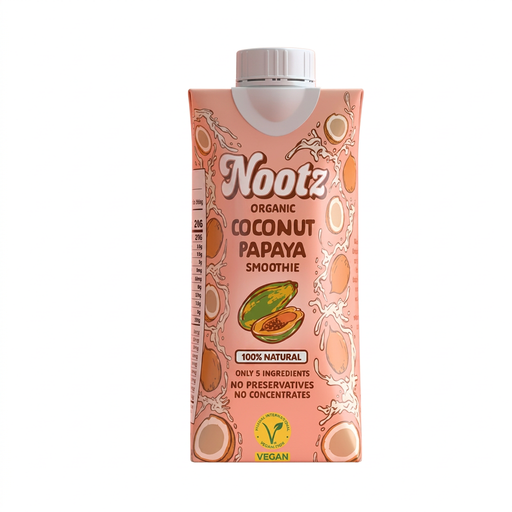
This coconut milk and papaya smoothie is a packaged option to assess as a snack during training; its label and your intended portion matter when deciding when to drink it.
 No image available
Nootz Coconut Milk Smoothie Papaya 180ml
For a packaged snack outside the immediate pre-run window, compare your intended portion with the label: the description lists 9g carbohydrate, 7g sugars and 6g fat per 100g, and names cane sugar as an ingredient. The pack is 180ml, while nutrition is stated per 100g, so do not treat those figures as amounts for the full pack. Check the fibre value on the product label if it matters to your pre-run choice; the UK Sports Institute advises lower-fat, lower-fibre foods when trying to minimise gastrointestinal distress before training.
View on Joybuy
Frequently asked questions
Does “no added sugar” mean a smoothie is sugar-free?
No. A fruit smoothie can contain naturally occurring sugars without added sugar. For example, Tesco lists 15g sugars per 150ml serving of Innocent Mangoes, Passion Fruits & Apples, which is labelled as having no added sugar. Check the sugars line for the portion you plan to drink.
How much smoothie counts towards 5 A Day?
The NHS says fruit juice, vegetable juice and smoothies count only once towards 5 A Day and advises limiting them to a combined 150ml a day. Check the serving size when buying a larger bottle.
Should I have a high-fibre smoothie before a long run?
Do not assume it will suit your pre-run routine. The UK Sports Institute advises lower-fibre foods before training when the aim is to minimise gastrointestinal distress. Check the drink’s fibre and ingredients, and try its portion and timing during training rather than for the first time before a key run.
Can a smoothie replace a marathon fuelling plan?
A smoothie can contribute carbohydrate, but it is not a substitute for a personalised, practised plan. World Athletics’ distance-running nutrition research describes balancing carbohydrate and fluid intake against the risk of gut discomfort; the drink’s portion, composition and timing all matter.
How should I store an opened chilled smoothie?
Follow the instructions on the bottle you buy. For example, M&S says to refrigerate its Mango, Pineapple and Passion Fruit Smoothie at 0°C to +5°C and drink it within four days of opening; other products may have different instructions.


