Shoppers comparing sugar labels
If you want a fruit drink while revising, the total-sugars figure tells you something a ‘no added sugar’ claim does not. Check the figure against the portion you would actually drink.


For an exam-revision snack, choose a smoothie by the amount you plan to drink, its total sugars and its ingredients rather than a ‘no added sugar’ claim alone. The NHS advises limiting fruit juice and smoothies to a combined 150ml a day and counts sugars in smoothies as free sugars; a full bottle may be larger than that amount.
If you want a fruit drink while revising, the total-sugars figure tells you something a ‘no added sugar’ claim does not. Check the figure against the portion you would actually drink.
A bottle can be convenient at a desk or library, but its full volume may exceed the NHS guidance of 150ml a day for fruit juice and smoothies combined. Consider whether you can portion and store what remains.
A frozen mix offers a make-at-home option if you have suitable storage. Read its ingredient and allergen label, and check whether nutrition figures describe the mix or the finished drink.
Start with the portion you intend to drink, then read the sugar and ingredient information for that amount.
| Priority | What to check | Your needs |
|---|---|---|
| Portion size | Compare the bottle volume with its stated serving size. The NHS advises no more than 150ml a day of fruit juice and smoothies combined; Tesco Groceries lists five 150ml servings in its 750ml Innocent bottle. | I want a drink I can portion during revision, rather than assuming the whole bottle is one serving. |
| Total sugars | Read ‘of which sugars’ and note whether the figure is per 100g, per serving or per bottle. The NHS says sugars in smoothies count as free sugars even when no sugar has been added. | ‘No added sugar’ is useful label information, but I need the total-sugars figure for the amount I plan to drink. |
| Ingredients | Check the current ingredient and allergen list for the specific product. Marks & Spencer lists oat beta-glucan containing gluten in its Green Smoothie Mix. | If I avoid an ingredient, I need to check the particular pack rather than assume all fruit smoothies use the same recipe. |
| Preparation and storage | Check whether the drink is ready to use or needs preparing, and follow its chilled, frozen and after-opening instructions. For a frozen mix, check whether the nutrition values refer to the mix or the prepared drink. | A ready-to-drink bottle suits taking to a study session; a frozen mix works only when I can prepare and store it as directed. |
A smoothie can contain sugars without added sugar. The NHS counts sugars in smoothies as free sugars, while Tesco Groceries declares 20g sugars per 250ml bottle of Mockingbird Raw Greens.
Read the total-sugars figure alongside the ingredients and the amount you intend to drink.
Pack size and serving size are not necessarily the same: Tesco Groceries identifies five 150ml servings in a 750ml Innocent bottle. The NHS guidance is 150ml a day for fruit juice and smoothies combined.
Check the stated serving size before opening a multi-serve bottle, and plan how to store the remainder.
A figure per 100g of frozen mix does not describe a whole bottle or necessarily a finished drink. Comparing those figures without considering the amount used can distort the choice.
Put figures on the same stated basis and check what goes into a prepared serving.
A chilled multi-serve drink and a frozen mix require different storage. Marks & Spencer identifies oat beta-glucan containing gluten in its Green Smoothie Mix.
Follow the pack’s storage and after-opening instructions, and check its current allergen information before purchase.
These examples show which product details are worth comparing; they do not describe every smoothie sold by each brand or retailer.
Tesco Groceries lists Innocent Mangoes, Passion Fruits & Apples Smoothie in a 750ml bottle.
Tesco Groceries provides product listings for the Innocent bottle and a 250ml Mockingbird Raw Greens smoothie.
Marks & Spencer lists both a ready-made Mango, Pineapple and Passion Fruit Smoothie and a Green Smoothie Mix for preparation at home.
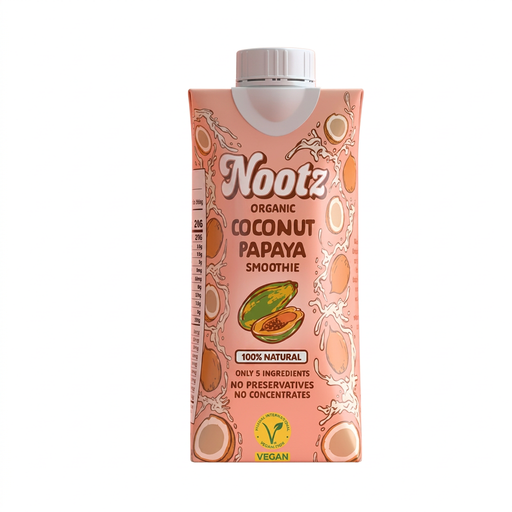
This ready-to-drink coconut-milk and papaya smoothie is an option to assess by pack volume, ingredients and the portion you intend to drink during revision.
 No image available
The 180ml pack is a ready-to-drink option, but drinking it all exceeds the NHS advised daily combined 150ml amount for fruit juice and smoothies. It contains cane sugar, so it is not a zero-sugar option. Check the pack label for the sugar figure that applies to the amount you will drink.
No. It does not mean the total-sugars figure is zero. The NHS counts sugars in smoothies as free sugars, so check the nutrition label for the portion you intend to drink.
The NHS Eatwell Guide advises limiting fruit juice and smoothies to a combined total of no more than 150ml a day. Check the bottle volume as well as its stated serving size.
Drinking the full 250ml bottle exceeds the NHS advised daily combined amount of 150ml for fruit juice and smoothies. Tesco Groceries declares 20g sugars per 250ml bottle of Mockingbird Raw Greens; read the figure for the amount you would actually drink.
Check its storage directions, ingredients and allergens, and whether its nutrition figures apply to the mix or a prepared drink. Marks & Spencer lists oat beta-glucan containing gluten in its Green Smoothie Mix.