
24/7 Customer Support

Free returns

Same-day & Next-day Delivery

Quality Guaranteed

Unlock Your Welcome Offers: FREE Delivery | Up to 80% OFF | Free 30-day JoyPlus trial
Download the APP
A smoothie maker can simplify breakfast, packed lunches and homemade snacks, but the wrong model may quickly become an expensive cupboard appliance. Marketing often focuses on motor wattage or the number of advertised functions, while the details that affect daily use receive less attention.
Before buying, watch for these common pitfalls:
For soft fruit, yoghurt and leafy ingredients, a compact smoothie blender can be adequate. If you regularly use frozen berries, ice or fibrous vegetables, look for practical features such as pulse control, an ice-crushing setting and suitable blade construction.
A 300W personal smoothie blender, such as the Tefal Mix & Move, is designed around single-serve drinks. A 600W jug blender, such as the Braun PowerBlend 1, offers more capacity and includes an ice-crush function. Higher-rated models may be useful for tougher ingredients, but they can also be larger, louder or more expensive to run and store.
Always follow the manufacturer’s instructions. Cut large ingredients into smaller pieces, add sufficient liquid and avoid overfilling.
Choose capacity according to how you prepare drinks:
Glass jugs can feel sturdy and resist odour retention, although they are heavier. Tritan or other BPA-free plastic containers are lighter and more practical for carrying. Check whether bottles include sealed drinking lids and whether the container is designed for blending directly.
A smoothie maker that is difficult to clean may be used less often. Look for removable blades, dishwasher-safe detachable parts and a base that can be wiped clean. Never immerse the motor base in water.
For UK use, check that the appliance is intended for a 220–240V supply, has clear operating instructions and includes appropriate safety features such as a lid lock or secure bottle indicator. Do not blend hot liquids unless the manual specifically permits it, and keep hands and utensils away from moving blades.

Why This Fits Their Persona: A practical choice for one-person households, office commutes and simple morning routines, with two 0.6L bottles included.
Its use case is clear rather than overloaded: blend directly into the bottle, use the pulse function for suitable frozen ingredients and rinse the removable blade promptly.
300W motor, two 0.6L Tritan bottles, one-button control and dishwasher-safe parts.
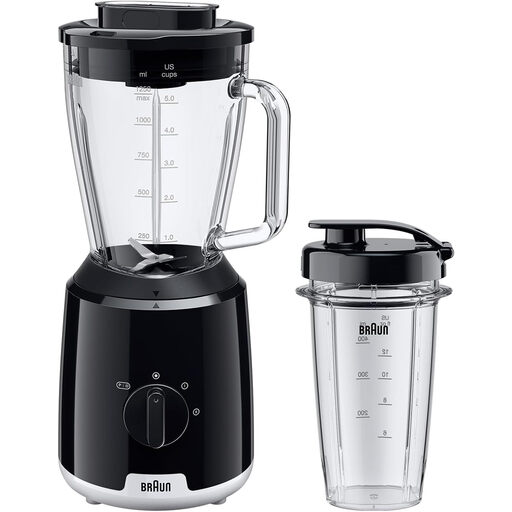
Why This Fits Their Persona: Suitable for households wanting a glass jug for everyday smoothies, sauces and frozen drinks without moving to a larger appliance.
The 1.5L glass jug gives clearer batch capacity information, while two speeds and an ice-crush function provide defined everyday controls.
600W motor, 1.5L triangular glass jug, Smoothie2Go bottle and dishwasher-safe jug, lid and blades.
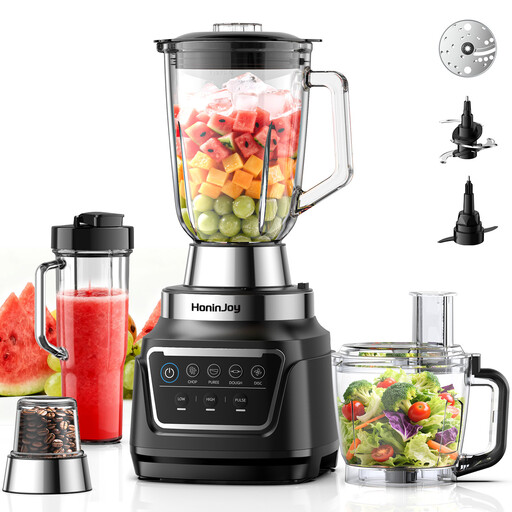
Why This Fits Their Persona: Designed for larger cooking routines involving smoothies, chopping, grinding, dough preparation and vegetable slicing.
Its expanded function set is matched with stated bowl and jar capacities, so buyers can assess whether the storage and cleaning workload suits their kitchen.
1300W maximum power, 1.5L blender pitcher, 2L food processor bowl, grinder jar and dishwasher-safe detachable parts.
A blender for smoothies works best when ingredients are loaded sensibly. Add liquid first, followed by soft fruit, leafy ingredients and frozen items. Do not exceed the marked fill line. For organic fruit smoothies, compare the ingredient list rather than relying only on front-of-pack wording.
For babies aged 6 months and over, ready-to-eat fruit pouches can be convenient when travelling. Ella’s Kitchen The Pink One contains organic apples, bananas, raspberries and rhubarb, with no added sugar. The Yellow Fruit option combines organic bananas, apples, apricots and pineapple. Squeeze onto a spoon, check the label for current information and follow the storage instructions after opening. These products should form part of a varied diet, and packaging caps must be kept away from young children.
A smoothie maker with bottles is useful for adults who need portable drinks, while a baby food blender may be more suitable when preparing fresh purées at home. These are different buying decisions, so consider portion size, texture control and cleaning before choosing one appliance for every task.
The terms are often used interchangeably. A personal smoothie maker usually refers to a compact appliance that blends directly into a bottle or cup. A smoothie blender may describe either a personal model or a larger jug blender. Check the capacity, blade system and included containers rather than relying on the product title.
Some can, but performance depends on the motor, blade design and instructions. Look for a stated ice-crush or pulse function and use small quantities with enough liquid. A frozen drink maker or specialist frozen-dessert appliance uses a different process, so it may not replace a conventional blender for sauces or fresh smoothies.
Rinse the jug or bottle immediately after use, use the correct fill level and avoid unnecessarily long blending cycles. Dishwasher-safe parts can reduce washing time, but check which components are suitable. A smaller personal blender may use less worktop space, while a larger multifunction blender can replace several kitchen appliances if you regularly use its extra attachments.
We have compiled a complete, real-time list of products that fully satisfy these strict selection criteria and UK safety regulations.