People planning individual snacks
Individually wrapped bars make the serving in a shared box easier to identify. Compare the energy and sugars for that bar with the snack you have planned, not just the figures per 100g.


Choose a snack-bar multi-pack by the nutrition of the bar you intend to eat, rather than its pack count or a protein, fibre or no-added-sugar claim. Compare kcal and sugars per bar for a planned snack, then check values per 100g to compare different-sized bars; a larger protein bar may fit a different snack plan from a smaller oat bar.
Individually wrapped bars make the serving in a shared box easier to identify. Compare the energy and sugars for that bar with the snack you have planned, not just the figures per 100g.
A protein or fibre claim may help narrow the options, but bar sizes differ. Check the whole serving alongside the nutrient that interests you.
Check the current ingredients, allergen statements and dietary markings for every flavour in the exact pack. A claim on one bar does not establish that every variant in a brand’s range has the same recipe.
Start with the serving you would actually eat. Use the per-100g panel to compare bars of different sizes, then check the per-bar figures and the contents of the multi-pack.
| Priority | What to check | Your needs |
|---|---|---|
| Portion and energy | Check the bar’s weight and kcal per bar. Compare per 100g when bar sizes differ, then use the serving figure for your planned snack. | I want to know what one wrapped bar contributes before choosing a box to use over several days. |
| Sugars and saturated fat | Read sugars and saturated fat per 100g and per bar, alongside the ingredients. NHS guidance identifies more than 22.5g sugars or 5g saturated fat per 100g as high. | A no-added-sugar or wholegrain claim is not enough for me to compare the complete nutrition of two bars. |
| Protein, fibre and size | Compare protein and fibre for the stated serving, then check its weight, kcal and sugars. Do not use a single nutrient claim as a substitute for the full label. | When I choose a protein or fibre bar, I also want to know whether it is the size of the snack I had in mind. |
| Sharing and suitability | Check the number of bars and whether flavours differ. Read each current ingredient list, allergen warning and relevant dietary marking. | Others will share this pack, so each included flavour needs to meet their requirements. |
Protein, fibre and wholegrain claims do not describe a bar’s complete nutrition. In its November 2025 audit of 458 snack bars from 10 major retailers, Action on Salt & Sugar classified 37% as high in sugars and 55% as high in saturated fat under UK front-of-pack thresholds.
Compare energy, sugars and saturated fat per bar and per 100g, as well as the protein or fibre you are looking for.
Bar count does not tell you the serving size: the Sainsbury’s listing for Eat Natural Apple describes 25g bars at 86 kcal each, while Ocado lists 50g TREK variety-pack flapjacks at 224–244 kcal each, depending on flavour.
Choose the serving first; use the number of bars to decide whether the pack suits repeated use or sharing.
Tesco Groceries lists 13g sugars per 45g bar for Nakd Peanut Butter Protein, which is also labelled no added sugar. The wording does not replace the total “of which sugars” figure.
Read that figure for the exact bar and use the ingredients list for context.
Ingredients and allergen statements matter at variant level. Tesco Groceries lists peanuts in Nakd Peanut Butter Protein and warns that it may contain soya and nuts.
Check the current label for every included flavour before buying or sharing where an allergy or dietary requirement applies.
These examples show why the exact variant and serving matter more than a brand name; they do not describe every bar in each range.
Graze offers Oat Boost multi-packs. Tesco Groceries lists the Cocoa Vanilla pack as four 30g bars.
Nature Valley’s UK range includes Crunchy family packs and an eight-bar Protein Peanut & Chocolate big pack.
Ocado lists a TREK Protein Flapjacks variety pack containing individually wrapped 50g bars in four flavours.
Nakd makes fruit-and-nut bar multi-packs, including a three-bar Peanut Butter Protein pack listed by Tesco Groceries.
Eat Natural offers fruit-and-nut bar multi-packs. Sainsbury’s lists the Apple Soft Fruit four-pack with individually wrapped 25g bars.
Alpen is a familiar cereal-bar name, but the exact product matters when comparing packs.
These oat, fruit-and-nut and protein-bar packs offer different serving sizes for planned snacks or sharing. Check the current nutrition and allergen label for the exact flavour before deciding which fits your needs.
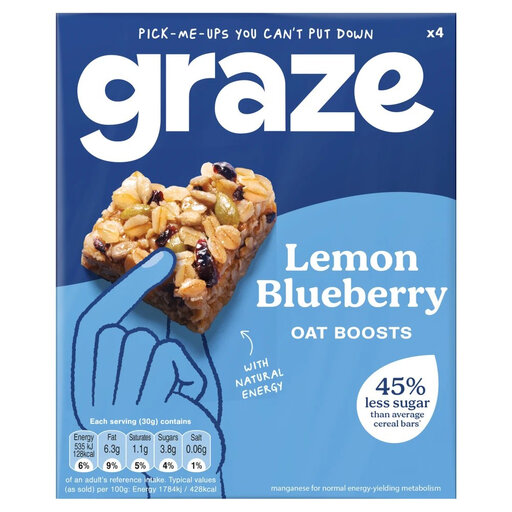 No image available
A four-pack of 30g oat bars to consider when you want a smaller planned serving. Compare its per-bar sugars and energy with other flavours, and check the current allergen statement before sharing.
 No image available
Another four-pack with 30g bars for a planned oat-bar snack. Check the Cherry Bakewell label itself rather than assuming its nutrition or allergen information matches another Graze flavour.
 No image available
This four-pack has 35g fruit-and-nut bars. If you are comparing it with oat or protein bars, pay particular attention to sugars per bar as well as energy, and check the nut-allergen statement.
 No image available
Consider this 12-pack when a 50g protein bar is the serving you intend to have. Compare its energy, sugars and protein per bar with smaller options, and check the current ingredients and allergens.
 No image available
This Golden Caramel option is also a 12-pack of 50g protein bars. Use its own per-bar nutrition and allergen label for the decision; flavour variants should not be treated as nutritionally identical.
Use both: per 100g helps compare differently sized bars, while kcal per bar describes the wrapped serving you plan to eat. NHS label guidance notes that portion figures may be provided as well as per-100g values; check whether the stated portion matches yours.
No. Tesco Groceries lists 13g sugars per 45g bar for Nakd Peanut Butter Protein despite its no-added-sugar label. Compare the “of which sugars” figure on the exact product.
No; compare the complete serving with the snack you have planned. Ocado lists 9g plant protein in each 50g TREK variety-pack flapjack, alongside 224–244 kcal depending on flavour, so the protein figure alone does not settle the choice.
Start with the per-100g nutrition panel: NHS guidance describes more than 22.5g sugars per 100g as high in sugars and more than 5g saturated fat per 100g as high in saturated fat. Then check the per-bar figures for the amount you would eat.
No. Check the current ingredients, allergen statement and dietary markings for each included flavour. For example, Tesco Groceries lists peanuts in Nakd Peanut Butter Protein and warns that it may contain soya and nuts; that information applies to the identified bar, not every Nakd product.