People planning individual portions
If you use a wrapped bar as a planned snack, the kcal in that bar matters more to your plan than the multipack’s total weight. Check whether the pack contains the portion size you intend to eat.


Choose a snack-bar multipack by the portion you will eat: check kcal per wrapped bar, then compare fibre, protein, sugars, saturated fat and allergens. A smaller flapjack may fit a planned smaller snack, while a protein-and-fibre bar offers a different nutrient mix; neither format determines whether the portion fits your overall intake. NHS guidance recommends reading nutrition information both per portion and per 100g.
If you use a wrapped bar as a planned snack, the kcal in that bar matters more to your plan than the multipack’s total weight. Check whether the pack contains the portion size you intend to eat.
If protein or fibre is a priority, compare the declared amount per bar alongside its kcal, sugars and saturated fat. A protein-labelled bar is not necessarily a smaller portion.
Vegan or gluten-free descriptions do not replace an ingredient and allergen check. Read the label of the exact flavour and pack, particularly where peanuts, nuts, milk, soya or cereals containing gluten matter to you.
Start with the wrapped portion, then use the full nutrition and ingredient information to compare bars that meet your preferences.
| Priority | What to check | Your needs |
|---|---|---|
| Portion and kcal | Check the number of bars, grams per bar and kcal per bar. Use the per-100g figures to compare products of different sizes. | I want to plan for the bar I will actually eat, rather than mistake the whole multipack for one serving. |
| Protein and fibre | Compare the declared grams per bar, then read kcal and the rest of the nutrition panel. Check the exact flavour rather than relying on a range-wide description. | If I am choosing a protein-and-fibre bar, I want to know what that particular portion provides alongside its other nutrients. |
| Sugars and saturated fat | Read total sugars and saturated fat per bar and per 100g. A “no added sugar” description does not give the total sugars figure. | A fruit-based, nut-based or chocolate-coated bar may appeal to me, but I still want to compare its full label. |
| Ingredients and allergens | Check the current pack’s ingredient list and any precautionary “may contain” statement. Confirm dietary descriptions for the exact variant. | Where an ingredient or possible trace matters to me, I need the details for the bar I am buying, not just its brand or product range. |
The nākd. Peanut Butter Protein bar is described by Tesco Groceries as having no added sugar, yet its listing gives 13g total sugars and 189 kcal per 45g bar. These figures describe different things.
Read total sugars and kcal per bar before deciding whether the portion fits your plan.
Per-100g figures help compare composition, but bars of different weights contribute different amounts when eaten whole. Tesco Groceries lists the Graze Cocoa Vanilla Oat Boost at 30g per bar; Holland & Barrett lists the TREK Biscoff Protein Flapjack at 50g.
Compare per 100g, then check the figures for each wrapped bar.
Other nutrients and allergens can change the decision. Eat Natural lists 5.6g saturated fat per 40g Peanuts & Dark Chocolate protein bar, while Holland & Barrett lists 12g sugars and 4.4g saturated fat per 50g TREK Biscoff flapjack.
Read the nutrition panel, ingredients and any “may contain” statement for the exact bar.
Pack counts and bar weights differ, so the number of wrapped snacks and the amount in each one may not match what you expect.
Check the bar count, weight per bar and current pack label before choosing a larger pack. Waitrose & Partners cautions that product recipes can change.
Brand ranges contain different bar sizes and recipes; use these examples to identify formats, then check the label of the exact product.
Its Oat Boost range includes smaller flapjack multipacks. Tesco Groceries lists Cocoa Vanilla Oat Boosts as four 30g bars with 116 kcal per bar.
Its range includes crunchy and protein bars. Nature Valley lists Protein Peanut & Chocolate in an eight-bar pack.
Its Peanut Butter Protein multipack contains three 45g bars. Tesco Groceries lists 189 kcal, 7.6g protein, 6.8g fibre and 13g sugars per bar.
TREK offers protein flapjacks as well as protein bars. Holland & Barrett lists its Biscoff Protein Flapjack as a three-pack of 50g bars.
Its protein range includes nut-and-chocolate bars. Eat Natural lists 40g for its Peanuts & Dark Chocolate variant.
Alpen is a familiar name in this category, but its product-availability information needs checking for any particular bar.
These options cover smaller oat bars and several protein-bar or flapjack formats. Compare the portion and the exact pack label before choosing; the products below are not all the same size or flavour.
 No image available
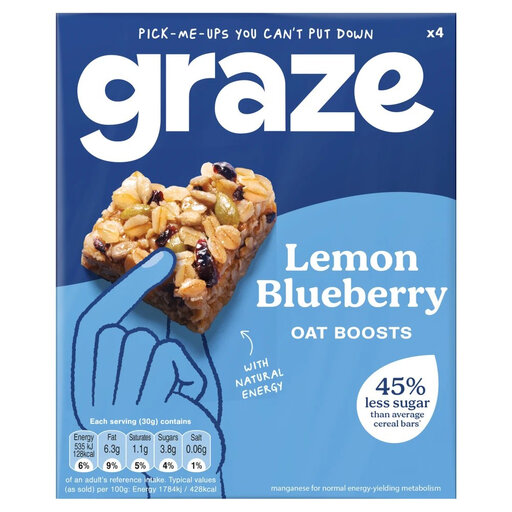
Four 30g portions offer a smaller-bar format for a planned snack. Check the Lemon Blueberry label for kcal, fibre in grams and allergens rather than applying figures from another Oat Boost flavour.
 No image available
This four-pack provides 40g bars for shoppers considering a protein-bar format. Read the Salted Caramel Nut label for its per-bar nutrition and allergens; figures for Nature Valley’s Peanut & Chocolate variant do not establish those details.
 No image available
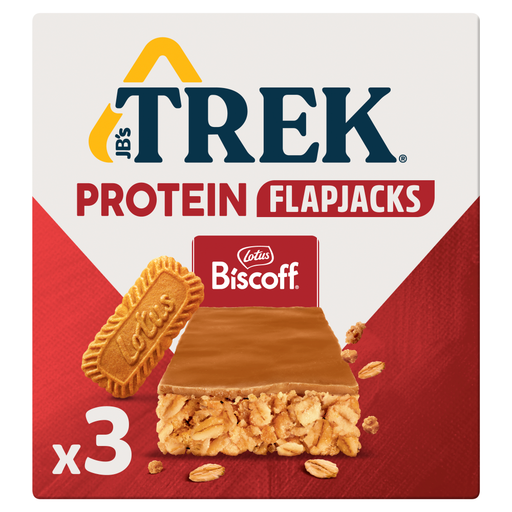
Consider this three-pack if you prefer a 50g flapjack portion. Holland & Barrett lists 230 kcal, 9.8g protein, 2.2g fibre, 12g sugars and 4.4g saturated fat per Biscoff bar; its ingredient information includes wheat, oats and soya.
 No image available
This 12-pack contains 50g protein bars. If you are comparing it with smaller wrapped snacks, check the Double Chocolate bar’s kcal and full nutrition panel per bar, along with its ingredients and allergens.
 No image available
This Peanut Butter variant also comes as twelve 50g bars. Check its own per-bar nutrition and ingredient list rather than assuming it matches the Double Chocolate flavour; pay particular attention to allergen information if peanuts matter to you.
Use both: per 100g puts different products on the same weight basis, while kcal per bar describes the wrapped portion you are likely to eat. NHS food-label guidance explains these two ways of presenting nutrition information.
No. It does not state the amount of total sugars in the bar. Tesco Groceries lists the nākd. Peanut Butter Protein 45g bar as having no added sugar while declaring 13g sugars and 189 kcal per bar, so check the nutrition panel.
No. Compare its wrapped portion and full nutrition with the alternatives you would actually eat. For example, Nature Valley states that its 40g Protein Peanut & Chocolate bar has around 10g protein and 4g fibre, while Holland & Barrett lists 230 kcal for a 50g TREK Biscoff Protein Flapjack; those figures answer different parts of the buying decision.
Read the current pack’s ingredients and any relevant “may contain” statement. GOV.UK guidance says that, for UK prepacked food, ingredients from the 14 regulated allergen groups must be clearly labelled in the ingredients list; check the exact flavour rather than relying on a brand-wide description.