Tea-break snackers watching portion calories
If you plan to eat one packaged bar with a drink, start with kcal per bar. Compare kcal per 100 g as well when bar sizes differ; a smaller serving does not necessarily mean a less energy-dense product.


For an afternoon tea break, compare calories for the portion you will eat before choosing between an oat bar, a fruit-and-nut bar and a protein bar. Tesco lists 116 kcal for a 30 g Graze Cocoa Vanilla Oat Boost, Sainsbury’s lists 131 kcal for a 35 g nākd. Blueberry Muffin bar, and Nature Valley lists 196 kcal for its 40 g Protein Peanut & Chocolate bar. A smaller serving is not by itself a low-energy product: check the per-100 g figure, sugars and the exact pack’s allergen information too.
If you plan to eat one packaged bar with a drink, start with kcal per bar. Compare kcal per 100 g as well when bar sizes differ; a smaller serving does not necessarily mean a less energy-dense product.
If you need a vegan, gluten-free or dairy-free bar, check those statements on the exact product. Sainsbury’s lists nākd. Blueberry Muffin as suitable for vegans and free from gluten and dairy; ingredient and may-contain statements still matter for other requirements.
If protein matters more to you than the smallest calorie figure, compare the amounts per bar alongside its calories. Nature Valley lists around 10 g protein, around 4 g fibre and 196 kcal for a 40 g Protein Peanut & Chocolate bar.
Start with the serving you would actually eat, then check the per-100 g panel and any dietary requirements that could rule a bar out.
| Priority | What to check | Your needs |
|---|---|---|
| Portion calories | Read kcal per bar or labelled serving, including whether a serving contains more than one bar. Compare kcal per 100 g when pack sizes differ. | I want to know the calories in the amount I will eat with my afternoon drink, rather than judge a bar by its size alone. |
| Sugars | Compare total sugars for the serving you will eat and per 100 g. Read the ingredient list alongside any front-of-pack claim. | A fruit, oat or protein description does not answer my question about sugars. Tesco lists 2.7 g sugars for a 30 g Graze Cocoa Vanilla Oat Boost; Sainsbury’s lists 17 g for a 35 g nākd. Blueberry Muffin bar. |
| Protein and fibre | Check grams of each nutrient per labelled bar, then read the kcal for that same portion. Keep serving sizes in view when comparing products. | If I am choosing a bar for its stated protein or fibre amount, I still want to know how it compares with a smaller-portion option. Nature Valley lists around 10 g protein and around 4 g fibre per 40 g Protein Peanut & Chocolate bar. |
| Dietary suitability | Check the exact recipe’s suitability statements, ingredients and contains and may-contain warnings. Do not apply one variant’s label to a whole brand. | For an allergy or another ingredient restriction, I need the information on the precise bar I am buying, even if its front label says vegan or gluten free. |
A small serving can have fewer kcal while the food remains much more energy-dense per 100 g. The two figures answer different buying questions.
Compare kcal for the amount you expect to eat, then use kcal per 100 g to compare bars of different sizes.
Fruit, oats, protein and fibre descriptions do not tell you the total sugars in a serving. Action on Salt and Sugar reported in its 2025 UK snack-bar review that 37% of the bars assessed would be high in sugars.
Read sugars, calories and saturated fat on the nutrition panel rather than choosing on a single front-of-pack claim.
A vegan or gluten-free statement does not answer every allergen question. The Joybuy listing for Nature Valley Protein Peanut & Chocolate, for example, lists peanuts, soya and milk as ingredients requiring allergen attention.
For the bar you intend to buy, read both its contains and may-contain statements against your requirements.
Graze’s Cocoa Vanilla Oat Boost is an example of a small oat-flapjack portion to compare for a tea break.
The Blueberry Muffin fruit-and-nut bar is a reference for shoppers comparing a stated vegan, gluten-free and dairy-free format.
Its oat and protein bars show why the labelled serving matters when comparing formats.
TREK provides protein-led bars for shoppers considering that nutrient alongside portion calories.
Its fruit-and-nut bars offer another format to assess against your dietary and portion requirements.
These Joybuy options include a small oat-bar portion and several protein-focused bars for an afternoon break. Compare each exact product’s nutrition panel before deciding which portion and format fits your needs.
 No image available
Consider this protein-bar format if protein is a priority for your afternoon snack. Compare calories and sugars per 50 g bar on the pack, and check the ingredient and allergen statements.
 No image available
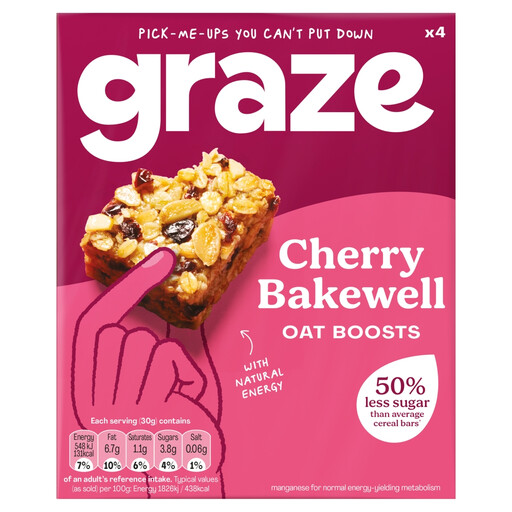
The 30 g oat-bar format may suit a tea break where you plan to eat one smaller portion. Check this Cherry Bakewell variant’s own kcal, sugars and allergen information rather than applying figures from another Graze flavour.
 No image available
This is another 50 g protein-bar option for a tea break. Use its own per-bar nutrition panel to compare it with Double Chocolate, and read the exact pack’s allergen statement.
 No image available
If you are considering this 50 g protein bar, check its per-bar calories as well as its ingredients. The peanut variant warrants particular attention to the pack’s allergen and may-contain statements.
 No image available
Its 60 g bar is a different portion size from the 50 g Grenade variants above. Compare kcal per bar as well as per 100 g, then check the ingredients and allergens on this flavour’s pack.
Use both: kcal per bar describes the portion you intend to eat, while kcal per 100 g helps you compare different bar sizes. Tesco lists 116 kcal for a 30 g Graze Cocoa Vanilla Oat Boost; Sainsbury’s lists 131 kcal for a 35 g nākd. Blueberry Muffin bar.
No. Fewer calories in a small serving do not, on their own, establish a low-energy claim for the food. Check its energy per 100 g separately from the calories in the portion you expect to eat.
No. Nature Valley lists around 10 g protein, around 4 g fibre and 196 kcal for its 40 g Protein Peanut & Chocolate bar. If portion calories matter most, compare that whole-bar figure with other bars rather than deciding from the protein description.
No. Those statements address particular requirements, not every ingredient or possible cross-contact warning. Read the contains and may-contain information on the exact bar before buying it for an allergy-related requirement.