Shoppers keeping an eye on portion calories
If you want a bar between lunch and dinner, compare kcal for the complete bar or stated serving. A smaller portion can have fewer calories while still warranting a look at sugars and saturates.


Start with the kcal in the whole bar you plan to eat, not a front-of-pack claim such as ‘protein’ or ‘no added sugar’. For a smaller afternoon portion, Tesco lists Eat Natural Red Berries at 87 kcal per 25 g bar and Graze Cocoa Vanilla Oat Boosts at 116 kcal per 30 g bar; if protein or fibre matters more to you, compare those nutrients alongside the calories in larger bars. Check sugars, saturates and the current pack’s ingredients and allergens before choosing.
If you want a bar between lunch and dinner, compare kcal for the complete bar or stated serving. A smaller portion can have fewer calories while still warranting a look at sugars and saturates.
If protein or fibre is a priority, compare the amount per bar with its kcal and serving weight. A protein-focused bar need not be the lower-calorie option.
Vegan or gluten-free wording applies to the particular product, not every bar from a brand. Check the current pack’s ingredients and allergen statement as well as its nutrition panel.
Compare the portion you will eat first, then decide which other nutrition figures and product declarations matter for that afternoon.
| Priority | What to check | Your needs |
|---|---|---|
| Calories and portion | Read kcal per whole bar or declared serving, alongside its weight in grams. Use per-100-g figures as an additional comparison, not a substitute for the portion you will eat. | For a smaller afternoon snack, I want to know the calories in one complete bar rather than mistake a 25 g bar for the same-sized portion as a 50 g flapjack. |
| Sugars and saturates | Compare sugars and saturated fat for the stated serving. Where shown, traffic-light labels provide another way to compare these figures; GOV.UK and Food Standards Agency label guidance explains their use. | A ‘no added sugar’ or protein claim is not enough for my choice; I also want to see the nutrition panel for the bar I will eat. |
| Protein and fibre | Read the grams per bar and compare them with kcal and portion weight. Check the exact flavour and format rather than applying another product’s figures. | If protein or fibre takes priority over the smallest calorie figure, I can weigh that trade-off using the values on the specific bar. |
| Diet and allergens | Check the exact product’s vegan, gluten-free or dairy-free declaration where relevant. Read both its ingredients and any ‘may contain’ statement on the current pack. | A suitable dietary label does not answer my separate question about peanuts, other nuts, soya or milk. |
‘Protein’ and ‘no added sugar’ describe different features from kcal per bar. Tesco lists the no-added-sugar Nakd Cocoa Hazelnut Protein Bar at 191 kcal per 45 g bar.
Use the claim to narrow your choices, then compare kcal, sugars and saturates for the serving you intend to eat.
Per-100-g values do not tell you the calories in a complete bar when portion weights differ.
Check the weight and kcal of one bar first; use per-100-g figures when you also want to compare products on the same weight basis.
A vegan or gluten-free declaration does not rule out peanuts or other relevant allergens. Ingredient and precautionary statements differ between products.
If you have an allergy, read the current physical pack for the exact flavour before eating it.
A familiar bar name may no longer identify a current product. Alpen’s product FAQ lists Alpen Light Bars among lines that are no longer made.
Confirm the current flavour, pack size and nutrition panel when shopping rather than carrying over details from an older listing.
These examples illustrate different bar formats; their figures and declarations belong to the named products, not every product from each brand.
Tesco lists Soft Fruit Bars Red Berries at 87 kcal per 25 g bar, making the portion size central to this example.
Tesco lists Cocoa Vanilla Oat Boosts at 116 kcal per 30 g flapjack.
Tesco lists the Cocoa Hazelnut Protein Bar at 191 kcal and 13 g sugars per 45 g bar.
Nature Valley UK describes its Protein Peanut & Chocolate bar as providing around 10 g protein and 4 g fibre per 40 g bar.
Tesco describes the Smooth Lemon Protein Flapjack as a 50 g bar providing around 9 g plant protein.
These options include cereal and oat bars, a protein flapjack and a Nakd bar. Compare the named flavour and per-bar label before treating any two as equivalent.
 No image available
For a smaller cereal-bar portion in the afternoon, compare kcal and sugars for one 21.5 g bar. Check the pack’s ingredients if gluten or another allergen affects your choice.
 No image available
If you are considering a protein flapjack instead of a smaller bar, compare protein and kcal for one 50 g Salted Caramel flapjack. Check its own label rather than using figures for TREK Smooth Lemon.
 No image available
For this 35 g Peanut Delight bar, check the current pack’s kcal, sugars and allergens. Do not use nutrition or ingredient figures for the differently named Cocoa Hazelnut bar to make this choice.
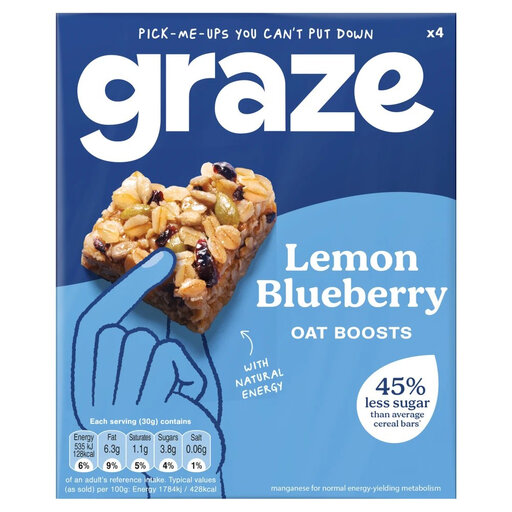 No image available
This 30 g oat-bar format offers another portion size to compare for an afternoon snack. Read the Lemon Blueberry nutrition and allergen panel rather than applying figures from Cocoa Vanilla Oat Boosts.
 No image available
Compare kcal and sugars for one 30 g Cherry Bakewell bar if this oat format suits your afternoon snack. Check its own ingredients and allergen statement, particularly if nuts are a concern.
Compare kcal for the amount you will eat—usually a whole bar or the stated serving—and read its weight alongside the figure. Per-100-g values help compare equal weights, but not the calories in differently sized complete bars.
No. Tesco lists the no-added-sugar Nakd Cocoa Hazelnut Protein Bar at 191 kcal and 13 g sugars per 45 g bar. Check both figures for the exact product instead of treating that claim as a calorie comparison.
Choose one if its protein content is a priority for you, but compare kcal per complete bar as well. Nature Valley UK describes its Peanut & Chocolate bar as providing around 10 g protein and 4 g fibre per 40 g bar; those figures alone do not make it the lower-calorie choice.
Read sugars, saturates, ingredients and allergens for the portion you plan to eat. GOV.UK and Food Standards Agency guidance explains that traffic-light labels, where used, can help you compare nutrition information across products.
No. These declarations answer different questions from a nut-allergen statement. If you have an allergy, check the ingredients and any ‘may contain’ wording on the current pack of the exact bar before eating it.