What should you check?
Start with total fat on a common per-100g basis, then check the portion and any requirements that could rule out a bar.
| Priority | What to check | Your needs |
|---|
| Total fat |
Compare total fat per 100g, then read saturates separately. Business Companion’s UK guidance sets the low-fat claim limit for solid foods at 3g fat per 100g. |
I’m looking to reduce total fat, so a claim about less sugar or more protein does not answer my main question. |
| Label detail |
Use the nutrition panel for the figures you need; traffic-light colours, where shown, are a separate quick reference. Check what any front-of-pack claim actually compares. |
I want to make sense of the label before choosing. In the Food Standards Agency’s 2024 Northern Ireland survey of 611 food shoppers, 49% said they actively used traffic-light labelling when shopping for food; this was not a survey of night workers or snack-bar buyers. |
| Portion |
Check the bar’s weight and its per-bar information as well as per-100g figures. Plan when you can take a break rather than treating the bar as your whole shift’s food. |
A portioned snack is useful for my break. The British Dietetic Association discusses lighter meals or snacks at night without setting one eating time for everyone. |
| Dietary fit |
Read the exact pack’s ingredients, allergen statement and any protein or free-from claims. Recheck the wrapper if you have a strict requirement. |
Protein or a particular ingredient exclusion may matter to me, but I also need to know whether this recipe contains an allergen I must avoid. |
Brand and product-line references
These examples show why the exact recipe and nutrition panel matter more than the type of bar printed on the wrapper.
Graze
Oat Boost flapjacks offer a 30g-bar format in the reviewed Banana Bread and Cherry Bakewell packs.
- Waitrose & Partners lists 19g fat per 100g for Banana Bread Oat Boosts.
- Tesco Groceries lists 22g fat per 100g for Cherry Bakewell Oat Boosts. A less-sugar claim on either flavour is not a low-fat claim.
Nature Valley
The reviewed Protein Peanut & Chocolate bar is a protein-led option.
- Nature Valley lists 10g protein per bar.
- Joybuy lists 28.3g fat per 100g and identifies peanuts, soya and milk as ingredients requiring allergen attention.
nākd.
Peanut Delight is a fruit-and-nut bar rather than an oat or protein-flapjack format.
- Tesco Groceries lists dates and peanuts as its main ingredients.
- Tesco lists 23g fat per 100g, and the bar contains peanuts.
Trek
The reviewed Original Oat Protein Flapjack comes as a 50g bar.
- Myprotein UK lists 10.2g protein per 50g bar.
- The same listing gives 19.6g fat per 100g, above the UK low-fat claim limit for solid foods given by Business Companion.
Eat Natural
The reviewed Dark Chocolate & Peanut Protein Bar is a peanut-led recipe.
- Eat Natural lists 19.5g protein per 100g for this bar.
- It also lists 36.3g fat per 100g and identifies peanuts and soya in the ingredients, with may-contain warnings for milk and several tree nuts.
Alpen
A “Light” name is not a substitute for checking total fat on an exact bar.
- Alpen lists Light Bars Chocolate & Orange among products no longer made. Check the variant and current pack before comparing nutrition figures.
Joybuy snack-bar options
These protein bars and one oat flapjack are options for a portioned night-shift snack. Compare each exact pack’s total fat per 100g if reducing fat is your main aim; the selection is not a list of bars that qualify for a UK low-fat claim.
 No image available
Grenade Soft Core Double Chocolate Protein Bars, 12 x 50g
A 50g portion to take on a shift break. Check the current pack’s total fat and saturates per 100g if fat reduction is the deciding factor; check its milk and soya allergen information.
 No image available
Grenade Soft Core Golden Caramel Protein Bars, 12 x 50g
Another 50g-bar pack for portioning into work breaks. Compare its own per-100g fat figure rather than assuming it matches the Double Chocolate variant, and check the milk and soya allergen information.
 No image available
Grenade Soft Core Peanut Butter Protein Bars, 12 x 50g
The Peanut Butter variant comes in 50g bars. Check its per-100g nutrition panel for the fat comparison, and read the current pack’s peanut, milk and soya allergen information.
 No image available
Grenade High Protein Low Sugar Oreo Flavour Bars, 4 x 60g
These 60g bars are a different portion size from the 50g Grenade variants above. Compare fat per 100g rather than relying on the protein or sugar wording, and check the pack for milk, soya and gluten-containing ingredients.
 No image available
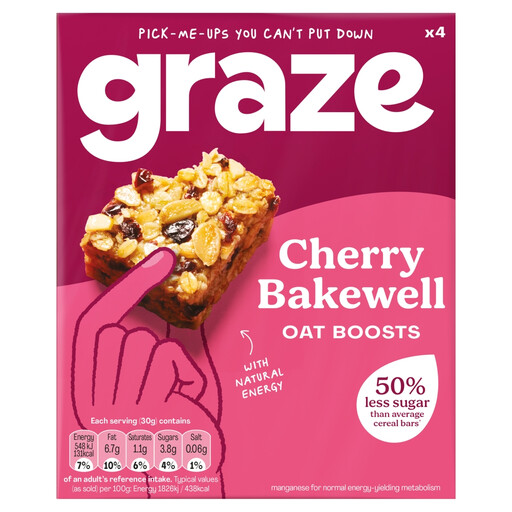
Graze Oat Boosts Cherry Bakewell, 4 x 30g
A 30g oat-flapjack option if you prefer a smaller bar for a break. Tesco Groceries lists 22g fat per 100g for this pack; check the current wrapper’s nutrition and allergen information before choosing it for a fat-first or dietary requirement.
Questions about choosing a bar
What does “low fat” mean on a UK snack-bar label?
Business Companion’s UK nutrition-claim guidance says a solid food may carry a low-fat claim only if it contains no more than 3g fat per 100g. Use the per-100g panel to compare bars of different sizes, then check the per-bar portion separately.
Does “less sugar” mean a bar has less fat?
No: the claims concern different nutrients. Waitrose & Partners lists 19g fat per 100g for Graze Banana Bread Oat Boosts, while Tesco Groceries lists 22g per 100g for Cherry Bakewell Oat Boosts; check sugar, total fat and saturates individually.
Should I choose a protein bar for a night shift?
Choose by the nutrition and ingredients that matter to you, not protein wording alone. Nature Valley lists 10g protein per Peanut & Chocolate bar, while Joybuy lists 28.3g fat per 100g for it; Myprotein UK lists 10.2g protein per 50g Trek Original Oat Protein Flapjack and 19.6g fat per 100g.
When might a bar fit into a night shift?
A portioned bar can be a planned break snack. The British Dietetic Association discusses possible benefits of lighter meals or snacks during night shifts but says the evidence does not establish one optimal eating time for every shift worker.
Which allergen details should I check before packing a bar?
Read the exact current wrapper, including ingredients and may-contain statements. Joybuy lists peanuts, soya and milk for Nature Valley Protein Peanut & Chocolate, while Tesco Groceries lists peanuts in nākd. Peanut Delight; another flavour or brand may have a different statement.


