
24/7 Customer Support

Free returns

Same-day & Next-day Delivery

Quality Guaranteed

Unlock Your Welcome Offers: FREE Delivery | Up to 80% OFF | Free 30-day JoyPlus trial
Download the APP
A solo microwave oven can handle everyday reheating, defrosting and simple cooking without the added cost or complexity of a grill or combination appliance. However, choosing by price or appearance alone can lead to frustrating compromises, particularly in a UK kitchen where worktop space, plug compatibility and running costs matter.
Joybuy Product Recommendation Officer guidance focuses on practical specifications rather than exaggerated claims. Before choosing, watch for these common buying pitfalls.
A microwave labelled as compact may still be deep enough to occupy valuable worktop space. Conversely, a 20L microwave may fit a standard dinner plate but leave little room around larger bowls. Always check the full height, width and depth, plus the turntable diameter, before ordering.
An 800W microwave generally heats food more quickly than a 700W microwave, but cooking times still depend on food quantity, container shape and moisture content. Higher power is not automatically more suitable for delicate foods. Power-level controls and a reliable defrost function can be more useful for everyday flexibility.
A digital microwave with auto-cook programmes can be convenient, but it may not suit someone who mainly reheats tea, soup and leftovers. A manual microwave with rotary dials is often straightforward for students, renters and older users. Conversely, households that frequently cook different foods may value precise digital timing and more power levels.
For safe installation, place the appliance on a stable, heat-resistant surface and follow the manufacturer’s ventilation guidance. Do not cover air vents or place the oven directly beside a hob, sink or other heat source.
A 700W microwave can manage reheating, defrosting and simple cooking, but may require longer timings than an 800W or 900W model. A higher output can be useful for busy households, but check whether the microwave includes several power settings.
A dedicated microwave with defrost function is more practical than relying on full-power heating, which can leave food partially cooked around the edges. For frequent defrosting or gentle reheating, an inverter microwave may deliver more consistent low-power operation than a conventional model, according to the manufacturer’s design specification.
Manual dials are simple and quick, while digital controls can provide clearer timing and automatic programmes. Look for:
Only use microwave-safe containers. Avoid metal, metallic trims and sealed containers, and never operate the appliance when empty.
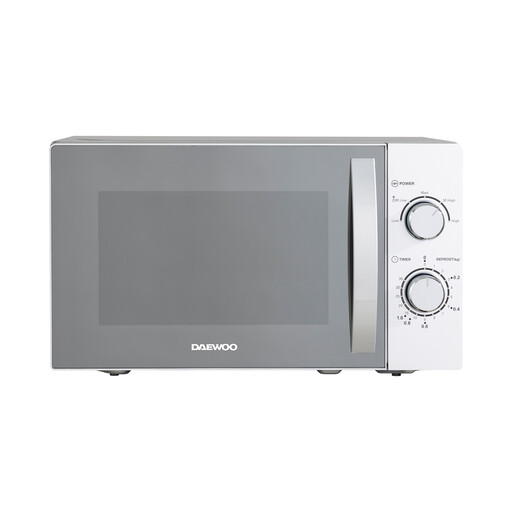
Why This Fits Their Persona: The compact 20L format and mechanical dials suit students, renters and first-time buyers who want uncomplicated reheating without a complex control panel.
It avoids unnecessary programme menus with manual time and power controls, while still providing a defrost function and removable glass turntable.
20L capacity, mechanical dial operation and a stated 700–800W output range depending on variant.
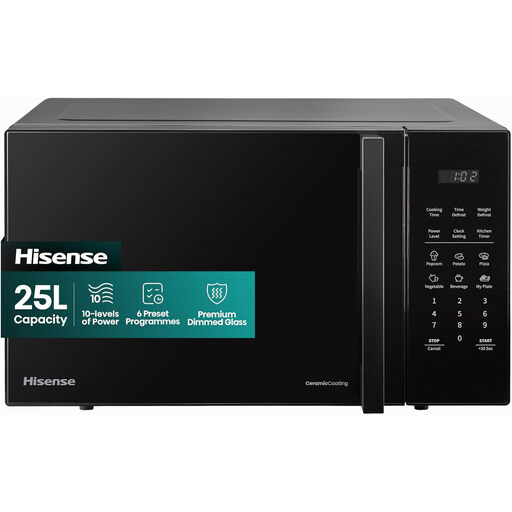
Why This Fits Their Persona: Its larger cavity, touch controls and automatic programmes are suited to families and busy home cooks who want more control over varied meals.
The 25L capacity and 31.5cm turntable help address the hidden space limitation found in smaller models.
900W output, 10 power levels, auto-cook programmes and auto defrost.
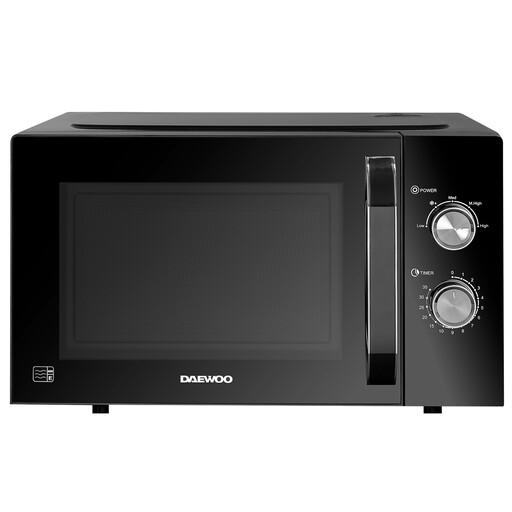
Why This Fits Their Persona: This model is suited to households that regularly reheat family portions and want manual operation rather than digital menus.
Its five power settings and dedicated defrost setting provide more useful control than a single high-power mode.
23L capacity, 800W output, 35-minute manual timer and removable glass turntable.
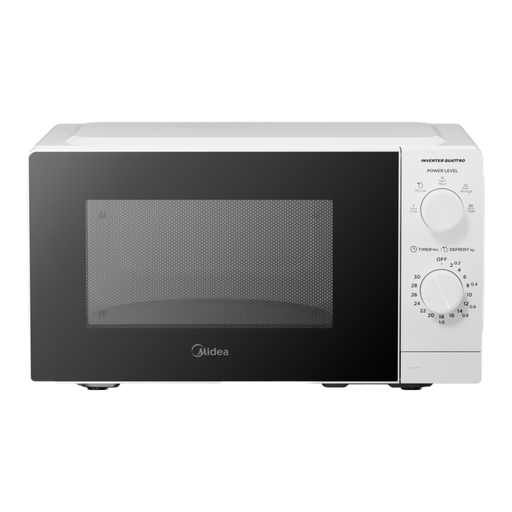
Why This Fits Their Persona: A compact option for couples and renters who value inverter technology, manual controls and an energy-saving standby mode.
The inverter system is specified for consistent lower-power operation, helping avoid the assumption that maximum power is suitable for every food.
20L capacity, 700W output, six power settings, inverter technology and energy-saving mode.
Choose a manual microwave if you want quick dial-based operation, fewer controls and easy timing adjustments. Choose a digital microwave if you prefer an LED display, automatic programmes, weight-based defrosting or longer programmable timers.
For colour, a black microwave can coordinate with darker appliances and hide everyday marks, while a white microwave can look lighter in a small kitchen. Colour should come after capacity, ventilation and control requirements.
We have compiled a complete, real-time list of products that fully satisfy these strict selection criteria and UK safety regulations.
Yes. A 700W microwave can reheat leftovers, cook simple meals and defrost frozen food. You may need to increase cooking times compared with an 800W or 900W model, following the appliance instructions and food packaging guidance.
Clearance varies by model, so follow the supplied manual. As a practical reference, the Daewoo 23L model specifies at least 10cm at the top and sides. Keep vents unobstructed and place the unit on a level, heat-resistant worktop.
Use the correct power and time rather than repeatedly running full-power cycles. Avoid unnecessary reheating, keep the interior clean and use an energy-saving microwave or eco mode where available. Standby savings are generally modest, but switching off at the socket when safe and convenient can reduce idle consumption.