
24/7 Customer Support

Free returns

Same-day & Next-day Delivery

Quality Guaranteed

Unlock Your Welcome Offers: FREE Delivery | Up to 80% OFF | Free 30-day JoyPlus trial
Download the APP
Choosing between solo microwave ovens can seem straightforward until you compare capacity, wattage, controls, installation and cooking functions. A compact 20L microwave may suit a student flat, while a 25L digital microwave could be more practical for family meals. The challenge is separating useful features from specifications that add cost without improving your everyday cooking.
This guide explains the key buying checks and matches several options to different UK household needs.
A 900W microwave generally heats food more quickly than a 700W model, but speed is not the only consideration. Higher power can overheat smaller portions if you do not adjust cooking times. A 700W or 800W microwave can be suitable for reheating, defrosting and simple cooking, particularly when used according to the food packaging instructions.
Also check that the product’s stated power refers to microwave output, rather than its total connected electrical load.
A larger cavity does not automatically mean the appliance is unsuitable for a small kitchen, but the external footprint still matters. A 20L microwave can accommodate standard plates while taking up less worktop space. A 23L or 25L microwave provides more room for larger dishes, but may be deeper or wider.
Measure the space where the appliance will sit, including room for ventilation. Freestanding worktop models commonly require clearance around their vents; always follow the manufacturer’s installation instructions rather than pushing the unit tightly against a wall or cabinet.
A digital microwave may offer auto-cook menus, a clock, weight-based defrosting and touch controls. These can be useful for households that regularly cook different foods. However, a manual microwave with rotary dials may be easier to operate and quicker to adjust for simple reheating.
Do not assume that a greater number of programmes guarantees better results. Check whether the control layout, timer range and defrost function suit how you actually prepare meals.
A microwave with a glass turntable is convenient because the removable plate can usually be washed separately. Confirm the diameter and ensure the roller ring is correctly positioned before use.
Power output affects cooking speed, while power levels control how aggressively the microwave heats. Five or six settings are sufficient for many daily tasks, including reheating, simmering and defrosting. Some digital models provide 10 levels for more precise adjustment.
For frozen food, use the dedicated auto defrost or defrost-by-weight function where available. It can reduce the need to estimate timings, but food should still be turned or separated when the instructions recommend it.
Most solo microwave ovens are freestanding appliances designed for a stable, heat-resistant worktop. A built-in microwave is installed inside suitable cabinetry and must have the required recess dimensions and ventilation. It is not interchangeable with a worktop model.
For an integrated kitchen, check whether the product includes an installation frame and whether professional fitting is required. Do not place a freestanding appliance inside a cabinet unless the manual specifically permits it.
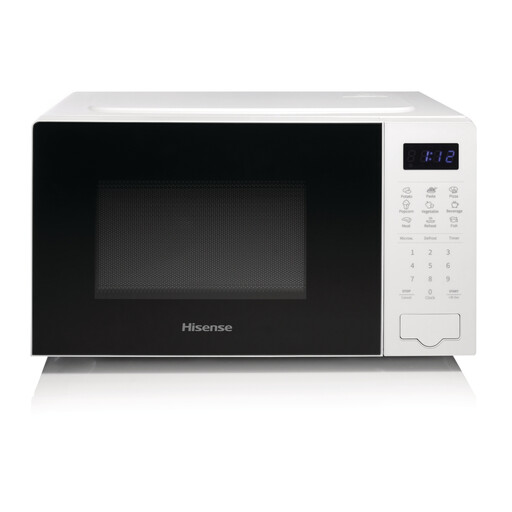
Why This Fits Their Persona: Its compact footprint and 20L capacity suit students, renters and smaller UK kitchens where worktop space is limited.
The 700W output avoids paying for unnecessary power, while rotary controls keep operation straightforward.
Five power levels, a defrost function and a removable 24.5cm glass turntable.
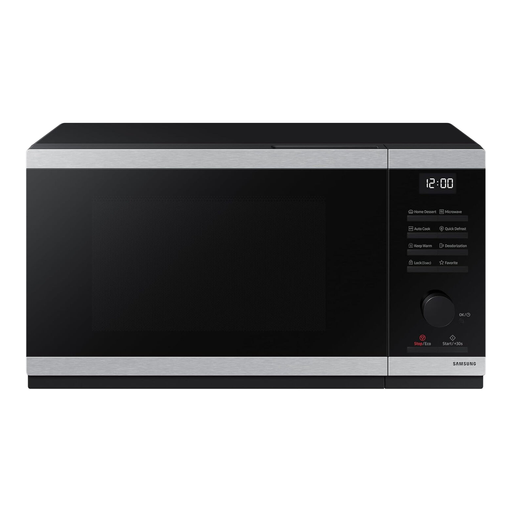
Why This Fits Their Persona: This 23L black microwave combines a larger everyday capacity with features suited to a modern, frequently used kitchen.
Its stated 23L capacity and 800W output offer a balanced specification rather than focusing only on maximum wattage.
Ceramic enamel interior, deodorisation function and Eco Mode for reduced standby consumption.
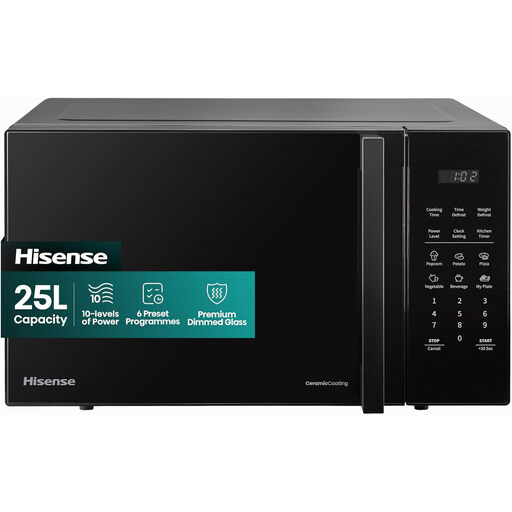
Why This Fits Their Persona: The larger cavity and digital controls suit families or households that regularly reheat substantial portions.
The 31.5cm turntable gives a clear, measurable indication of usable space, rather than relying only on the headline capacity.
900W output, 10 power levels, auto-cook programmes and auto defrost.
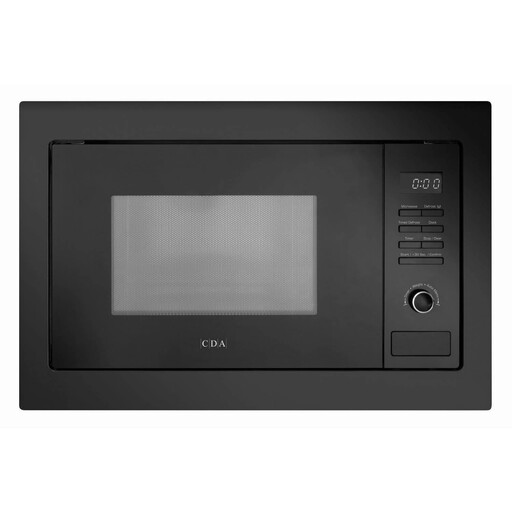
Why This Fits Their Persona: It is designed for homeowners creating a streamlined fitted kitchen without using valuable worktop space.
The product is specified as built-in, with cabinet installation requirements clearly stated, unlike a worktop model placed inside unsuitable furniture.
25L capacity, 900W output, auto-cook menus and a removable 27.5cm glass turntable.
We have compiled a complete, real-time list of products that fully satisfy these strict selection criteria and UK safety regulations.
Yes. Solo models use microwave energy for reheating, defrosting and cooking, but they do not provide a conventional grill or oven function. They are suitable for porridge, vegetables, rice, jacket potatoes, ready meals and similar dishes when the cookware and instructions are appropriate.
A 20L microwave is generally suitable for one or two people and standard dinner plates. Families may prefer a 23L or 25L model, but check the turntable diameter and external depth before ordering.
Running cost depends on the appliance’s power rating, cooking time and how often it is used. Short heating cycles can use less electricity than running a full-size oven for a small portion. Features such as an energy-saving mode may reduce standby consumption, but switching the appliance off at the socket when appropriate can also limit standby use.