
24/7 Customer Support

Free returns

Same-day & Next-day Delivery

Quality Guaranteed

Unlock Your Welcome Offers: FREE Delivery | Up to 80% OFF | Free 30-day JoyPlus trial
Download the APP
Choosing a professional camera can feel like navigating a minefield of technical specifications and marketing claims. For years, the Sony Alpha 7 III has been a benchmark for performance and value in the full-frame mirrorless market. But as we move through 2026, with newer models available, you might be wondering if it still holds its ground as a wise investment for your creative or commercial work.
This guide is designed to cut through the clutter. As the Joybuy Product Recommendation Officer, my role is to provide you with clear, practical information to help you decide if the a7 III is the right tool for your needs. We will look at its core features, compare it with other options and offer straightforward advice for photographers and videographers in the UK.
Before diving into specific models, let's cover a few key considerations that will help you make an informed choice.
For many professionals, the term full-frame mirrorless camera is synonymous with quality. A full-frame sensor is physically larger than the APS-C sensors found in many consumer and prosumer cameras. This larger surface area captures more light, which generally translates to better performance in dim conditions, a wider dynamic range for more flexibility in editing and the ability to achieve a shallower depth of field for that classic, professional-looking background blur in portraits.
A camera body is only as good as the lens attached to it. The Sony 28-70mm kit lens bundled with the a7 III is a versatile starting point, covering wide-angle to short telephoto ranges suitable for everything from landscapes to portraits. However, the real strength lies in Sony's extensive E-mount lens ecosystem. When evaluating the Sony a7 III price UK, remember to factor in the long-term value of having access to a vast range of high-quality prime and zoom lenses from both Sony and third-party manufacturers.
When your photography is your business, certain features are non-negotiable. For disciplines like wedding photography, dual card slots are essential for creating instant backups and preventing data loss. A fast, reliable autofocus system with eye-tracking ensures your subjects are always sharp, while a silent shutter allows you to capture candid moments without being disruptive. These are the kinds of professional-grade features that have kept the a7 III relevant.
Here are our recommendations, selected to meet the needs of different creators, from aspiring beginners to seasoned professionals.

Why It Stands Out: The Sony a7 III remains a formidable tool due to its exceptional balance of performance, reliability and price. It packs a suite of professional features into a compact body, making it a true workhorse. The 24.2 MP full-frame sensor delivers outstanding image quality, while the 693-point phase-detection autofocus system provides tenacious subject tracking.
The inclusion of 5-axis in-body image stabilisation helps produce sharp handheld shots, even with slower shutter speeds or non-stabilised lenses. For videographers, it offers high-quality 4K UHD video with full pixel readout, S-Log profiles for colour grading and dual card slots for peace of mind during critical shoots.
Pros:
Who is it for? This camera is ideal for professional and semi-professional photographers and videographers specialising in weddings, events, portraits and commercial projects. It is also a fantastic choice for serious hobbyists looking to upgrade to a full-frame system without paying a premium for the very latest model.

Why It Stands Out: The Sony a6100 packs some of Sony's most impressive autofocus technology into a much smaller and more affordable package. It features the same lightning-fast 0.02s AF acquisition and Real-time Eye AF found in its more expensive siblings, making it incredibly capable for capturing sharp photos of moving subjects.
Its 24.2 MP APS-C sensor still delivers high-resolution images, and the 180° tiltable LCD touchscreen makes it a natural fit for vlogging and selfies. With 4K video recording and a microphone input, it’s a complete content creation tool.
Pros:
Who is it for? The a6100 is suited for content creators, vloggers and aspiring photographers who want professional-level autofocus and great image quality without the size and cost of a full-frame system.
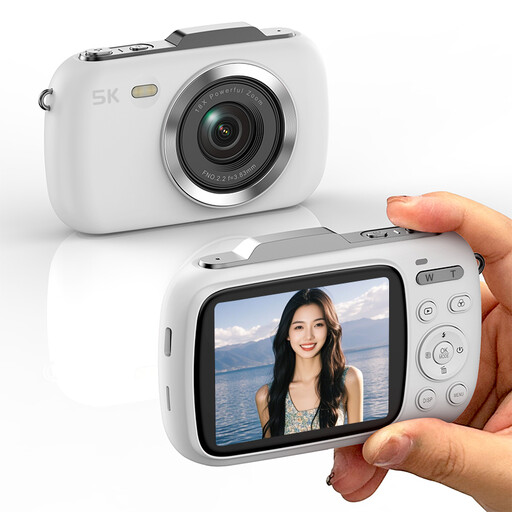
Why It Stands Out: The Komery G7 is focused on accessibility and ease of use. It offers impressive-sounding specifications like 5K video and 80MP image resolution in a simple, point-and-shoot design. It's an all-in-one package aimed at those who want to start creating video content or taking photos without a steep learning curve.
Features like an anti-shake mode and an 18x digital zoom provide creative flexibility, while its straightforward operation makes it a good entry point into photography.
Pros:
Who is it for? This camera is designed for beginners, teenagers or anyone looking for a pocket-friendly, uncomplicated camera for casual vlogging, family photos and holiday snapshots.
If the models above don't quite fit what you're looking for or if you're interested in exploring a wider variety of straightforward cameras, we have more to see. Browse our curated collection of easy to use cameras to find the perfect match for your needs and budget.
Yes, absolutely. While newer models may offer incremental improvements in resolution or video frame rates, the Sony a7 III's core feature set remains professional-grade. Its sensor, autofocus system and reliability are proven. For many working photographers, it represents the sweet spot of performance and value, making it a highly sensible investment even in 2026.
The primary differences often lie in resolution, processing power and advanced video features. For example, the a7 IV offers a higher resolution sensor (33MP vs 24.2MP), an upgraded processor and more advanced video options like 10-bit colour depth. However, for many professional applications, the a7 III's specifications are more than sufficient, and it delivers its performance at a more accessible price point.
The Sony a7 III is an excellent camera for wedding photography. Its key strengths for this work include its reliable and fast Eye AF for sharp portraits, a completely silent electronic shutter for capturing quiet moments during a ceremony and dual card slots for essential image backup. Its strong low-light performance is also a major advantage for dimly lit reception venues.