
24/7 Customer Support

Free returns

Same-day & Next-day Delivery

Quality Guaranteed

Unlock Your Welcome Offers: FREE Delivery | Up to 80% OFF | Free 30-day JoyPlus trial
Download the APP
Navigating the world of digital cameras can be a complex task, especially with the impressive range of options available. If you're considering a Sony mirrorless camera, you're looking at a system known for its innovation, performance and versatility. From compact APS-C camera models ideal for vlogging to powerful full-frame mirrorless camera bodies for professional work, the Sony Alpha series offers a tool for every creator.
This guide is designed to help you understand the key differences within the Sony lineup. We will break down the essential features to consider and provide our top recommendations to help you find the right Sony Alpha camera for your photography and videography needs.
Before diving into specific models, it's helpful to understand a few core concepts that will guide your decision. Focusing on these areas will ensure you invest in a camera that aligns with your creative goals.
The sensor is the heart of a digital camera, and its size is a critical factor. Sony offers two main sensor sizes in its mirrorless range:
For many creators, video performance is just as important as still photography. When evaluating a 4K vlogging camera or a hybrid camera, look beyond the resolution. Key features to consider include:
One of the significant advantages of the Sony Alpha ecosystem is the universal Sony E-mount camera system. This means that lenses are interchangeable between both APS-C and full-frame bodies. While it's generally advisable to use lenses designed for your specific sensor size, this cross-compatibility offers flexibility as you grow and potentially upgrade your camera body in the future.
Here we present a selection of Sony mirrorless cameras that cater to different types of creators, from those just starting their journey to seasoned professionals.

Why It Stands Out: The Sony A6100 packs some of Sony's most acclaimed autofocus technologies into a compact and approachable body. Its Real-time Tracking and Real-time Eye AF are remarkably effective at keeping subjects sharp, whether you're taking photos of active children or filming a vlog. The 180-degree tiltable screen is specifically designed for self-recording.
View Details for the Sony A6100

Why It Stands Out: The Sony A7 III has earned its reputation as a true workhorse. It brought high-end full-frame features, such as a 24.2 MP sensor, 5-axis in-body image stabilisation, and a sophisticated 693-point autofocus system, to a wider audience. It remains a highly capable and reliable choice for a huge range of photographic and video applications.
View Details for the Sony Alpha 7 III
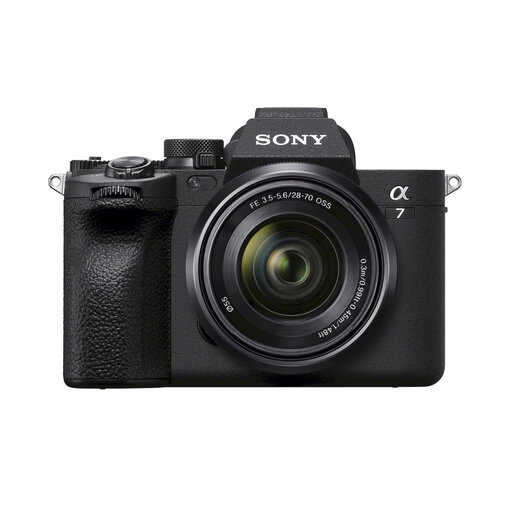
Why It Stands Out: The Sony A7 IV is a modern hybrid camera designed from the ground up for creators who do it all. It features a new 33.0 MP sensor for greater detail and the powerful BIONZ XR processor for next-level performance. Its video capabilities are a significant step forward, with 4K 60p recording and 10-bit 4:2:2 colour for professional post-production workflows. The fully articulating vari-angle screen makes it adaptable to any shooting angle.
View Details for the Sony Alpha 7 IV
If the models above aren't quite what you're looking for, or if you wish to explore a wider range of lenses and accessories, we invite you to browse our complete collection. Discover more cameras to suit every budget and creative need.
Explore All Photography and Video Cameras
Yes, certain models are excellent for beginners. The Sony A6100, for example, is designed with user-friendly features like a responsive touchscreen and reliable automatic modes, while still offering the manual controls and image quality that allow a new user to grow their skills.
The Sony A7 IV is the successor to the Sony A7 III and offers several key upgrades. The main differences include a higher resolution sensor (33MP vs 24.2MP), more advanced video capabilities (4K 60p and 10-bit colour vs 4K 30p and 8-bit), a more sophisticated autofocus system with bird eye-tracking and a fully articulating screen compared to the A7 III's tilting screen.
Yes, all Sony Alpha mirrorless cameras share the same E-mount. You can mount a full-frame lens on an APS-C body without issue. You can also mount an APS-C lens on a full-frame body, but the camera will typically switch to a 'crop mode' to match the lens's smaller image circle, which reduces the final image resolution. For optimal quality, it is best to use lenses designed for your camera's sensor size.