
24/7 Customer Support

Free returns

Same-day & Next-day Delivery

Quality Guaranteed

Unlock Your Welcome Offers: FREE Delivery | Up to 80% OFF | Free 30-day JoyPlus trial
Download the APP
Upgrading your television audio can make dialogue easier to follow and films more engaging, but choosing between soundbars is not simply a matter of selecting the highest wattage. Some products use impressive numbers to suggest stronger performance, while overlooking room size, connection standards or the practical limits of virtual surround sound.
Three common buying traps are worth avoiding:
The right choice depends on your television, room layout, viewing habits and tolerance for additional speakers.
Channel numbers describe the intended audio layout. A 2.0 channel soundbar generally provides left and right audio in one enclosure, while a 2.1 channel soundbar adds a separate bass channel, usually through a subwoofer. This can suit smaller living rooms where stronger low-frequency output is wanted without rear speakers.
A 3.1.2 channel soundbar adds a dedicated centre channel for dialogue and two height channels, usually delivered through upward-firing drivers. A 5.1.2 channel soundbar provides more surround information, while systems such as a 9.1.4 channel soundbar or 11.1.4 channel soundbar typically include rear speakers, a subwoofer and multiple height channels.
More channels can create a broader listening field, but they also require more space and careful positioning. Check whether rear speakers are included, rather than assuming the channel description means a complete multi-speaker package.
A Dolby Atmos soundbar can process compatible object-based soundtracks, but the television, streaming service, disc player or games console must also deliver a suitable signal. HDMI eARC is the most flexible connection for modern home cinema because it can carry higher-bandwidth audio formats between compatible devices.
Standard HDMI ARC may be sufficient for many compressed formats, while optical connections have more limited format support. Before buying, check that your TV has the required port and that your console or streaming device can pass audio through correctly. HDMI eARC also commonly supports CEC, allowing one compatible remote to control volume.
Measure the gap beneath your screen before ordering. A soundbar that is too tall may obstruct the television’s lower edge or remote sensor. Also check the width: a compact model may look more balanced with a smaller TV, while a wider bar can suit a large screen.
Power figures should be read alongside the full specification. For example, the Samsung HW-Q990F lists 756 W RMS and an 11.1.4-channel layout, while the LG SH5A lists 320 W total power in a 2.1 configuration. These are different system designs rather than directly comparable quality scores.
For UK households concerned about energy use, check standby consumption and whether the subwoofer enters standby automatically. The Samsung HW-Q990F specification lists 0.5 W standby consumption, while its subwoofer is separately rated at 48 W power consumption. Actual use varies with listening volume and operating mode.

Why This Fits Their Persona: A compact option for flats, bedrooms or smaller UK living rooms where simple TV improvement matters more than cinema-scale bass.
Its 2.0 layout and built-in woofer make the absence of a separate subwoofer clear, avoiding misleading assumptions about a full surround package.
40 W output, Bluetooth, USB playback, Voice Enhancement Mode and Night Mode in a compact 2.0 design.

Why This Fits Their Persona: Suitable for film viewers who want Dolby Atmos processing and streaming features in a single, discreet bar.
The specification identifies Dolby Atmos, HDMI eARC and optical inputs separately, so buyers can match the connection to their television instead of relying on a vague “cinema” label.
Nine internal transducers, two up-firing drivers, Wi-Fi, Bluetooth, AirPlay 2, Spotify Connect and Chromecast built-in.

Why This Fits Their Persona: A substantial home cinema system for larger rooms, regular film nights and gamers who have space for rear speakers and a subwoofer.
The 11.1.4 configuration is supported by 23 speakers, a wireless active subwoofer and wireless rear speakers, making the system layout explicit.
756 W RMS, Dolby Atmos, DTS:X, HDMI eARC, Wi-Fi, Bluetooth 5.3, Game Mode Pro and room calibration.
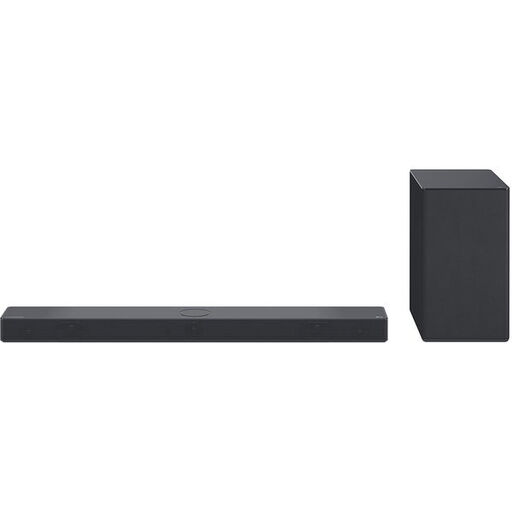
Why This Fits Their Persona: A practical match for compatible LG OLED C Series owners and console players using 4K gaming features.
Its TV synergy bracket is specified for LG OLED C Series models, while HDMI eARC and 4K pass-through support are clearly listed for suitable setups.
3.1.3 channels, 400 W total output, 220 W wireless subwoofer, Dolby Atmos, DTS:X, VRR and ALLM up to 120 Hz.
We have compiled a complete, real-time list of products that fully satisfy these strict selection criteria and UK safety regulations.
They can be a practical upgrade when built-in TV speakers sound thin, lack bass or make speech difficult to follow. A compact 2.0 or 2.1 model may suit everyday viewing, while a multi-channel home cinema soundbar is more appropriate for films and gaming.
Not always. Some systems can receive selected Atmos formats through standard ARC or other connections, but HDMI eARC offers broader format support and is the safer choice for a modern TV, streaming device or games console. Confirm compatibility across every device in the signal chain.
Lifespan depends on usage, ventilation, software support and the condition of the power supply. Avoid blocking vents or upward-firing drivers, keep liquids away and use a surge-protected mains connection where appropriate. A model with the required inputs and streaming features is less likely to become inconvenient as other equipment changes.