
24/7 Customer Support

Free returns

Same-day & Next-day Delivery

Quality Guaranteed

Unlock Your Welcome Offers: FREE Delivery | Up to 80% OFF | Free 30-day JoyPlus trial
Download the APP
A soundbar can make television dialogue easier to follow, add bass to films and music, and reduce the clutter of a separate speaker system. However, choosing between compact soundbars, wireless models and a full home cinema sound system is not simply a matter of selecting the highest wattage.
A search for a “best soundbar” can quickly lead to products that look impressive on paper but do not suit your television, room or viewing habits. The most common buying mistakes usually involve overestimating power ratings, assuming every Dolby Atmos soundbar creates overhead sound, and forgetting to check connection and placement requirements.
This guide explains the practical specifications that matter, then matches several soundbars to different UK household needs.
A higher wattage figure may indicate greater output capacity, but it does not automatically mean clearer speech or better detail. Room size, speaker layout, audio processing and the quality of the source all affect what you hear.
For example, a 2.0 channel soundbar with a built-in woofer may be suitable for improving everyday television audio, while a 2.1 channel soundbar with a wireless subwoofer is more focused on adding low-frequency impact. Neither configuration is universally suitable for every room.
Features such as DTS Virtual:X, surround expansion and Dolby Atmos processing can widen the soundstage. Their results depend on the room, ceiling height, furniture and listening position. A model with up-firing speakers may produce a more noticeable height effect than a compact unit using only front-facing drivers, but it still does not create the same physical speaker layout as separate rear channels.
A soundbar may support Bluetooth for music streaming but still need an optical cable or HDMI connection for the television. Bluetooth TV connections can also vary between television brands and models.
For the most straightforward setup, check whether your television has HDMI ARC or HDMI eARC. eARC can carry higher-bandwidth audio formats, including compatible Dolby Atmos signals. Also check whether the soundbar has HDMI inputs if you plan to connect a games console, Blu-ray player or set-top box directly.
The first number describes conventional main channels, the second usually refers to a subwoofer, and a third can indicate height channels.
Measure the space beneath your television before ordering. A soundbar that is too tall may obstruct the lower edge or infrared receiver. Confirm the width as well: a 95cm unit may look disproportionate beneath a smaller screen.
A wireless subwoofer reduces the need for a cable between the bar and bass unit, but it still needs a nearby mains socket and sufficient ventilation. Check its footprint before deciding where it will stand.
Voice enhancement, a dedicated centre speaker or AI dialogue processing can make spoken words more prominent. These features adjust the balance between voices, music and effects; they are not a substitute for correcting poor source audio or television settings.
A night mode generally reduces bass and limits sudden changes in volume. This can be useful in flats, terraced homes or bedrooms where other household members and neighbours may be disturbed.
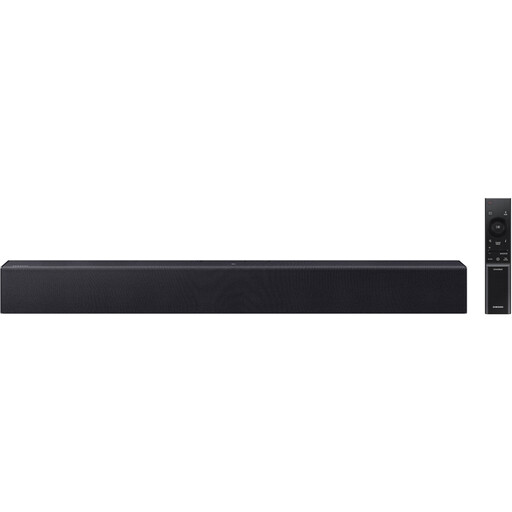
Why This Fits Their Persona: Its 64.1cm width and all-in-one design suit smaller UK lounges, bedrooms and TV cabinets where a separate subwoofer would be inconvenient.
The built-in woofer avoids the added cost, cabling and placement demands of an external bass unit, while Voice Enhancement and Night Mode address two common everyday frustrations.
40W output, four front-firing speakers, Bluetooth 4.2, HDMI ARC, optical input and USB music playback.

Why This Fits Their Persona: It is suited to viewers wanting Dolby Atmos processing, wireless streaming and room calibration in a streamlined premium setup.
Its ADAPTiQ calibration headset helps account for room characteristics, while HDMI eARC provides a suitable connection for compatible high-bandwidth audio.
Nine internal transducers including two up-firing drivers, Dolby Atmos and Bose TrueSpace, Wi-Fi, Bluetooth, AirPlay 2 and Chromecast built-in.
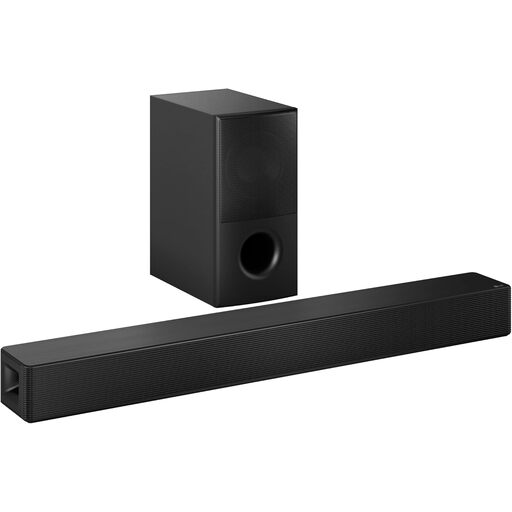
Why This Fits Their Persona: The 2.1 channel layout and dedicated wireless subwoofer suit larger living rooms, regular film nights and music playback where stronger bass is wanted.
The separate bass unit makes the channel layout clear rather than relying on a small built-in woofer, and Adaptive Sound Control adjusts the balance between dialogue and bass-heavy content.
320W total output, 200W wireless subwoofer, HDMI ARC, optical input, USB, Bluetooth and Dolby Digital/DTS support.
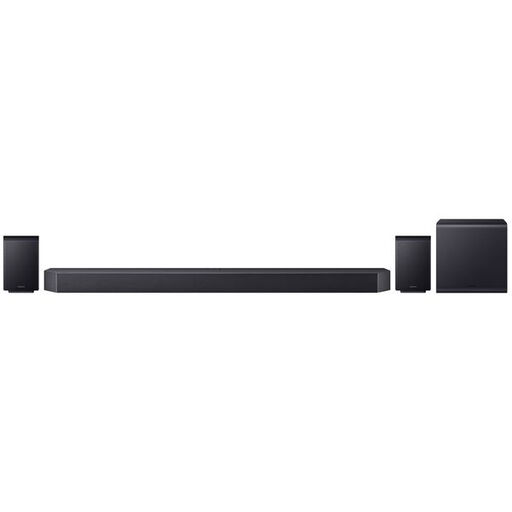
Why This Fits Their Persona: This larger multi-speaker system is aimed at dedicated film viewers, gamers and households with enough space for a wireless subwoofer and expanded surround hardware.
Its 11.1.4 channel specification and included wireless subwoofer make the physical speaker arrangement clear, rather than implying that a compact bar alone can reproduce every surround position.
756W RMS rated power, 23 speakers, wireless subwoofer, HDMI eARC, Wi-Fi, Bluetooth 5.3, DTS:X, Q-Symphony and night mode.
We have compiled a complete, real-time list of products that fully satisfy these strict selection criteria and UK safety regulations.
Most soundbars use modest power compared with a complete separates-based home cinema system. Actual consumption varies by model, volume and standby settings. Look for the stated typical and standby consumption, and switch the unit off at the mains if it will not be used for an extended period.
Not always. Optical audio and HDMI ARC can be sufficient for standard television, stereo and some surround formats. HDMI eARC is more useful when you want compatible high-bandwidth formats, such as lossless audio or certain Dolby Atmos sources. Your television and source device must also support the required format.
There is no fixed lifespan because usage, ventilation, software support and component quality vary. Keeping the soundbar dry, allowing ventilation and avoiding blocked ports can help protect it. Before buying, check the warranty, available replacement accessories and whether the model receives relevant firmware updates.