Late-night and shared-home film viewers
If others are asleep or nearby, you want to follow speech and quieter moments without sudden effects becoming disruptive.


For quiet film viewing through a TV, look for a documented night-listening control alongside dialogue enhancement: the two address loud effects and hard-to-hear speech in different ways. Check your TV's audio connection and settings before choosing a bar; an Atmos label alone does not tell you how it will handle a film at low volume.
If others are asleep or nearby, you want to follow speech and quieter moments without sudden effects becoming disruptive.
If missed lines make you rewind, dialogue controls or a centre-speaker design may matter more to you than stronger bass.
If you want a single bar for your TV, check its audio outputs and how the soundbar will respond to your usual remote before buying.
For film soundtracks played quietly through a TV, decide which matters most to you: containing loud effects, hearing soundtrack detail, connecting and controlling the bar, or expanding the system later.
| Concern | What to check | Who this matters to |
|---|---|---|
| Dialogue and loud effects | Look for a documented night-listening control and a separate dialogue setting. Check what each control changes. | If I need to hear quiet lines without action scenes disturbing others, I would put speech and peak control first. Roughly 40% of consumers would share that primary concern. |
| Soundtrack detail | Assess the sound at your usual low volume; treat spatial-audio support separately from night and dialogue controls. | I want to follow the score and quieter background sounds even when I keep the TV volume down. Around 30% of consumers would make soundtrack detail their main priority. |
| TV connection and control | Identify the TV's HDMI ARC or eARC port and confirm the bar's inputs and remote-control behaviour. | If I want an uncomplicated TV upgrade, the connection and everyday volume control need to work with my set. Approximately 20% of consumers would put that need first. |
| Room to expand | Check which additional speakers or bass components work with the exact bar, and what space they need. | I would rather start with one bar but keep the option to add components later. Roughly 10% of consumers would prioritise expandability. |
Atmos support does not establish whether a soundbar can make dialogue easier to hear or reduce the impact of loud effects.
Check for documented night and dialogue controls separately. If Atmos matters to you, also confirm that your TV and playback source can deliver a compatible format.
Sony says the HT-S2000 turns Night Mode off when the system is powered down, so a later film session may start without it.
Check how the bar you choose enables night, dialogue and bass settings, and whether it remembers them between sessions.
Connection choice can affect everyday control. Sonos says Beam (Gen 2) needs HDMI ARC or eARC for Atmos; its optical fallback does not provide HDMI-CEC or voice control.
Find your TV's audio-output port and settings, then confirm the exact soundbar's input and remote-control behaviour.
An expandable soundbar is not necessarily a complete surround setup. Additional components also need space and setup.
Check the contents of the exact bundle and whether you need more than the base bar for your listening habits.
Beam (Gen 2) is a compact TV soundbar to consider if you want separate controls for speech and late-night listening.
The HT-S2000 is a 3.1-channel option for viewers interested in a centre speaker and selectable Voice and Night modes.
The Bose Smart Soundbar is worth considering if you prefer dialogue adjustment that responds automatically when people speak.
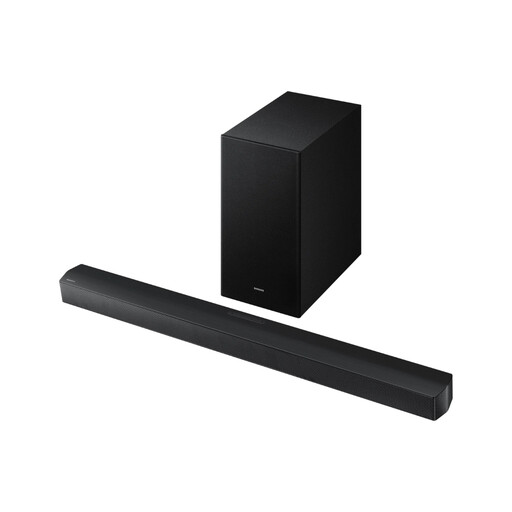
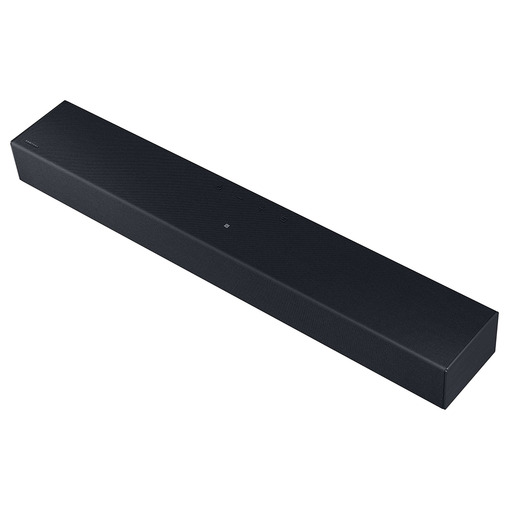
These Samsung TV soundbars offer different starting points for low-volume film viewing: one pairs a 3.1-channel bar with a wireless subwoofer, while the other is a 2.0-channel bar. Check how each model's listening controls suit your films and TV.
 No image available
Consider this for TV films if both dialogue and bass at low volume concern you; check whether its described Voice Enhance and bass-reducing Night Mode meet those needs.
The 3.1-channel system includes a wireless subwoofer, which needs a suitable place in the room. Confirm your TV's audio-output connection before ordering.
 No image available
Consider this for late TV viewing if you want to assess bass reduction and clearer speech without choosing a separate-subwoofer setup; check its described Night Mode and Voice Enhancement Mode with your usual films.
It is a 2.0-channel soundbar. Confirm which of its stated connection options works with your TV and how you will control the volume.
Look for a documented night-listening control alongside dialogue enhancement. Sonos and Sony describe night settings for quieter viewing, while dialogue controls address speech; check the exact model because one control does not necessarily do both jobs.
You can if the exact soundbar and TV have a compatible alternative connection. Sonos documents an optical-adapter option for Beam, but says it loses HDMI-CEC and voice control; Beam (Gen 2) also needs HDMI ARC or eARC for Atmos playback.
No: an Atmos label does not tell you whether a bar has night or dialogue controls. Atmos playback also depends on a compatible source and connection, so check quiet-listening features separately.
Ask the seller about electrical-equipment take-back when buying a replacement, or check your local electrical recycling options. GOV.UK describes same-type take-back requirements for retailers under applicable arrangements, so confirm how the seller's scheme works.