
24/7 Customer Support

Free returns

Same-day & Next-day Delivery

Quality Guaranteed

Unlock Your Welcome Offers: FREE Delivery | Up to 80% OFF | Free 30-day JoyPlus trial
Download the APP
A soundbar with wireless subwoofer can make dialogue clearer, add depth to music and bring more impact to films without the installation work of a traditional speaker package. However, product listings often make comparison harder than it needs to be. Large wattage figures, impressive channel counts and phrases such as “cinematic sound” do not always tell you how a system will suit your television, room or viewing habits.
Before buying a wireless soundbar, look beyond the headline specification. These are the most common pitfalls UK shoppers should avoid.
RMS power provides a useful indication of the system’s rated output, but it is not a complete measure of sound quality. Speaker design, room size, audio processing and placement also affect the result. A 370 W system may be more practical in a smaller lounge than a much larger home cinema system, particularly if you mainly watch television and stream music at moderate volume.
The connection between the soundbar and subwoofer is wireless, but the subwoofer still requires mains power. You will need a nearby socket and a stable position for the unit. Check the subwoofer dimensions before ordering, as a compact model may fit beside a TV stand more easily than a larger cabinet.
A Dolby Atmos soundbar may use upward-firing drivers to reflect sound from the ceiling. Results can vary with ceiling height, texture and room layout. Very high, angled or heavily absorbent ceilings may reduce the overhead effect. For a convincing surround presentation, check whether the system includes rear speakers, uses virtual processing or combines both approaches.
The channel number describes the intended speaker layout. A 2.1 soundbar generally has left and right channels plus a subwoofer. A 3.1 system adds a dedicated centre channel, which can help anchor dialogue to the screen. A 3.1.2 channel soundbar adds two height channels, while an 11.1.4 channel soundbar is designed for a much more expansive presentation and commonly includes rear speakers and upward-firing drivers.
More channels can provide a wider soundstage, but they also mean a larger system, more components and additional placement requirements. Consider whether you have room behind the sofa for rear speakers before choosing a surround soundbar.
For a modern soundbar for TV, HDMI eARC is a useful specification. It can carry compatible high-bandwidth audio formats from supported televisions and streaming devices. HDMI ARC is suitable for many everyday setups, while optical connection is a practical fallback when HDMI is unavailable.
Check the formats supported by both the television and soundbar. Dolby Atmos support may depend on the connection method and source content. A Bluetooth soundbar is convenient for music from a phone, but Bluetooth alone does not replace HDMI eARC for the full home cinema experience.
Measure the space beneath the screen, including the TV stand and any infrared sensor area. A soundbar that is too tall may obstruct the television or remote signal. Also consider the subwoofer’s floor space and the distance to a mains socket.
For gaming, check HDMI pass-through, 4K support, refresh-rate compatibility, VRR and ALLM where relevant. These features can matter more than a large power figure if you use a current games console.
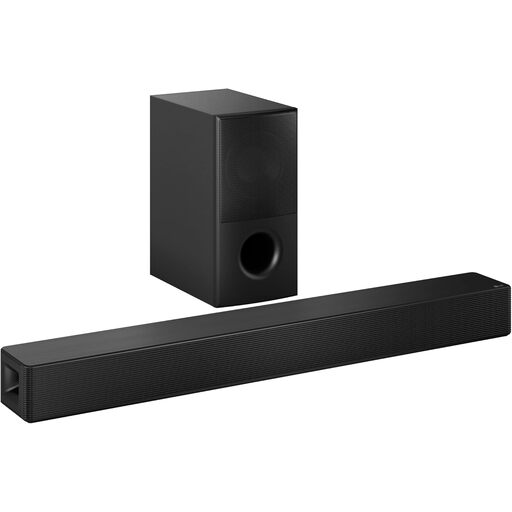
Why This Fits Their Persona: A straightforward choice for improving everyday TV, film and music audio without adding rear speakers. Its 945 mm soundbar width suits many medium-sized television setups.
The 2.1 layout makes its capabilities clear rather than suggesting a full rear-speaker system. The wireless 200 W subwoofer adds low-frequency output while still requiring only a separate mains connection.
320 W total rated output, HDMI ARC, optical input, USB and Bluetooth 4.0. Adaptive Sound Control adjusts emphasis between voices and bass.

Why This Fits Their Persona: Suited to film and streaming enthusiasts with enough space for rear speakers and a separate subwoofer.
Its 11.1.4 specification is supported by included wireless rear speakers and a subwoofer, rather than relying only on virtual surround processing.
756 W RMS rated power, Dolby Atmos, DTS:X, eARC, Wi-Fi, Bluetooth 5.3 and room calibration through SpaceFit Sound Pro.
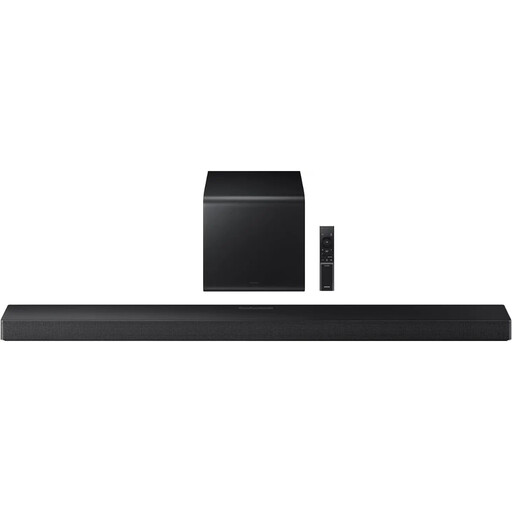
Why This Fits Their Persona: A suitable middle ground for Samsung TV owners wanting Dolby Atmos and a compact installation that can be wall-mounted or placed on furniture.
The 3.1.2 layout clearly identifies two height channels, while the convertible design helps avoid awkward positioning when changing between wall and tabletop placement.
330 W output, wireless Dolby Atmos, SpaceFit Sound Pro, HDMI eARC, Wi-Fi, Bluetooth and Q-Symphony compatibility.
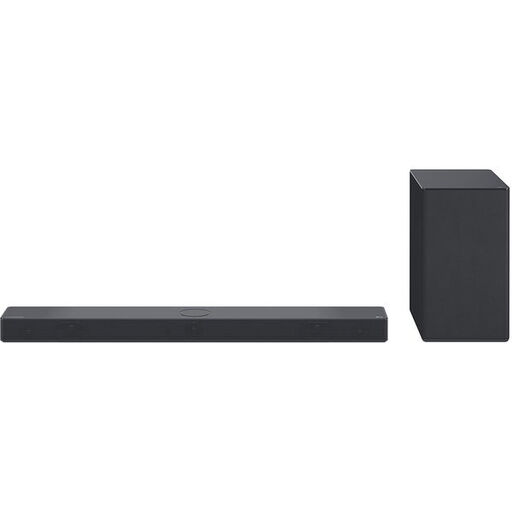
Why This Fits Their Persona: Designed for LG OLED C Series owners and gamers who want height audio, wireless streaming and high-refresh-rate console support.
Its 3.1.3 configuration specifies three upward-firing channels, while the listed 4K pass-through, VRR and ALLM features provide clearer compatibility information for gaming setups.
400 W total output, Dolby Atmos, DTS:X, IMAX Enhanced, HDMI eARC, Bluetooth 5.0, Wi-Fi, AirPlay and Chromecast.
We have compiled a complete, real-time list of products that fully satisfy these strict selection criteria and UK safety regulations.
It can be a practical upgrade when you want stronger bass and clearer TV audio without installing separate front, centre and rear speakers. Choose a system with a dedicated centre channel if dialogue is a priority, or consider rear speakers if surround positioning is important.
Yes. The audio signal is transmitted wirelessly, but the subwoofer normally needs its own mains connection. Position it close enough to a socket and avoid routing cables across walking areas.
Consumption varies by model, listening volume and standby behaviour. For example, the Samsung HW-Q990F lists typical power consumption of 41 W and standby consumption of 0.5 W, while its subwoofer lists 48 W. Check the individual product specification for the most relevant figures before buying.